How Sollos uses Prolific to run rigorous longitudinal research on Sound Therapy

Sollos is a Universal Music Group audio wellness venture, a multi-disciplinary team creating what Head of Product Rory Smith describes as "science-powered sounds for focus, relaxation, and sleep." This needs to be backed by rigorous scientific evidence, including controlled studies published in peer-reviewed journals, alongside research into how people experience the audio in their daily lives.
Prolific gives the UMG team the participants and the flexibility to do exactly that. As Rory puts it, "we treat Prolific as our lab."
The challenge: Creating UMG’s science-backed wellness product
Sollos curates and remixes music based on decades of research into how audio affects mood and behavior, then enhances it with auditory beats called “sound supplements” - special soundwaves that can influence neural activity and have positive effects on the mind, body, and mood. These are blended into the mix like a new instrument, and are designed to respect the music's artistic integrity while adding something extra.
Artists from a range of genres and styles have signed up to Sollos, from artists like Post Malone, Selena Gomez, Ariana Grande, Bastille, and Olivia Dean to neo-classical artists like Ludovico Einaudi, Olafur Arnalds, Chad Lawson, and Sophie Hutchings.
Sollos audio now powers an entirely new category on Apple Music called Sound Therapy, which was created as part of an exclusive partnership between the two companies.
Backing music wellness with scientific evidence
A product promising better focus and sleep needs evidence to back it up, and Sollos gathers that evidence through two research tracks.
One is a rigorous scientific program led by Tara Venkatesan, Director of Cognitive Science, that tests the target audio against control groups. The other, led by Rory and Emma Rugg, Head of Design, examines how people experience audio in real-world contexts using a research app.
“We really want to make sure the music we create is evidence-backed and does what we want it to do,” explains Rory.
Much of this research involves longitudinal studies with complex requirements. The team needed a fast, reliable way to recruit engaged participants who would stick with studies for weeks at a time. As they explored the provider landscape, it became evident that Prolific could provide them with access to the participants they needed at the pace they required.
The solution: Fast, high-quality participants at a quarter of the price
Sollos came to Prolific through Tara, who was already familiar with the platform from her academic background. They decided to use it for their research into how Apple Music users experience Sollos, and were impressed by the speed and value it offered compared to other providers.
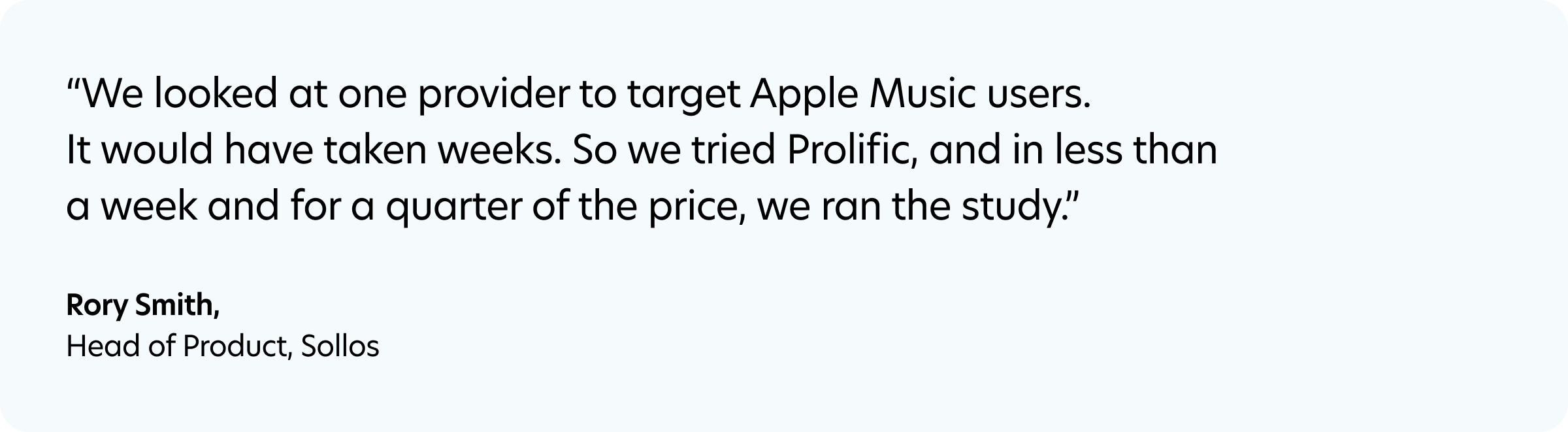
There were some initial challenges. Prolific's pre-screener asks participants whether they use Apple Music, but the responses were updated only once a year. When Rory raised this, Prolific helped the team design studies that validate their screeners and moved the Apple Music question to a much more frequent update cycle. "There's a nimbleness to the whole thing which really works for us," he says.
The team self-serves on the platform, designing and running its own studies, with on-call support when something unusual comes up. For the longitudinal work, they integrated with the Prolific API to automate participant messaging and approvals.
Compared with how the team used to recruit, managing everything from screeners to NDAs by hand, the difference is stark.
A four-week study, run one week at a time
A recent longitudinal study asked participants to listen to Sollos content over a four-week period, after which they completed in-app surveys before and after listening to track how they felt.
A four-week study lives or dies on whether participants stick with it, and keeping people engaged across the full month can prove challenging. But Prolific enabled the team to run these multi-wave studies successfully.
Rather than onboarding a large group and hoping that enough would stay with the study for a full month, the team structured the project into four single-week sprints. They reviewed listening behavior at the end of each week and approved participants for the next.
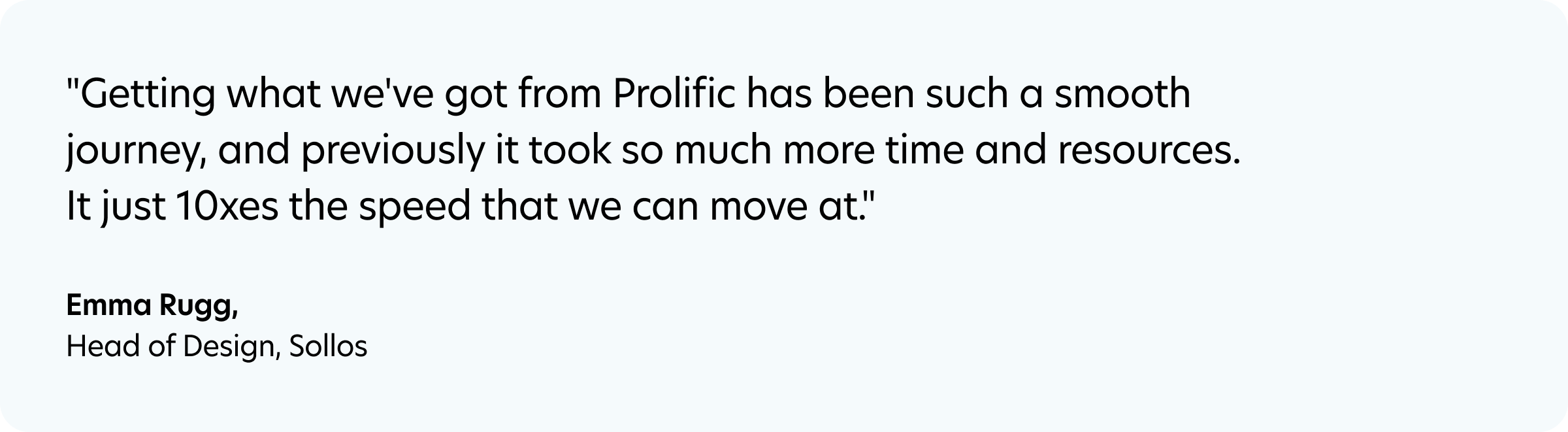
"That ability alone is something we couldn't really find elsewhere," Emma says. "We weren't able to set the study up in that way on other platforms." When a participant hadn't met the criteria for a given week, they could be replaced easily, which kept the study moving without losing time to re-recruitment.
Participants who are willing to go the extra mile
Sollos studies can be complex. There are often many questions for participants to answer. They may also be tested on the quality of their headphones or asked to distinguish between volume levels. It's unusual work by the standards of an online panel. But even with the requirements, the team was struck by how willingly people took it on.
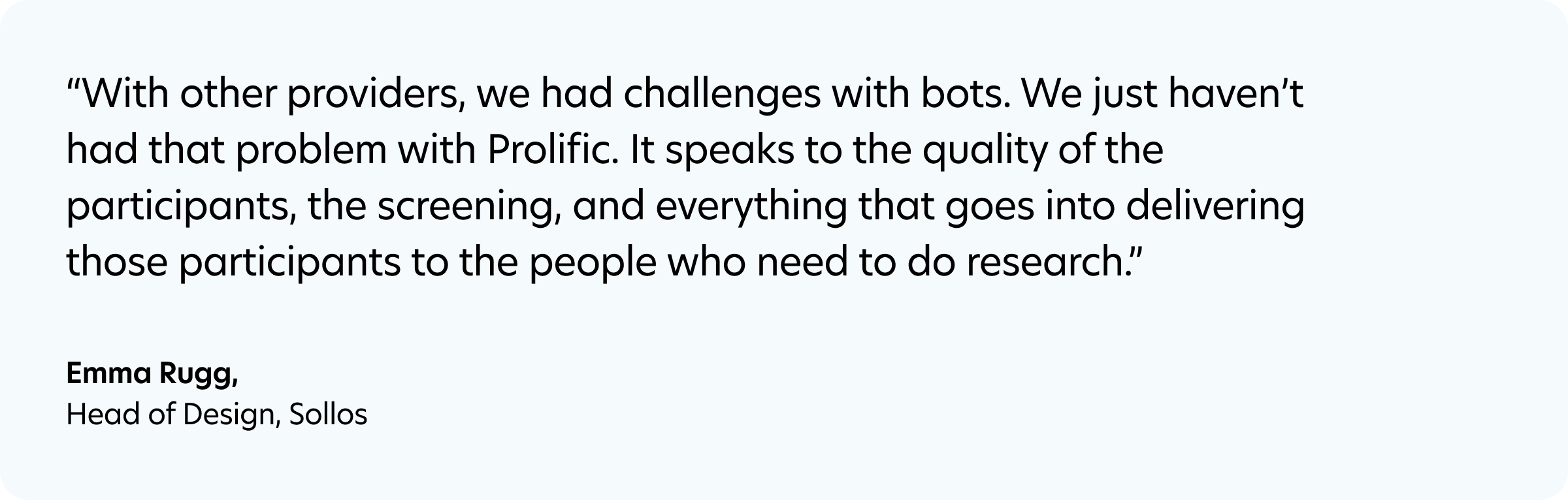
"They seem very motivated, very willing to jump through these hoops," Emma says. The data was better for it. With other providers, the team had to manually read through responses that didn't feel human, going back again and again in protracted processes.
Participants often write back unprompted, with the support inbox regularly receiving messages about how the music has affected them. They included listeners with chronic pain finding respite in the relaxation content, and people who finally found a reliable way to sleep after struggling with insomnia for years.
The results: Doubled focus and an extra hour of sleep
Among those who listened to the focus content, roughly half reported a doubling of their focus after just 20 minutes. Participants who struggled most with anxiety and stress saw their baseline anxiety drop by 25% over the course of the study. And the poorest sleepers who initially reported the lowest sleep quality were sleeping an extra hour per night on average by the end of the four weeks.
A gateway to engaged research participants
The team continues to expand research, running pricing studies to gauge willingness to pay for a direct-to-consumer product. They even recruited video testimonials by inviting participants to opt in to sharing their stories on camera. Next up is a controlled study with a leading healthcare organization to test whether Sollos audio can support clinicians' sleep during shift work.
Rory's advice to anyone weighing up the platform: "Don't get stuck in thinking that it's just some sort of academic research tool. It's a gateway to loads of engaged people from all walks of life."
You can listen to Sound Therapy, Sollos’ audio wellness collection designed to help you focus, relax, or get a better night’s sleep, on Apple Music.
Prolific gives research teams access to 300k+ engaged, verified participants and the flexibility to run studies that most panels can't handle, including longitudinal work. Get started.