What’s New: Live study feedback, real-time editing and more


From spotting issues as they happen, to editing your study once it goes live, this month's updates give you more visibility and control while your research is running. Scroll down to explore what's new.
View live study feedback and make real-time edits to your research
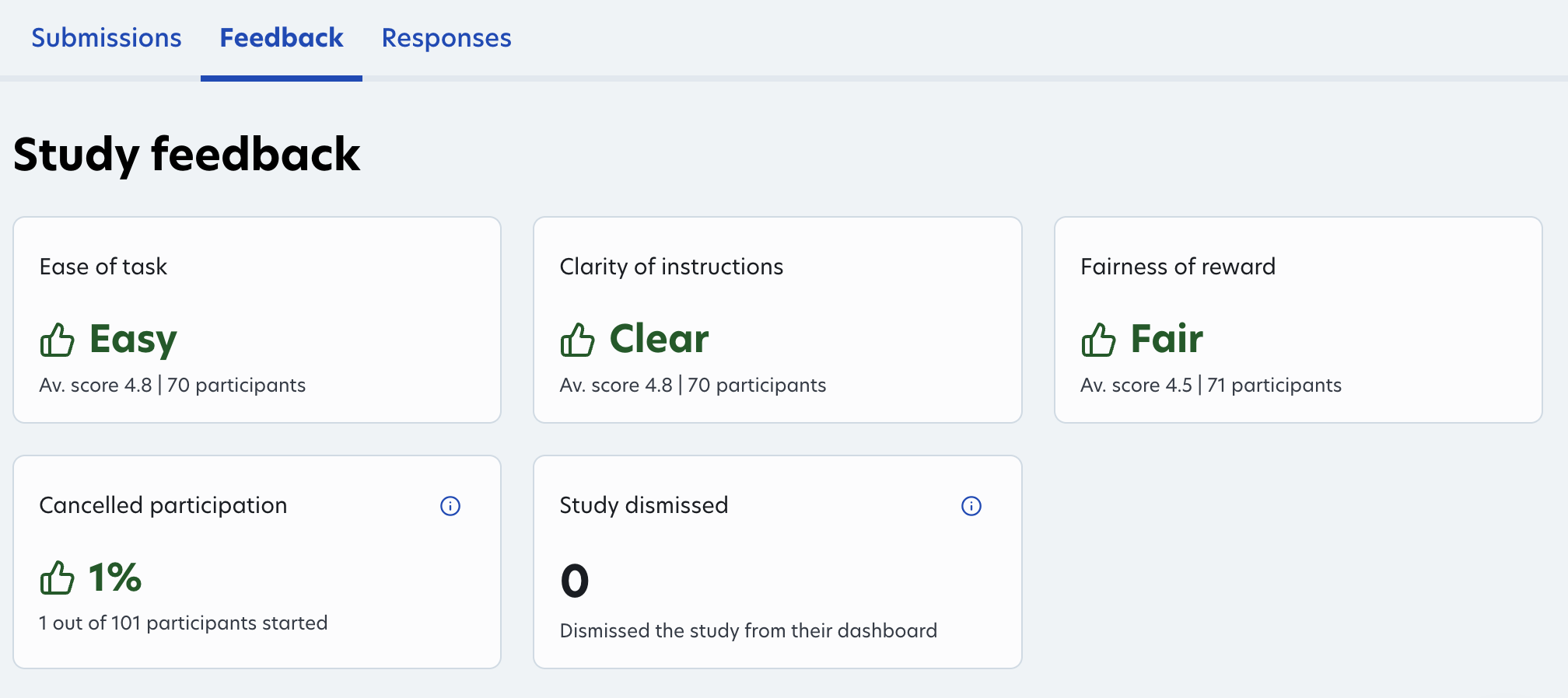
Instead of waiting until data collection ends to find out something isn't working, you can now catch issues early with live participant feedback. Review the feedback, make edits to your study and address issues, all while it's still running.
At the top of the feedback tab, five cards summarise the participant experience: ease of task, clarity of instructions, fairness of reward, cancelled participation and study dismissed. You can also see written feedback where participants have provided it, and filter by feedback category or source. This makes it easier to pinpoint specific issues, for example, identifying a technical problem a participant ran into mid-study, or understanding why participants are cancelling their participation.
This combination gives you an early signal on whether your study is running smoothly, so you can step in and make changes before data collection wraps up. Study feedback is rolling out to a limited number of workspaces while we refine the feature. If you can't see it yet, don't worry, it's coming soon.
Make changes during your study
You can now update your study description after it's gone live, so you no longer need to stop a study just to fix a typo or add new instructions.
Here's what you can edit, and where:
- Description editing: API and UI
- URL editing: API only for now, with UI support coming soon
- Content warning label: API only for now, with UI support coming soon
Learn more about study feedback and live editing.
MTurk is closing for good on 30th September
Amazon has confirmed MTurk will fully shut down this fall. Researchers have been moving toward more rigorous platforms like Prolific for years, driven by real differences in data quality, participant vetting, and fair pay.
If you're rethinking online recruitment, watch our latest webinar, A New Era for Data Quality in Online Research. In this session, Dr. Andrew Gordon and Becca Richards, Prolific's Head of Research Science and Senior Product Manager, discuss what actually makes a research platform trustworthy, for researchers and participants alike.
A more verified, richer participant network
Our focus this half is to enrich our network and build the richest data source in the industry.
In the last week alone, 90-day active participants answered 25% more About You questions compared to three months ago. We’re seeing the strongest areas of growth in technical, health and work profiles, which means you can target and refine your audiences with even more precision.
125,000+ Verified professionals
The Expert Network is growing each month, with new methods of verification and segments added regularly.
- Language specialists: Assessed with a CEFR proficiency test, our multi-linguists are all fluent in English as a standard, and are the most active Expert group. 82.3% of all language specialists are active within the last 90 days, completing tasks such as audio transcription, cultural alignment and more.
- Healthcare professionals: GMC / NPI credential-checked, our clinicians span general medicine, specialties and mental health. The cohort includes 35+ clinical specialties with an average of 9 years experience, who take part in research like biomedical AI annotation, clinical accuracy reviews and mental health screening. Request a sample here.
- Coders: Individually tested for specific coding language competency, most coders are proficient in a minimum of 2 languages. Coding tasks run with Prolific hold a 20 hour average time to data, request a sample here.
Longitudinal studies: now available via API, with quota and representative sampling
Earlier this year we launched longitudinal studies to help researchers run complex, multi-wave research with ease. Since then, we've been working to make it more intuitive and more accessible to how you work.
You can now set up and manage longitudinal projects directly via the Prolific API, not just the UI. Previously, running something like a six-wave diary study meant building six separate studies by hand, managing allowlists between each one, tracking attrition manually, and calculating costs yourself. Longitudinal projects bring all of this into a single, structured workflow, with a built-in retention and cost calculator: enter your target final sample size and anticipated retention rate, and Prolific will calculate how many participants to recruit upfront.
Quota and representative sampling
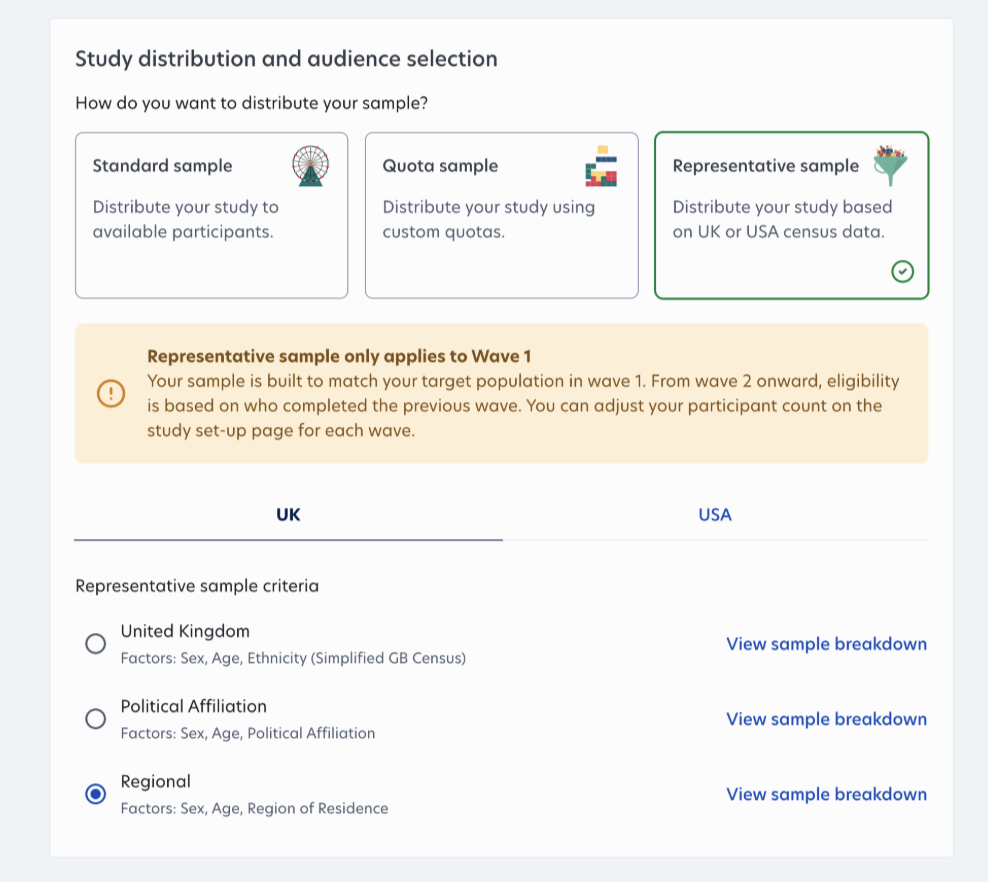
When setting up Wave 1 recruitment criteria, you can now choose a sample type: Standard, Quota, or Representative. Quota sampling lets you set proportional splits across demographic filters; representative sampling applies census-based breakdowns (UK/US) in one click. The sample type locks once Wave 1 goes live, so your cohort composition is guaranteed from the start. (Waves 2 onwards are unaffected, since they rely on participants having completed the previous wave.)
Learn more about creating your first longitudinal project. Available now in the UI and API.
More multimodal evals run on Prolific than ever before
With the new multimodal capabilities and greater study flexibility recently added, 15x more research now runs through AI Task Builder! Researchers across all industries are using it for a wide range of use cases:
- Fact-checking AI model outputs and ranking AI generated videos
- Multilingual evaluation with verified language specialists
- Scientific annotation with STEM Experts
- How people interpret emotions expressed by social robots
Get started
Build multimodal studies directly in the UI, or via the API and CLI. If you’re not sure where to start, talk to our team and we'll set your first multimodal study up with you.
Run repeat research
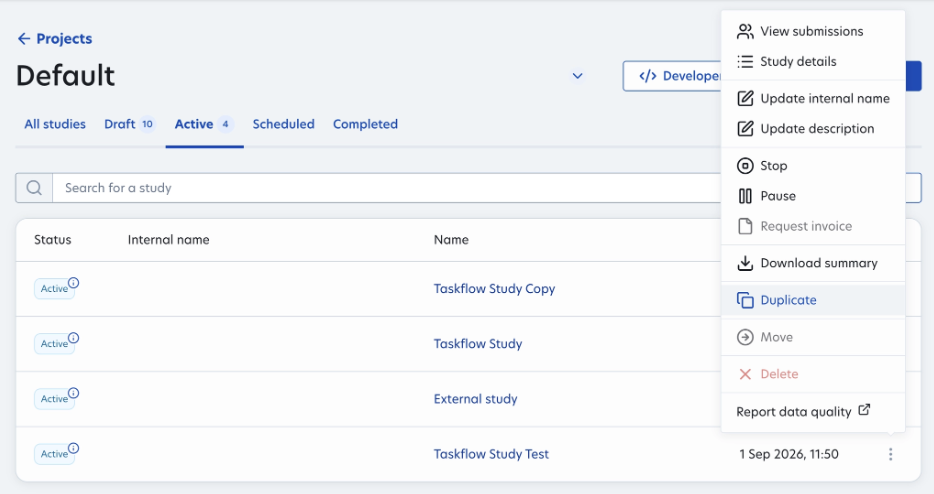
A small but mighty feature upgrade this month is Taskflow duplication. To make it easier to run repeat research, you can now duplicate Taskflow studies directly from the Project page, or within a study itself. Once duplicated, it clones into a draft with a fresh collection, which gives you a head start to data collection. You can find out more on how to do this here.
The Signal is live - Prolific's new podcast on research evidence
Hosted by Prolific's Research Sciences team the podcast aims to provide peer-level conversations and real findings from the field. First episode has Dr. David Rothschild, Economist at Microsoft Research and Co-Chair of AAPOR's task force on AI in survey research, in conversation with the Prolific's Head of Research Sciences, Andrew Gordon. They get into what AI actually gets right in survey research at this point, and where it's still shaky - synthetic data, transparency versus fixed standards, all of it grounded in real evidence rather than hype either direction.
Listen or watch on Spotify, Apple Podcasts or YouTube.
Meet the team in person
24th-26th September: Association for Consumer Research Conference, Chicago
Prolific's own Simon Jones will be speaking Friday at 8:20 AM on session CP1.6: Getting Real About AI & Data , digging into what's actually happening with AI in research right now. We’ll also be in the exhibitor section giving away $500 in Prolific credit, so stop by, say hi, and enter to win!
5-6th October : TMRE 2026, Denver
Prolific is sponsoring The Market Research Event, where Eric Mercadante, Prolific's research scientist, will present findings from our latest research, "Do Richer Personas Improve Synthetic Data Performance? A Fidelity Paradox." Drop by stand #412 to find out more.
6-9th October: Conference on Language Modeling, San Francisco
Stop by booth #200 and share your boldest AI opinion at our booth and see live research show you if the crowd agrees.
AI leaders dinners
Our ‘In the Loop’ intimate dinners for human-data leaders in AI, bring together those who oversee annotation, evaluation, and data-quality programs for open conversation and community-building. Limited seating is available, please RSVP for attendance.
- 23rd September in San Francisco: luma.com/1oeb2yu4
- 14th October in NYC: https://luma.com/kknlmr2y
- 21st October in London: https://luma.com/cp9r8b8h