Calling a Democrat a "Democratic Socialist" changes how voters see them, but not how they vote

This summer, the Democratic Party spent arguing with itself about one word: socialism.
Zohran Mamdani’s victory in the New York mayoral election in November 2025 gave democratic socialism its most prominent elected figure in years, while progressive candidates have continued to challenge more established Democrats in primaries around the country. Abdul El-Sayed’s Senate primary victory in Michigan this August was another reminder that candidates well to the left of the party’s recent mainstream can win large, competitive Democratic primaries.
But the same summer also produced Wisconsin, where DSA member Francesca Hong led every poll and every betting market for governor and then lost the primary by less than half a point.
The debate within the Democratic Party is alive: should they embrace or reject the socialist label?
Republicans have been happy to encourage that debate. Democratic candidates are increasingly being tied to socialism whether or not they use the label themselves, while candidates such as El-Sayed have become national Republican targets.
But Republicans have their own version of this problem. Recently, Trump's approval rating went net-negative on border security for the first time in his term, the last issue where he'd still been above water, leaving him underwater on all twelve issues tracked in the Strength In Numbers/Verasight poll. Some Republican candidates have already started editing their own campaign sites; one Texas congressional hopeful swapped "Trump conservative" for "proven conservative" this summer. A recent Brookings analysis showed that while MAGA Republicans won the party, they may be about to lose the country.
Both sides, in other words, are running the same play against each other: Democrat as secret socialist, Republican as MAGA extremist. There are good reasons for both parties to think this might work. Recent polling consistently finds that the factional labels are less popular than the broader parties they sit within. In a Reuters/Ipsos poll conducted shortly before our experiment, 43% of registered Independents said they would be less likely to vote for a candidate who identified as a democratic socialist, while 59% said the same about a candidate associated with MAGA. Other polling finds a similar distinction between voters’ views of particular policies and their reaction to the political identities attached to them. (Navigator Research)
But there’s an important question hiding inside those numbers. When someone tells a pollster that the words "democratic socialist" would make them less likely to support a candidate, what exactly have we learned?
They might genuinely dislike the label. They might think it makes the candidate sound more extreme. But elections don’t normally ask voters whether they like a label in isolation. They ask them to choose between two candidates, each with a party, a set of policies, and an opponent. Someone can dislike the words "democratic socialist" and still prefer that candidate to the Republican on the ballot. Likewise, someone can recoil from MAGA while still choosing the Republican over the Democrat.
That distinction is what we wanted to test.
Instead of asking people whether labels matter, we changed the labels
In August, we surveyed 1,500 US adults and embedded a simple experiment in the survey. Every respondent saw a hypothetical House election between a Democratic candidate and a Republican candidate. The candidates always had the same policy positions: the Democrat supported expanding healthcare access, increasing taxes on large corporations and billionaires, and protecting abortion access nationwide; the Republican supported lower taxes, increased oil and gas production, and stronger enforcement at the southern border.
What changed was how the candidates described themselves.
A quarter of respondents saw a Democrat versus a Republican. Another quarter saw a Democratic Socialist versus a Republican. A third group saw a Democrat versus a MAGA Republican, and the final group saw a Democratic Socialist versus a MAGA Republican.
That design lets us ask a narrower question than most of the political debate around these labels, but also answer it much more cleanly. The Democratic candidate doesn’t suddenly acquire a more left-wing platform when we call him a Democratic Socialist. The Republican doesn’t adopt different policies when we add MAGA. Party, policies, and opponent are all held constant. The only thing that changes is the label itself.
Afterwards, we asked respondents how liberal or conservative they thought each candidate was, which candidate they would choose, and how likely they would be to vote in the race. Because the question we’re most interested in is candidate choice, the main results below focus on the 1,323 people in our sample who told us they were registered to vote.
Voters certainly noticed the labels
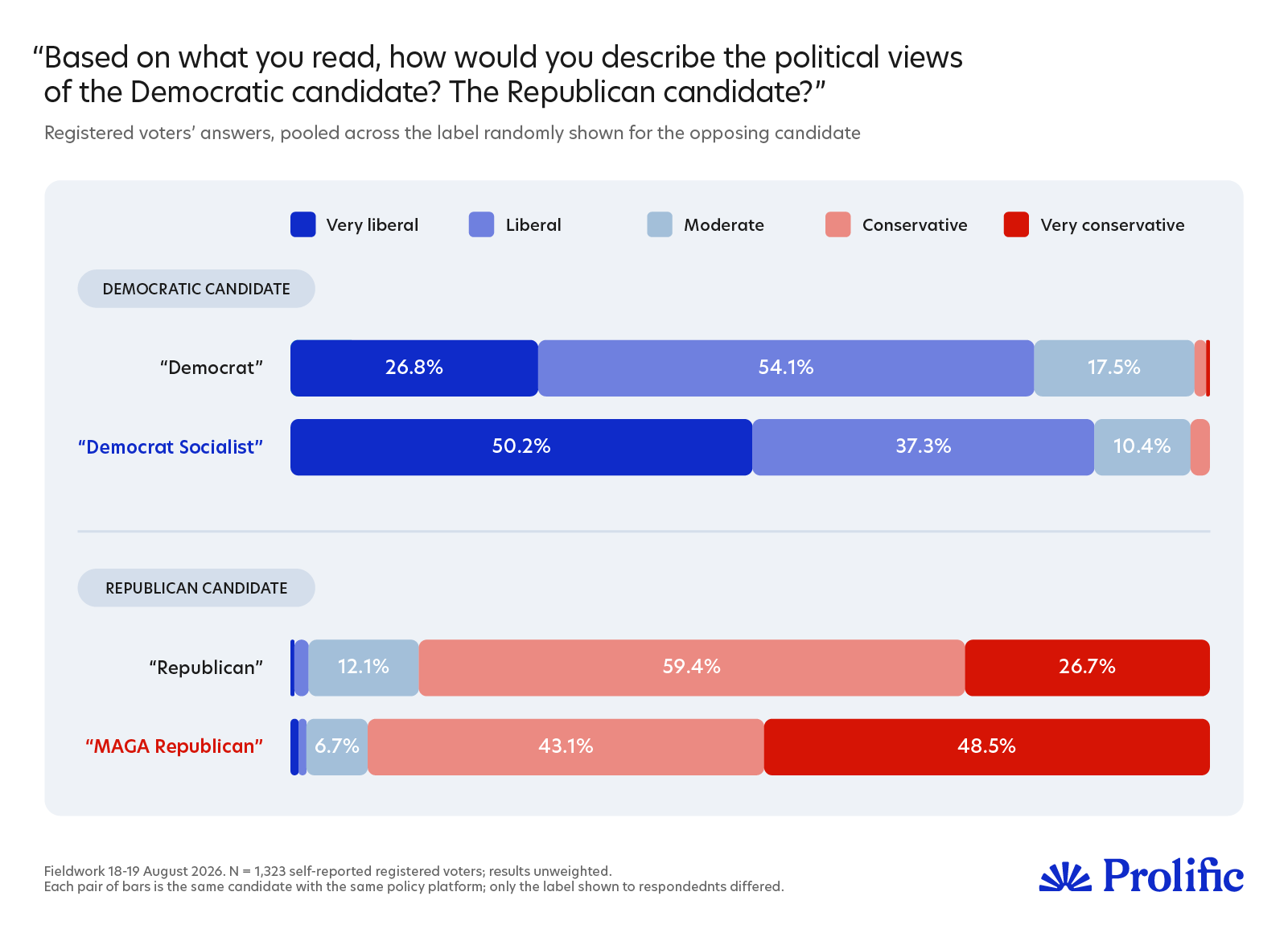
The first result is important because it tells us the experiment actually worked. If "Democratic Socialist" and "MAGA" had barely changed how people saw the candidates, then a small effect on candidate choice would not tell us very much. Perhaps voters had simply ignored the manipulation.
That is not what happened.
When the Democratic candidate was described simply as a Democrat, 26.8% of registered voters called him "very liberal." When exactly the same candidate, with exactly the same policies, was described as a Democratic Socialist, that rose to 50.2%. In other words, adding two words to the description increased the share of voters placing the candidate at the ideological extreme by 23.5 percentage points.
The Republican side looks remarkably similar. 26.7% described the plain Republican candidate as "very conservative." Add the word MAGA, without changing anything else about him, and that rises to 48.5%, an increase of 21.8 points.
So there is nothing subtle about how voters interpret these identities. "Democratic Socialist" communicates that a Democrat is substantially further left; "MAGA" communicates that a Republican is substantially further right. The labels do almost exactly what their supporters and critics probably expect them to do.
What is much less obvious is what happens after voters make that ideological judgement.
Seeing a candidate as more extreme did not make voters stay home or switch sides
If "Democratic Socialist" or "MAGA" makes a candidate look much more ideologically extreme, there are two obvious ways that could matter electorally. Some voters might become less willing to take part in the election at all. Others might still vote, but switch which candidate they prefer, or become unsure.
So we looked at turnout first.
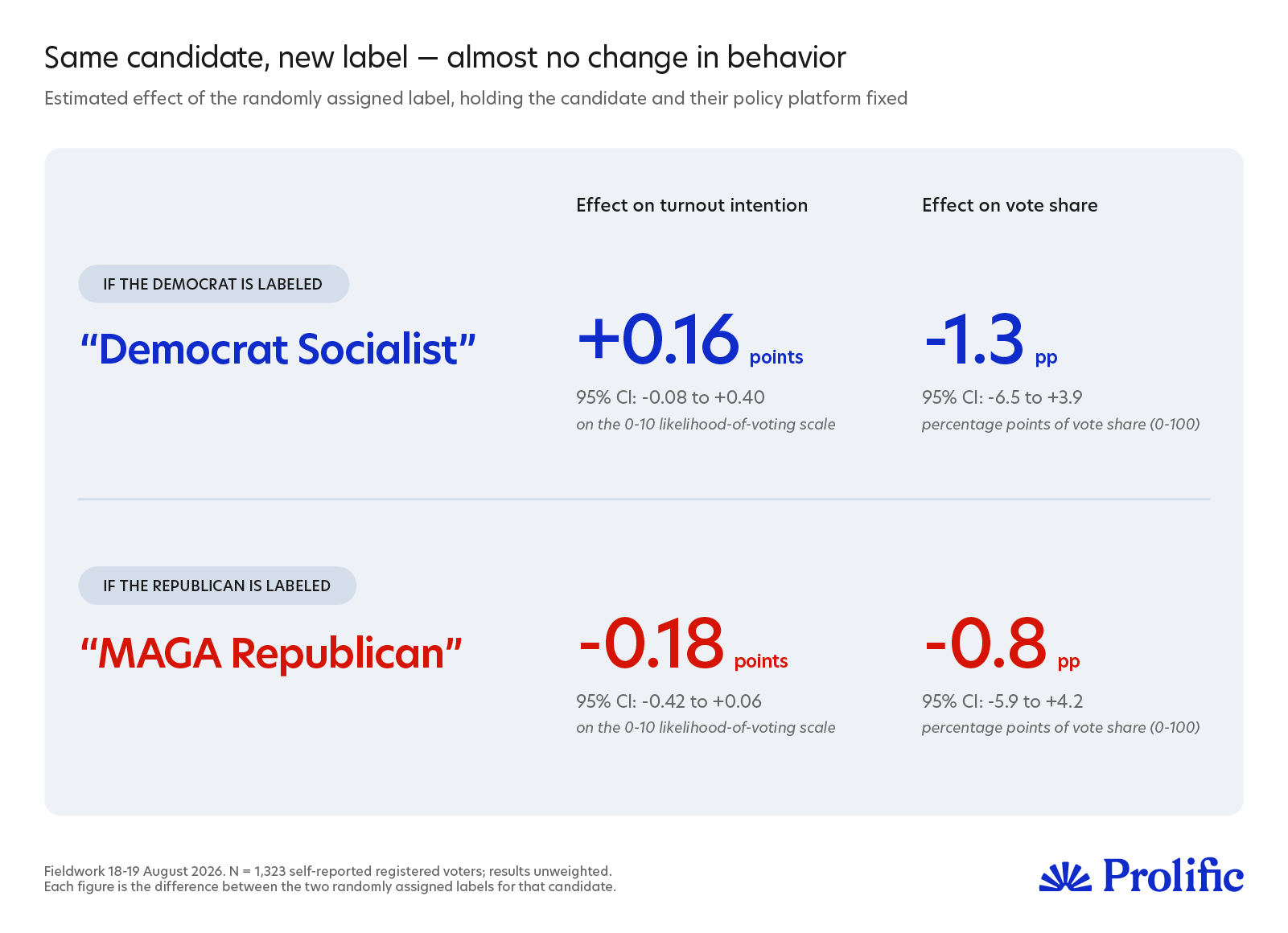
Respondents rated how likely they would be to vote in the hypothetical race on a 0-to-10 scale. The Democratic Socialist label increased stated turnout likelihood by just 0.16 points, with a 95% confidence interval from −0.08 to +0.40. The MAGA label reduced it by 0.18 points, with a confidence interval from −0.42 to +0.06. Neither effect is statistically significant.
That matters because the turnout measure is relatively precise. We aren’t seeing evidence that voters react to the more ideological label by deciding they would rather sit the election out. Whatever the labels are doing to perceptions, they are not producing any clear demobilization effect.
The next question is whether people still intend to vote, but change who they would vote for, or become more unsure about their choice.
Again, very little moves. The Democratic Socialist label reduced the share choosing the Democratic candidate by 1.3 percentage points, with a 95% confidence interval ranging from a 6.5-point decrease to a 3.9-point increase. The MAGA label reduced the share choosing the Republican candidate by 0.8 points, with a confidence interval from a 5.9-point decrease to a 4.2-point increase. Neither difference is statistically significant.
Nor do we see a meaningful rise in uncertainty. The broad pattern is stability: people are not becoming noticeably less willing to vote, and they are not clearly shifting from one candidate to the other or into the undecided category.
That is what makes the contrast with the perception results so interesting. The labels change how voters place the candidates ideologically by more than 20 points, but those shifts do not seem to travel very far into electoral behavior. Voters notice the labels, and they use them to decide that the candidates are further from the center. But once party and policy positions are already clear, that change in perception does not appear to make many people stay home, switch sides, or become unsure.
I think this also helps explain why questions asking whether a label would make someone "more or less likely" to support a candidate can be misleading if they are treated as direct estimates of electoral impact. Those questions tell us something real about how voters feel about the labels. What they don’t tell us is whether that discomfort is strong enough to alter participation or candidate choice when the actual alternative is in front of them. Our experiment suggests those are quite different things.
Independents are a particularly useful test
There is an obvious objection to the overall result. Perhaps Democrats will vote for the Democrat, and Republicans will vote for the Republican almost regardless of the factional label, which could wash out a much larger effect among people who do not identify with either party. That possibility is especially relevant given the Reuters/Ipsos finding that large shares of Independents explicitly say both democratic socialism and MAGA make them less likely to support a candidate.
So we looked separately at the 371 registered voters in our sample who identified as Independent, and the same basic pattern appears.
Among Independents, the share calling the Democratic candidate "very liberal" rose from 28.4% to 46.4% when we added the Democratic Socialist label. The corresponding average marginal effect from the full experiment is +17.7 points. For the Republican candidate, the share saying "very conservative" rose from 24.4% to 41.8% when MAGA was added, an estimated effect of +17.1 points.
Yet candidate choice again hardly moved. The estimated effect of adding Democratic Socialist on choosing the Democratic candidate was +0.3 points among Independents. For MAGA and Republican candidate choice, it was +1.1 points. Neither is statistically significant.
We also tested something statistically more meaningful: are the effects among Independents actually different from the effects among everyone else? They are not, at least not in a way we can distinguish from sampling variation.
There is an important limit here, however. With 371 Independents, the estimates are much less precise than in the overall sample, and the confidence intervals leave room for effects that could matter politically. This is not evidence that the true effect among Independents is exactly zero. But neither do we see the kind of large collapse in support that we might expect if Independents’ stated dislike of these labels translated directly into candidate choice.
The opponent doesn’t seem to change the effect
The four-way design gives us one more useful test. It’s possible that these labels matter only in relation to the opponent. Perhaps "Democratic Socialist" looks particularly damaging when the alternative is a conventional Republican, but matters less once the Republican is also carrying an ideological label. Or perhaps voters tolerate MAGA differently when they are facing a Democratic Socialist rather than a plain Democrat.
We tested that directly by looking at whether the effect of one label changed depending on the label attached to the opposing candidate. We found no convincing evidence that it did.
That’s why the main figures in this article average over the two versions of the opponent. The Democratic Socialist effect is the average effect of adding that label whether the candidate is facing a Republican or a MAGA Republican, and the MAGA effect is calculated in the same way.
The broader point is that there does not seem to be a hidden version of the result in which these labels suddenly become electorally powerful once both candidates are framed as ideological extremes.
What does that actually tell us about real elections?
The safest conclusion is not that labels don’t matter. They plainly do. If a two-word change can roughly double the share of voters describing a candidate as "very liberal" or "very conservative," then those words are carrying a substantial amount of political information. The more interesting conclusion is that perception and choice are not the same thing.
A voter may decide that a candidate is much further left after seeing "Democratic Socialist" and still prefer that candidate to the Republican. Another may see a MAGA Republican as substantially more conservative but still prefer him to the Democrat. Party attachments, policy preferences, and dislike of the opponent can all be strong enough that changing the ideological interpretation of one candidate does not necessarily change the final choice.
This also puts some limits on what our experiment can say about the current arguments inside both parties. When a democratic-socialist candidate wins or loses a real election, the label is not the only thing that changed. Those candidates may have different policies, biographies, donors, campaign organizations, levels of media attention, and opponents. Voters may know more, or much less, about them than the people in our experiment knew about our hypothetical candidates.
Our design deliberately strips those differences away. That is its strength, but also its boundary. We aren’t estimating what would happen if a conventional Democrat were replaced by an entirely different democratic-socialist candidate. We’re estimating what happens when the candidate is labelled, either intentionally or not, as a Democratic Socialist or a MAGA Republican.
That is a narrower question, but it is precisely the question conventional polling can’t answer very well.
What we can and can’t rule out
It’s also important not to turn a statistically insignificant result into proof of no effect.
Our candidate-choice estimates are small, but they are not infinitely precise. The experiment had roughly 80% power to detect effects of around seven percentage points on candidate choice. Effects below that remain possible, and the confidence intervals around the estimates include changes of several points in either direction.
That matters because a three-point effect can be electorally important even if it looks tiny beside a 22-point change in perceived ideology. Many competitive House and Senate races are decided by margins smaller than that.
So the result is not "Democratic Socialist costs exactly 1.3 points" or "MAGA costs exactly 0.8." Nor is it "these labels have no electoral effect." The data are not precise enough for either claim.
The more defensible conclusion comes from comparing the scale of the two outcomes. Whatever effect the labels have on candidate choice in this experiment, it’s much less obvious than their effect on perceptions. We can see very clearly that the labels move ideological placement. We can’t see comparable evidence that they move the choice between candidates. That difference is the result.
A few final methodological caveats
The experiment was conducted within one survey, on August 18–19, 2026. Respondents were recruited using fully crossed age × sex × ethnicity quotas, and the main analysis above uses the 1,323 respondents who self-reported being registered to vote. Voter registration was not independently verified.
The main experimental comparisons are unweighted. That’s intentional: because assignment to the four conditions was random, the treatment effect comes from comparing those randomized groups rather than from using population weights. We also repeated the analysis using our survey weights as a sensitivity check, and the same broad pattern remained: very large changes in perceived ideology, without statistically significant changes in candidate choice.
This is also not a generic-ballot poll. The overall percentage of people choosing the Democrat or the Republican depends on the political composition of our sample and isn’t the quantity this experiment was designed to estimate. That’s why we’re reporting how much the labels changed candidate choice rather than publishing the underlying Democratic and Republican shares as an estimate of the national midterm environment.
Finally, this is a hypothetical race. Respondents told us whom they would choose; we didn’t observe a real vote. That distinction is worth keeping in mind whenever experimental survey results are translated into claims about electoral behavior.
Where does that leave the debate?
Political strategists are not imagining the stigma attached to these labels. Voters really do interpret "Democratic Socialist" and "MAGA Republican" as signs that a candidate is much further from the ideological center. Other polling is also right to show that many voters say those identities make candidates less appealing.
What our experiment adds is a second step. Once voters have the party, the policies and the opposing candidate in front of them, that dislike does not automatically become a different choice.
That’s useful precisely because it complicates the simple story both sides often tell themselves. If a candidate loses, it’s tempting to blame the ideological label. If they win, it’s tempting to declare that the label never mattered.
Real elections are too messy for either conclusion. Our experiment strips away some of that mess and finds something more modest: the labels are powerful signals of ideology, but, on their own, they seem to carry much less weight in the final choice.
For me, that gap is more interesting than a simple "labels matter" or "labels don't matter" conclusion. It suggests that voters can notice ideological differences very clearly without those differences necessarily becoming decisive. And it’s a useful reminder of something survey researchers should probably say more often: what people tell us they dislike is not always the same as what changes the choice they eventually make.
Do you want to use this data for reporting, academic work, or something else? Contact oriol.jover@prolific.com to discuss potential collaborations.
You can access the full experimental results here.
You can access the full questionnaire here.
Methodology: Prolific fielded this survey Aug. 18–19, 2026, among 1,500 US adults recruited using fully crossed age × sex × ethnicity quotas. Respondents were randomly assigned with approximately equal probability to one of four versions of a hypothetical congressional race. Candidate party and policy positions were held fixed; only the labels "Democrat" versus "Democratic Socialist" and "Republican" versus "MAGA Republican" varied.
The main figures reported above are unweighted randomized comparisons among the 1,323 respondents who self-reported being registered to vote. The existing survey weights target the US adult population and are used only as a sensitivity check; weighted estimates lead to the same substantive conclusion. We also tested whether either label’s effect depended on the opposing candidate’s label and found no evidence that it did, so headline effects are pooled across the two opponent conditions.
Experiment:
EXPERIMENT INTRODUCTION (shown to all respondents before randomization)
Imagine that only two candidates are running for the U.S. House of Representatives in your congressional district.
In the next page, we will give you information about these two candidates. Please, read the information carefully.
After you read the information, we will ask you questions about the candidates and how you would behave in that hypothetical election.
CANDIDATE CARDS (policies identical across all four arms; only the label changes)
Arm A — Democrat + Republican
Candidate A is running for the Democratic Party. The candidate identifies as a Democrat. The key policies in their manifesto are:
Expand access to healthcare.
Increase taxes on large corporations and billionaires.
Protect legal access to abortion nationwide.
Candidate B is running for the Republican Party. The candidate identifies as a Republican. The key policies in their manifesto are:
Lower taxes on individuals and businesses.
Increase domestic oil and natural-gas production.
Strengthen enforcement of immigration laws at the U.S.–Mexico border.
Arm B — Democratic Socialist + Republican
Candidate A is running for the Democratic Party. The candidate identifies as a Democratic Socialist. The key policies in their manifesto are:
Expand access to healthcare.
Increase taxes on large corporations and billionaires.
Protect legal access to abortion nationwide.
Candidate B is running for the Republican Party. The candidate identifies as a Republican. The key policies in their manifesto are:
Lower taxes on individuals and businesses.
Increase domestic oil and natural-gas production.
Strengthen enforcement of immigration laws at the U.S.–Mexico border.
Arm C — Democrat + MAGA Republican
Candidate A is running for the Democratic Party. The candidate identifies as a Democrat. The key policies in their manifesto are:
Expand access to healthcare.
Increase taxes on large corporations and billionaires.
Protect legal access to abortion nationwide.
Candidate B is running for the Republican Party. The candidate identifies as a MAGA Republican. The key policies in their manifesto are:
Lower taxes on individuals and businesses.
Increase domestic oil and natural-gas production.
Strengthen enforcement of immigration laws at the U.S.–Mexico border.
Arm D — Democratic Socialist + MAGA Republican
Candidate A is running for the Democratic Party. The candidate identifies as a Democratic Socialist. The key policies in their manifesto are:
Expand access to healthcare.
Increase taxes on large corporations and billionaires.
Protect legal access to abortion nationwide.
Candidate B is running for the Republican Party. The candidate identifies as a MAGA Republican. The key policies in their manifesto are:
Lower taxes on individuals and businesses.
Increase domestic oil and natural-gas production.
Strengthen enforcement of immigration laws at the U.S.–Mexico border.