Why Burnham is waiting on Jackdaw and Rosebank until after the Holborn and St Pancras by-election

Andy Burnham is facing one of the first major climate decisions of his premiership.
Two North Sea oil and gas projects, Jackdaw and Rosebank, need government approval to go ahead. Both projects already had licences, but their original approvals were stopped by the courts in 2025 because the environmental assessments did not include the emissions created when the oil and gas are eventually burned. The government now has to decide whether to give them the go-ahead or not.
Jackdaw had been expected to receive approval in September. Nonetheless, the government eventually decided to push it back to late autumn, right after the Holborn and St Pancras by-election, and past the Labour conference in Liverpool.
The timing is hard to separate from the politics. Holborn and St Pancras is Keir Starmer's former seat, and Labour is defending it against Green Party leader Zack Polanski in a race that isn't a formality: PollCheck's model currently has Labour on 41.7% against the Greens' 37.8%. Polanski has already made Jackdaw part of his campaign. He is telling voters that the climate crisis is on the ballot and accusing Labour of waiting until after the election before revealing what it plans to do.
So, is Burnham avoiding a decision that would be broadly unpopular? Our polling suggests something more specific.
Most Britons support approving at least one of the two projects. Labour-leaning voters are more divided than the national picture, but still lean toward approval. The political risk is concentrated among Green-leaning voters, precisely the group Labour has the strongest reason to avoid angering before 8 October.
What we did
We surveyed 1,498 UK adults on 19 August 2026, using crossed quotas for age, sex, and region. The results were then weighted to the UK adult population on age by sex, region, 2024 general election vote, education by age, and housing tenure.
Everyone first read a short factual description of Jackdaw and Rosebank, covering what each project would produce, how long it could operate, and where its output would be sold. We then randomly split respondents into two groups. Three-quarters, 1,124 people, received only that basic information. The remaining 374 received an additional page summarising the Climate Change Committee's assessment of what further UK oil and gas extraction could mean for emissions, bills, jobs, and energy security.
The split lets us check whether providing more information changes what people believe about the projects and whether they should be approved. Unless a comparison between the two experimental groups is stated explicitly, the results below come from the basic-information group only. This keeps the main findings tied to the shortest factual introduction shown in the survey.
Nationally, Burnham has room to approve
Nationally, most of the public seems to be on board with further drilling in the North Sea: 67% support approving at least one project. Support is not equal across both projects, however. Although both projects are supported by a majority of the general population, Jackdaw is slightly more popular: 63% support it, compared to 58% for Rosebank.
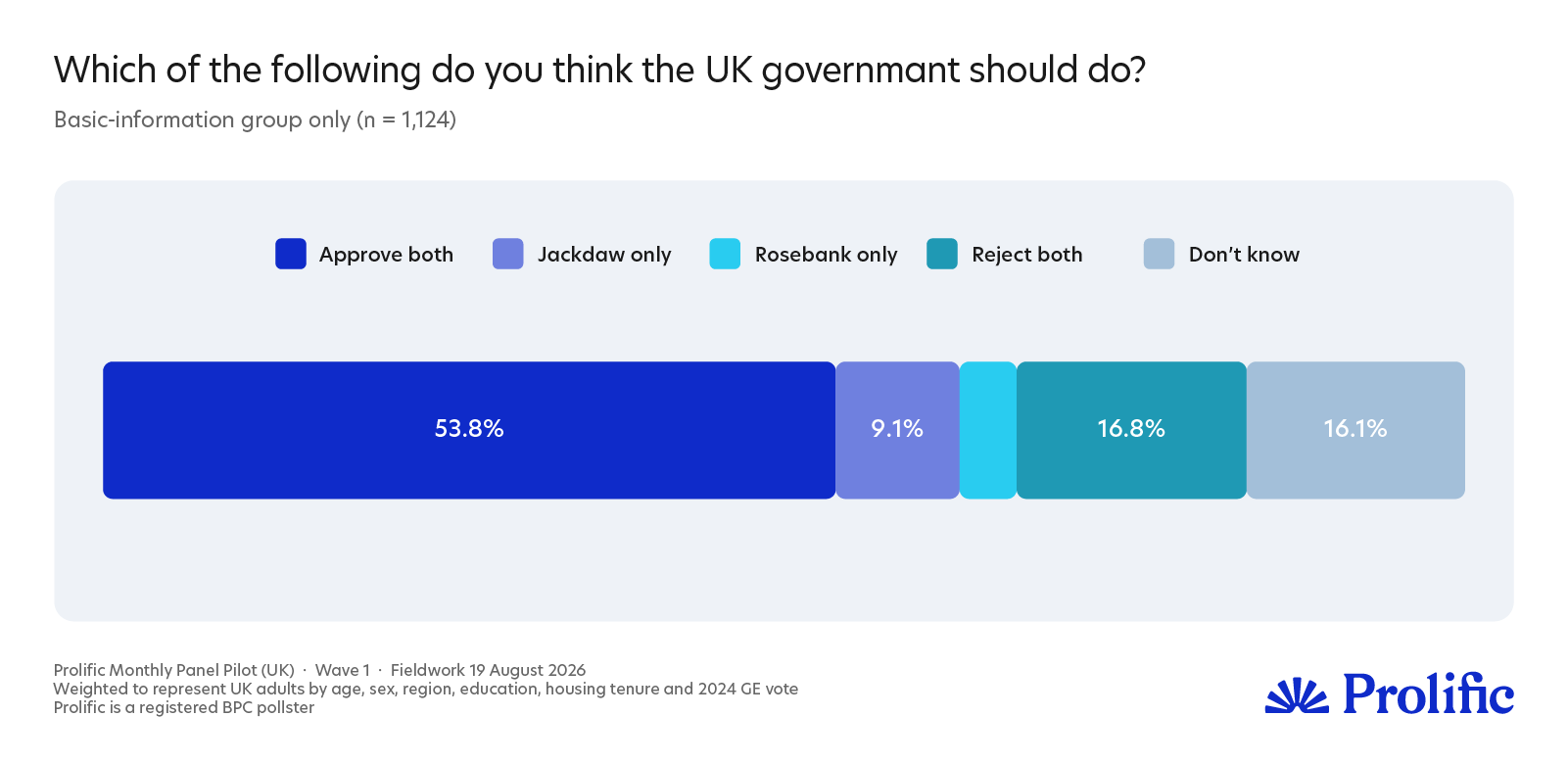
Those numbers make a national backlash against any approval look less likely than the political debate might suggest. They also fit the difference between the projects. Jackdaw would mainly supply gas to the UK network for around eight to eleven years. Rosebank would operate for much longer, mainly produce oil, and sell that oil internationally. Respondents were somewhat more comfortable with Jackdaw, but there was no public majority for rejecting either project.
The voters Labour risks angering are unusually important right now
National opinion is only one part of the calculation. At the moment, politically what matters is not what the public thinks, but the opinion of the key voters that will decide the next by-election: Labour-leaning and Green-leaning voters.
What do these voters think of both projects? Among people who currently lean Labour, 59% support approving at least one project. Among current Green leaners, that falls to 40%. Of those leaning Green, 42% want both projects rejected outright.
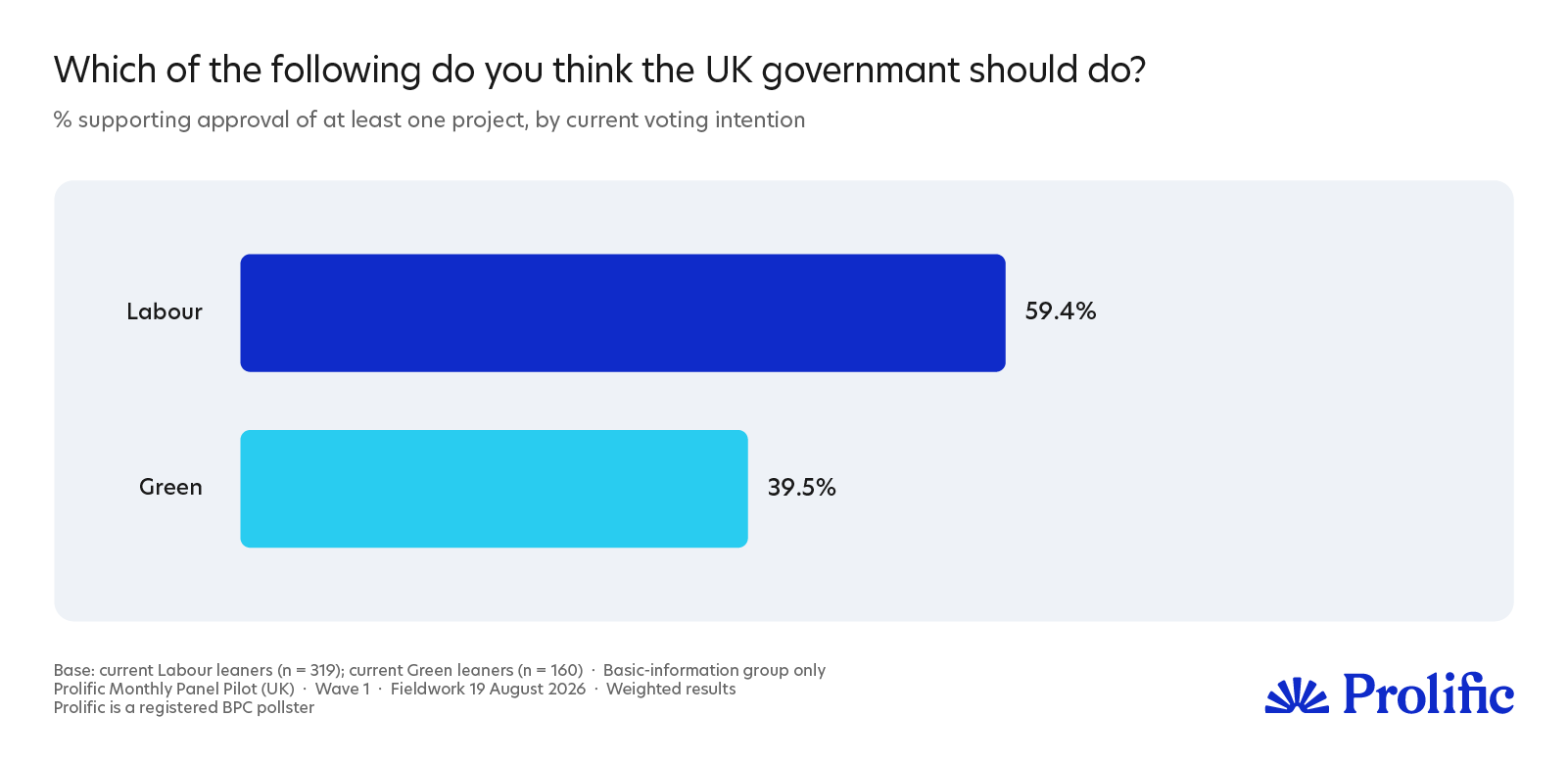
Green-leaning voters are clearly more hostile to approval, although even they are not unanimous. Roughly four in ten would still allow at least one project to proceed. For Labour leaners, approval is the majority position.
In most circumstances, that would leave Burnham with a relatively comfortable political position. His own current voters are more supportive than opposed, and the national public is more supportive still. Holborn and St Pancras changed the audience. Labour is fighting an election against the Green leader in a constituency where the Greens have made climate policy one of the central dividing lines.
Approval carries much more downside among Green-leaning voters
We also asked how approving Jackdaw and Rosebank would change respondents' views of Burnham. Among Labour leaners, 25% said they would see him more favourably and 18% less favourably. The balance is mildly positive, with most saying it would make no difference.
Green-leaning voters reacted very differently. Almost half, 49%, said approval would make them view Burnham less favourably. Only 11% said more favourably.
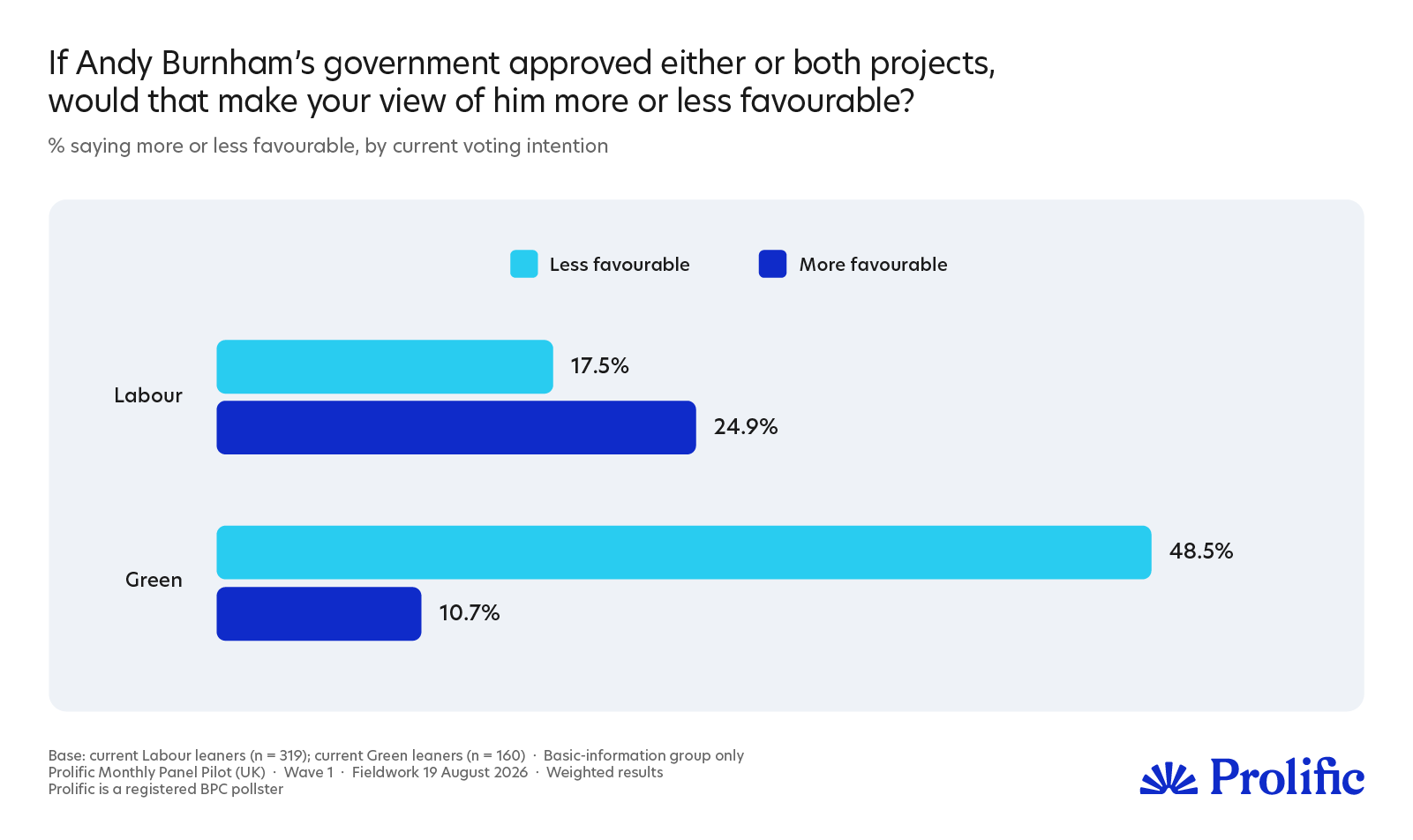
These numbers change the political calculation for the government. Announcing approval now appears to offer limited upside among Labour’s current supporters, while giving Green-leaning voters a much stronger reason to think less of the prime minister. Polanski could use the decision to frame the by-election as an opportunity to push Labour further to the left and send a message against further North Sea drilling.
These responses cannot tell us how many voters would actually switch parties. Telling a pollster that a decision changes your view of a politician is easier than changing your vote at the ballot box. They do show, however, that the strength of the reaction is very different on the two sides of the Labour-Green contest.
The manifesto argument gives the Greens a ready-made attack line
Labour's 2024 manifesto promised not to issue new oil and gas licences, while also saying that existing licences would not be revoked. Jackdaw and Rosebank sit uncomfortably between those two commitments. Their licences remain in place, but the government still has to grant fresh development consent after the court ruling.
The public is divided over what approval would mean. Overall, 44% believe allowing the projects to proceed would feel like Labour breaking its promise, while 37% consider it would feel like keeping it. The difference is small enough to treat cautiously.
Current Labour leaners split almost exactly down the middle: 45% believe approval would feel like breaking the promise, against 43% who believe it would mean keeping it. Among Green leaners, 57.6% said breaking, and 23.9% said keeping.
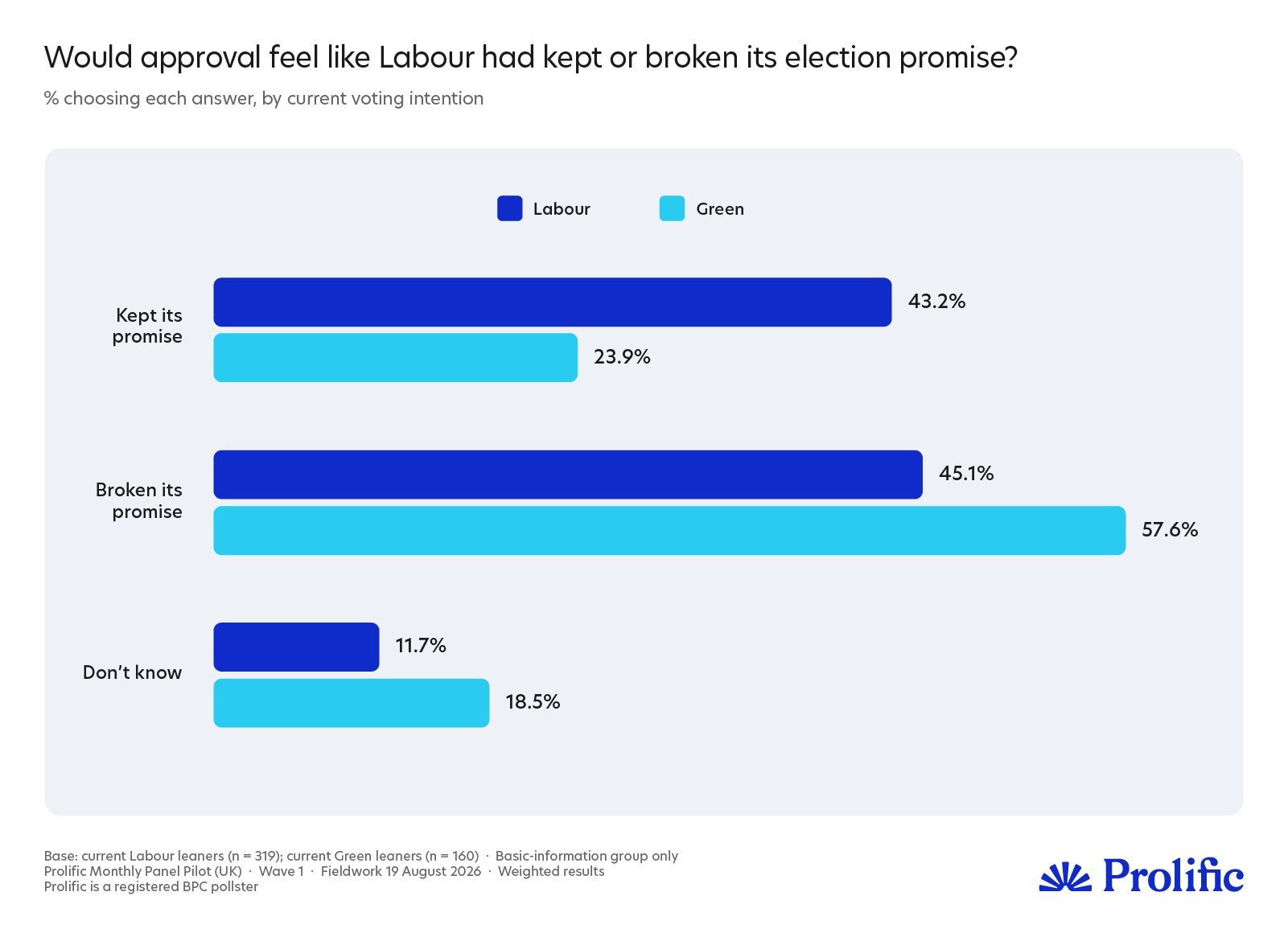
For Polanski, that provides a simple argument: he can describe approval as evidence that Labour's climate promises cannot be trusted. That message lands much more cleanly among Green-leaning voters than it does among Labour's current base. Releasing the decision during the campaign would hand him a new example at the point when Labour has the least to gain from debating it.
Many voters see the climate cost and support drilling anyway
The broader public view is more complicated than the debate between the parties. A majority, 55%, believe approving the projects would harm the UK's climate targets. At the same time, 81% think approval would help protect energy-sector jobs and 68% think it would help keep household bills down.
The most revealing result comes from looking at the same people across those questions. Among respondents who believe the projects would harm Britain's climate targets, 58% still support approving at least one.
Those respondents recognized the climate cost and reached a supportive position anyway. Some may have placed more weight on employment, domestic production, or energy security. Others may have accepted continued extraction during the transition away from fossil fuels. We did not ask them to rank those considerations, so the survey cannot say which trade-off each person made.
The result does show why national attitudes are more permissive than the party debate implies. Acknowledging climate harm does not lead most of this group to reject both projects.
More information changed beliefs about bills, but not support for the projects
There is a reasonable concern with any finding like this. Perhaps respondents supported approval because they assumed that producing more oil and gas in Britain would noticeably reduce their bills. If that belief changed, support might fall with it.
We tested that by randomly giving a quarter of respondents additional information before asking the same questions. The extra page summarized the Climate Change Committee's 2022 assessment of further UK oil and gas extraction, including its conclusion that the effect on consumer prices would be marginal at most. It also covered jobs, energy security and emissions.
The information changed what people believed about how the projects would affect their bills. In the basic-information group, 68.1% thought approval would help keep household bills down. That fell to 59.2% among those who received the additional information, a statistically significant drop of 8.9 percentage points.
Support for the projects held up. It moved from 67.2% in the basic-information group to 68.5% in the additional-information group. The estimated change was 1.4 points, with a 95% confidence interval from a 5.6-point fall to an 8.3-point increase. We detected no clear movement in either direction.
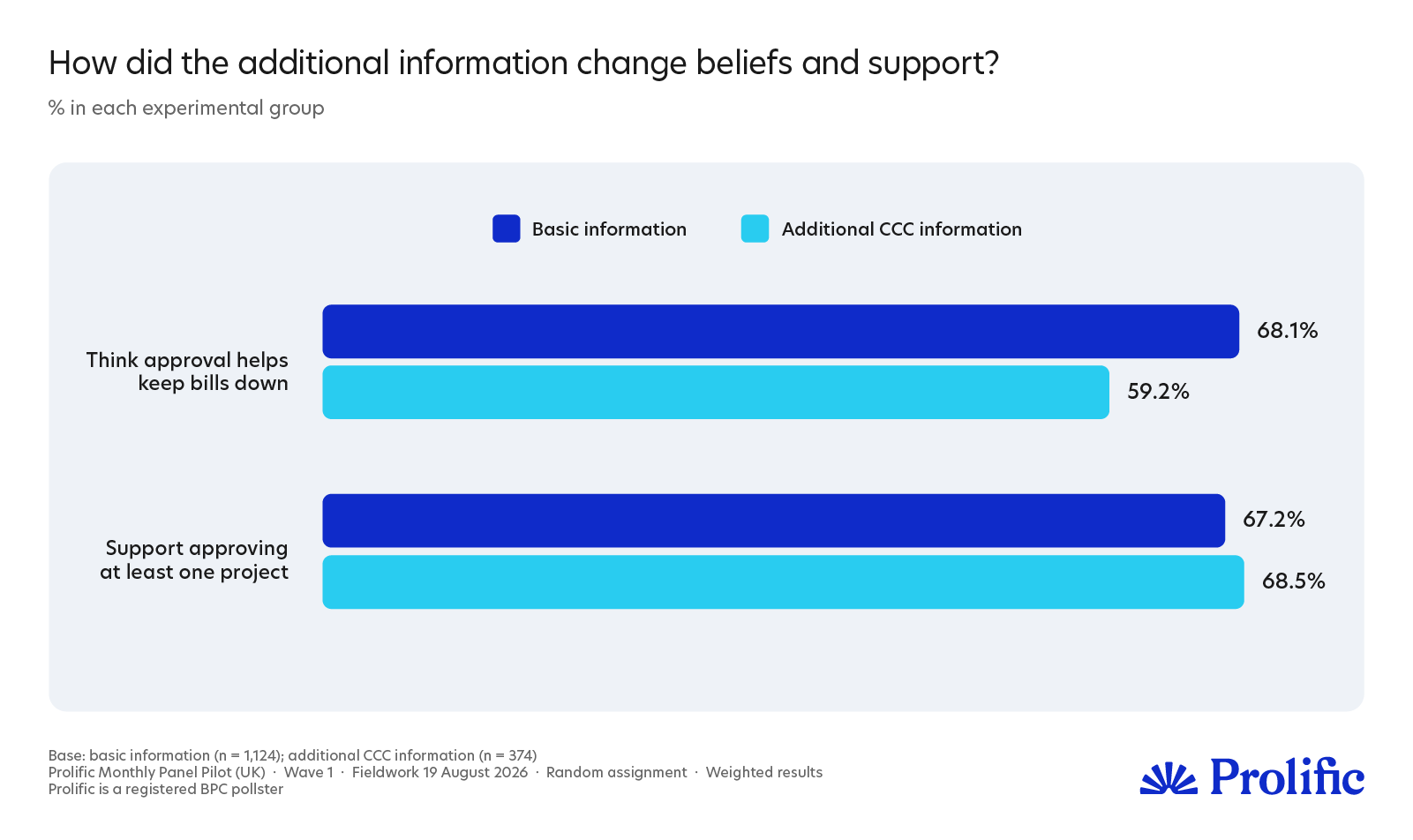
The experiment does not prove that no information could change opinion. It tells us that this particular summary moved an important factual belief without producing a corresponding shift in approval. Respondents also became more decisive, with the share answering "don't know" falling by 5.5 points, while the balance between support and rejection remained broadly stable.
That makes the overall support harder to explain as a simple misunderstanding about bills. People revised one of the expected benefits and continued to support the projects at roughly the same rate.
Waiting is the lower-risk political option
None of this tells us why Burnham or his advisers have chosen the current timetable. The government says any decision will consider the environmental assessments, public representations and the rest of the available evidence. Ministers have not announced a formal deadline.
The polling does show the political logic of waiting. Across the country, approval is a majority position. Current Labour leaners are also relatively accepting of it. Once voters receive additional information questioning one expected benefit, overall support remains much the same.
The immediate problem sits on Labour's left. Green-leaning voters are more likely to reject both projects, more likely to see approval as breaking Labour's promise, and much more likely to say it would make them view Burnham less favorably. Those voters matter more than usual while the Green leader is trying to take a Labour seat and is already campaigning against Jackdaw.
Burnham will still have to make the decision. Waiting until after the Labour conference and the Holborn and St Pancras by-election changes the political setting in which he makes it. Our results suggest why that setting matters.
The caveats
This is one survey of 1,498 UK adults, conducted on 19 August 2026 through Prolific's opt-in online panel. Respondents were recruited using quotas for age, sex and region. Results were weighted to the UK adult population using age by sex, region, 2024 general election vote, education by age, and housing tenure.
The main toplines in this article use the 1,124 respondents who received the basic factual description. The other 374 respondents received the additional Climate Change Committee information. Assignment between those groups was random. The descriptive results are weighted; the experimental conclusion also holds without weights.
The current Labour and Green comparisons use 319 Labour leaners and 160 Green leaners. The Green group is large enough to show the broad pattern, but still small enough that the exact percentages should be treated as directional. These groups are based on current voting intention rather than recalled 2024 vote because the political question concerns the electorate Labour and the Greens are competing over now.
All respondents received information about Jackdaw and Rosebank before answering. These figures therefore measure opinion after a short factual introduction, rather than completely unprompted views of North Sea drilling. Support for each project was derived from one question asking whether respondents would approve both, approve one, reject both, or did not know.
Finally, the survey was conducted a month before the reported delay. Public opinion can change as the decision receives more attention. The subgroup findings help describe the incentives around the current debate; they do not establish that the by-election caused the delay or predict how many votes approval would move.
Do you want to use this data for reporting, academic work, or something else? Contact oriol.jover@prolific.com to discuss potential collaborations.
To dig deeper into these figures, you can explore the results by downloading the cross-tabulation tables to conduct your own analysis.
You can access the full questionnaire here.
Methodology: Prolific surveyed 1,498 UK adults on 19 August 2026, weighted to the UK adult population on age × sex, region, 2024 general election vote, education × age, and housing tenure. All respondents received a short factual description of the Jackdaw and Rosebank projects before answering. Current party lean is based on stated current voting intention, not 2024 recalled vote. The current-Labour-lean (n=319) and current-Green-lean (n=160) subgroup comparisons are unweighted-sensitive descriptive breakdowns; confidence intervals have not been separately computed for these specific splits. Prolific is a registered BPC pollster.
Basic intro (shown to everyone):
Next, we will ask you a few questions about the debate over further drilling in the North Sea. Please read the information below before answering those questions.
The UK government is deciding whether to approve two North Sea oil and gas projects, Jackdaw and Rosebank, to begin production. Construction has already started on both, but neither can begin producing oil or gas without this new approval.
Jackdaw would produce mainly gas for about 8 to 11 years, mostly for the UK gas network, accounting for around 6.5% of UK gas production at its peak.
Rosebank would mostly extract oil, potentially operating until 2051. The oil would be sold on international markets and would account for around 10% of UK oil production at its peak.
Extended intro (shown to a random 25% of the sample):
In 2022, the Climate Change Committee (CCC), the independent body that advises the UK government on emissions targets, wrote to the government about new North Sea oil and gas developments. Its assessment included:
Emissions: The net effect on global emissions could not be determined. UK oil and gas production has a lower carbon footprint than the global average, which could reduce emissions if it replaces equivalent imports, but extra UK production also adds to global supply, and some of that would likely increase overall consumption rather than replace production elsewhere.
Bills: Any increase in UK extraction would have "at most a marginal" effect on the prices UK consumers pay, since these are set by international markets, not by how much the UK itself produces.
Jobs: North Sea drilling supports well-paid local jobs, which are important for the area, but similar jobs could also be created in wind power and carbon capture.
Energy security: Producing more oil and gas in the UK could reduce reliance on imports, improving energy security, but this could also be achieved by reducing consumption of oil and gas.