Data centers have become a political liability for Republicans in the midterms, survey finds

The AI data center fight inside the Republican Party has been building for weeks. In mid-August, the National Republican Senatorial Committee circulated a memo warning that data centers had become "the anchor" dragging down Senator Jon Husted's re-election bid in Ohio, as Democrats hammered him over the industry's local costs, and that the damage could spread to other races if voters' concerns weren't addressed.
On September 15, Trump's longtime pollster Tony Fabrizio sent Republican candidates a memo of his own, telling them that "unqualified support for building more AI data centers is a losing position" and that they should support new projects only if developers cover their own power costs and protect nearby communities' water and electricity supplies.
The next day, the House passed the Ratepayer Protection Act 417 to 3, a bill that tells state utility regulators to consider making data centers pay for the grid upgrades their demand creates rather than passing that cost to ordinary households. Five days after that, Texas Governor Greg Abbott directed state regulators to stop issuing new state environmental permits for data centers until an audit of the grid and water impact is finished, building on a moratorium he'd already put in place in August.
Data centers seem to have become a potential political liability for Republican candidates. Instead of asking people what they think about data centers, we asked something more specific: does a Republican congressional candidate's position on data centers change how much support they get, and does it change differently depending on who's voting?
What we did
Most data center polling asks people to react to a policy in isolation. Do you support making developers pay for grid upgrades? Do you support pausing new approvals? Those questions are useful, but nobody votes for a policy sitting by itself. They vote for a candidate, and a candidate's position is one piece of a much bigger picture.
We wanted to isolate that one piece. Between September 16 and 18, we asked 1,493 US adults to compare hypothetical Republican candidates running for Congress in their own district, each defined by a different position on data centers.
The status-quo candidate keeps approving new data centers under the rules already on the books, with no new requirements attached.
The ratepayer-protection candidate also approves new data centers, but requires developers to cover the grid infrastructure they need instead of passing that cost to households.
The pause candidate pauses new approvals while regulators study the local effects, including electricity and water, and write rules for future projects.
Every respondent judged all three possible matchups between these candidates: the status-quo candidate against the ratepayer-protection candidate, the status-quo candidate against the pause candidate, and the ratepayer-protection candidate against the pause candidate. In each one, they could pick a candidate or say neither. We randomized the order of the three matchups.
Testing all three matchups gives us a fuller picture than a single head-to-head contest. Comparing the status-quo candidate with the ratepayer-protection candidate tells us whether adding ratepayer protections helps. Comparing the status-quo candidate with the pause candidate tells us whether the more restrictive option helps. But neither comparison tells us which alternative voters prefer once the two face each other. The third matchup does, and it reveals the main divide in the results.
The status-quo candidate loses to both alternatives
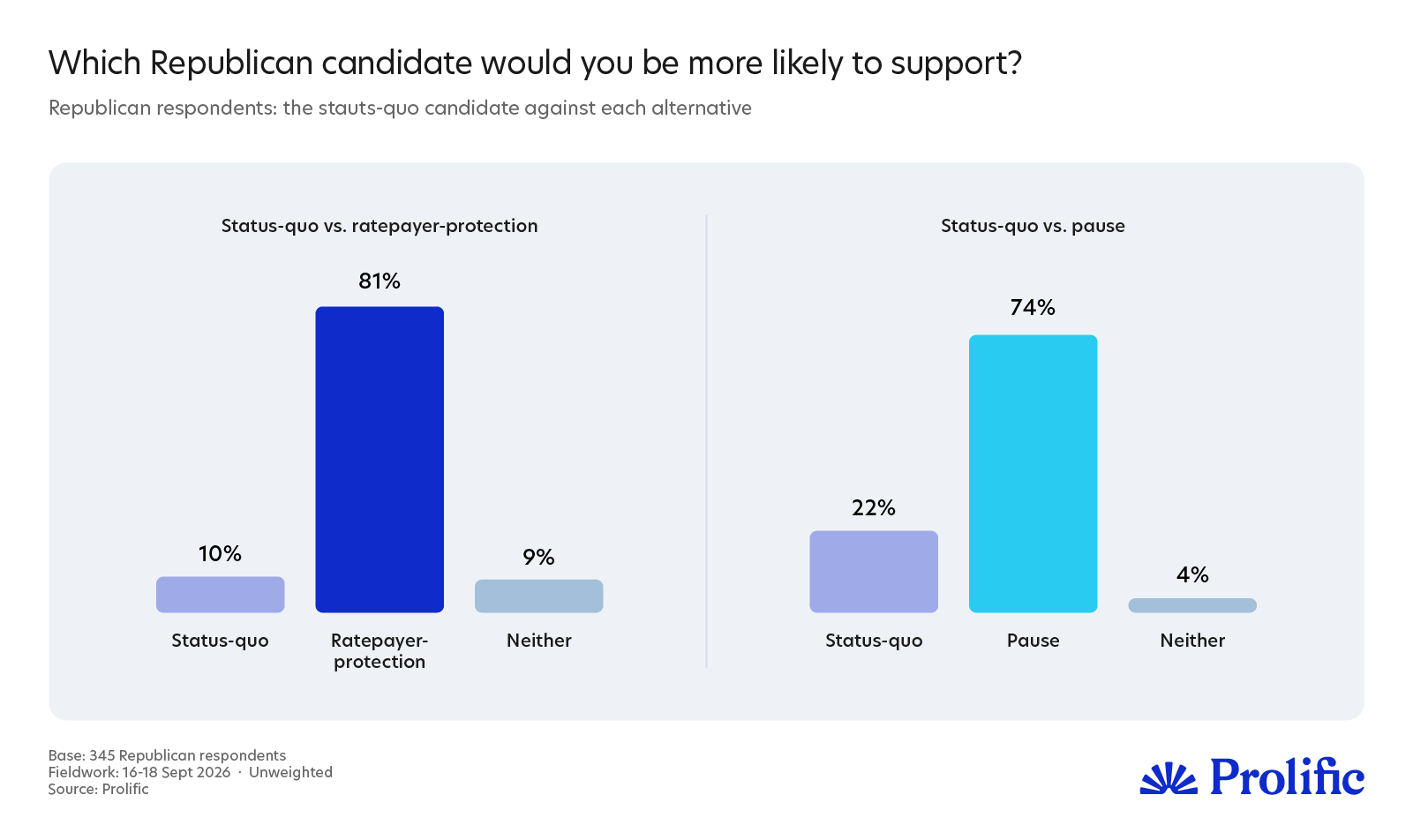
Let’s start with the 345 Republicans in our sample. When faced with the ratepayer-protection candidate, the status-quo candidate lost badly: 81% chose the ratepayer-protection candidate, 10% stuck with the status quo, and 9% picked neither.
Facing the pause candidate, the status-quo candidate lost almost as decisively: 74% chose the pause candidate, 22% stuck with the status quo, and 4% picked neither.
Because every respondent judged the status-quo candidate in both matchups, we can check whether the same people rejected that candidate twice, or two different groups happened to agree. It's the same people. 65% of Republicans picked the alternative candidate in both contests involving the status-quo candidate. That's one consistent verdict on one candidate, not two separate results that happened to land the same way.
It's worth being precise about what that verdict is. The ratepayer-protection candidate still supports building more data centers. They just won't let households bear the cost. Republican respondents didn't reject data centers. It was running for office on keeping things exactly as they are, once voters had another Republican option.
Republicans split over what should replace it
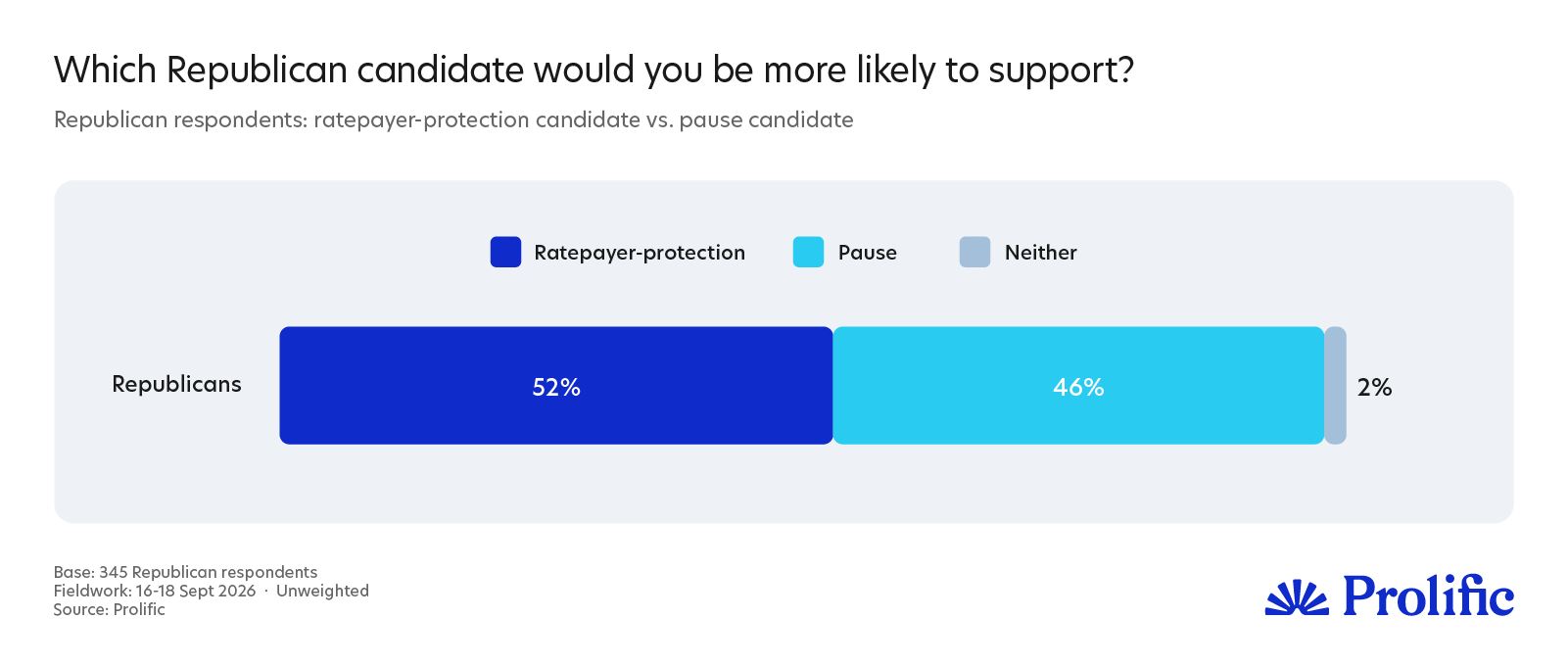
Take the status-quo candidate out of the race and put the other two against each other, and Republican respondents are almost evenly split: 52% support the ratepayer-protection candidate, 46% the pause candidate, 2% neither.
We can't call that 6-point gap with confidence. The 95% confidence interval runs from a 4-point edge for the pause candidate to a 17-point edge for the ratepayer-protection candidate, so "split" is a more accurate description than "leading."
That reframes the two results above. The 81% who picked the ratepayer-protection candidate over the status quo weren't calling that candidate the strongest possible option. They were saying that candidate beats one offering nothing new. The 74% who picked the pause candidate were making the same point about that one. Both alternatives easily beat the status quo. Neither beats the other.
Independents pick a clear winner
Now let's look at the 425 independents in our sample. They didn't split the way Republicans did. Facing the same choice between the ratepayer-protection candidate and the pause candidate, 56% chose the pause candidate, while 24% preferred the ratepayer-protection candidate. Nonetheless, roughly one in five (21%) picked neither, a much higher opt-out rate than Republicans showed.
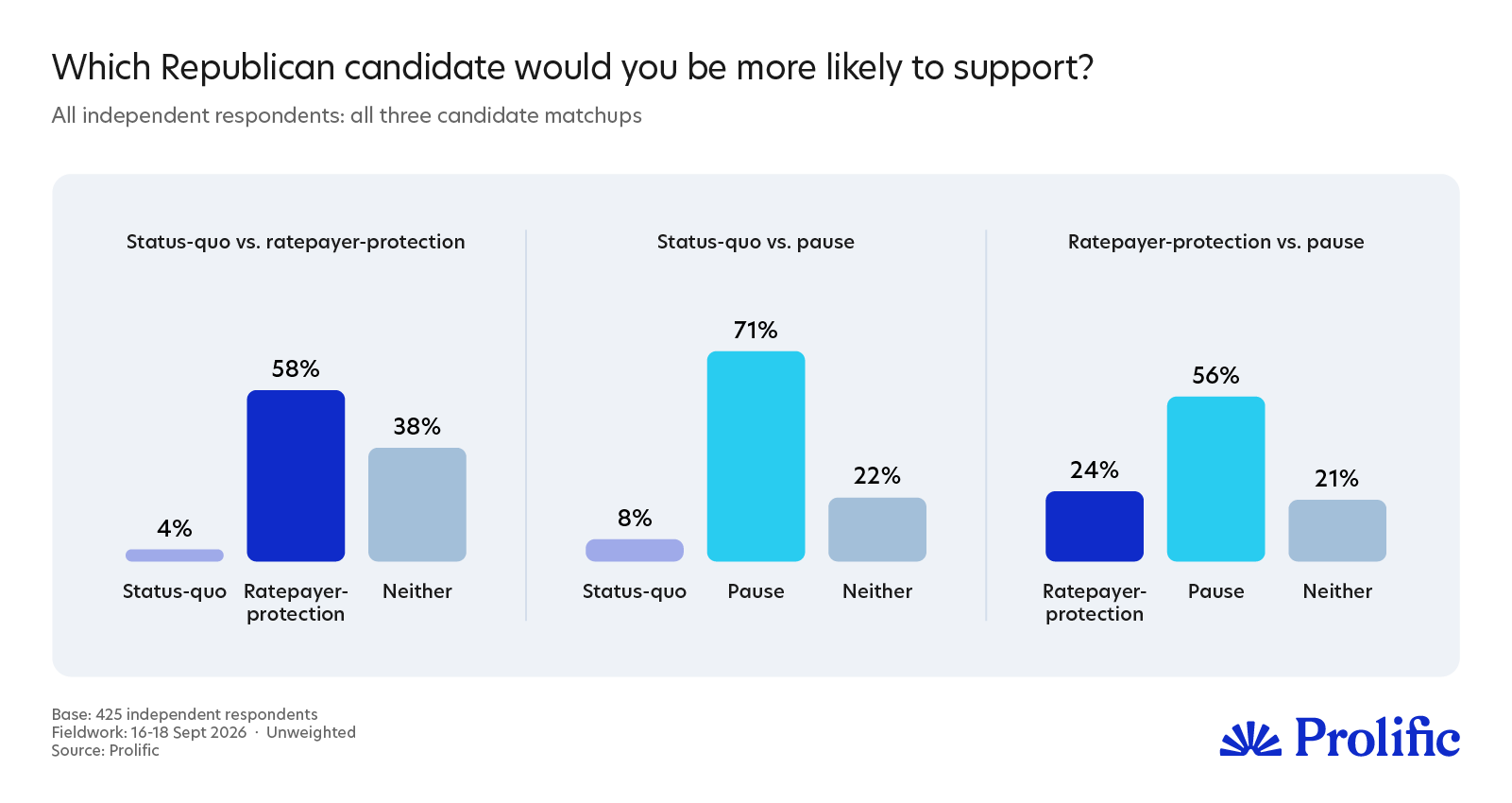
Unlike Republicans, independents clearly favor the more restrictive of the two alternatives.
It isn't just the Democratic-leaning independents
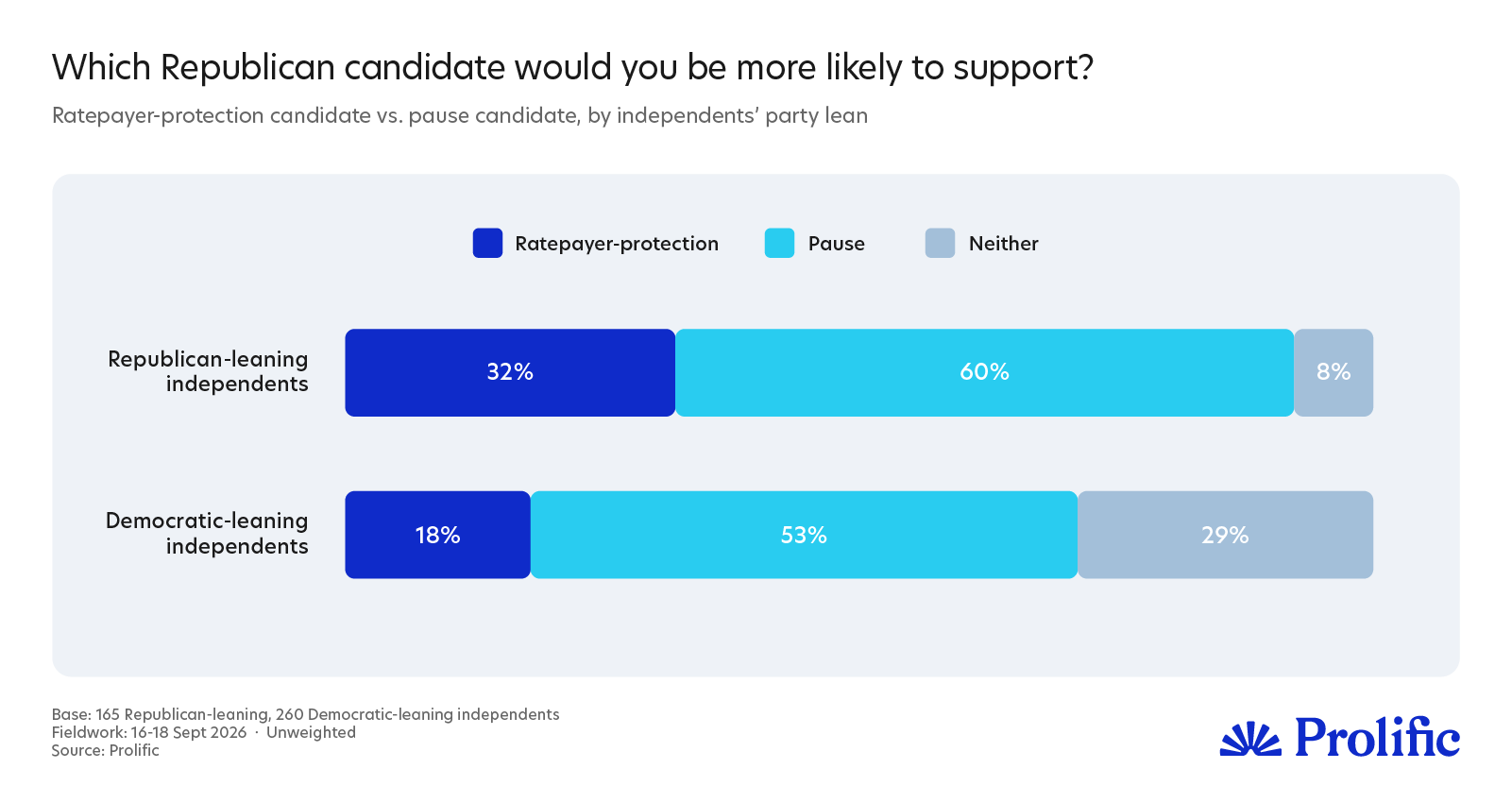
The obvious follow-up is whether that 56-24 result is really just Democratic-leaning independents pulling the average up. We split independents by party preference, and the pause candidate wins in both groups.
Among the 260 Democratic-leaning independents, the pause candidate beats the ratepayer-protection candidate 53% to 18%, with 29% choosing neither. Among the 165 Republican-leaning independents, the pause candidate wins even more decisively: 60% to 32%, with 8% choosing neither.
Put Republican-leaning independents next to Republican identifiers, and you get the sharpest contrast in the whole survey. Republicans favor the ratepayer-protection candidate over the pause candidate by 52 to 46. Republican-leaning independents, a group campaigns may otherwise consider part of the broader Republican coalition, favor the pause candidate by 60 to 32.
That's a 34-point gap in which candidate wins, between two groups a campaign would normally treat as the same audience. We tested that gap directly: it's 33.97 points, with a 95% confidence interval of 16.40 to 51.53.
Republican-leaning independents reach that 60-32 result the same way Republicans reach their 52-46 split, by rejecting the status-quo candidate decisively first: they lose to the ratepayer-protection candidate 70 to 5 and to the pause candidate 80 to 10 among this group. The disagreement with the Republican base only shows up once the status-quo candidate is out of the race. And once it is, Republican-leaning independents land much closer to Democratic-leaning independents than to Republicans.
Does any of this actually matter to how people vote?
After the candidate tournament, we asked respondents how much a Republican candidate's position on data centers could affect whether they'd consider supporting them. Among Republicans, 51% said "a lot" or "some." Among independents, 41% said the same.
Those numbers are worth using carefully. Respondents answered this question right after spending several minutes comparing three different data center positions, so it doesn't tell us how important the issue felt walking in. What it tells us is that after thinking it through, about half of Republicans and four in ten independents don't consider a candidate's position on this irrelevant to their vote.
How confident should we be in these results?
The big margins hold up well. Among Republicans, the ratepayer-protection candidate beats the status-quo candidate by 72 points (95% CI: 65.2 to 78.5), and the pause candidate beats the status-quo candidate by 52 points (95% CI: 43.7 to 61.2). Between the ratepayer-protection candidate and the pause candidate, Republicans are genuinely split, not in the lead: 6 points, with a confidence interval that crosses zero (-4.4 to 16.6).
These are unweighted, directly observed shares. Applying survey weights barely changes anything: the Republican margin over the status quo moves from 72 to about 76 points for the ratepayer-protection candidate and stays close to 52 for the pause candidate, the gap between the two alternatives among Republicans narrows slightly to about 3 points, and the independent preference for the pause candidate stays around 34 points either way.
We also checked whether the results depended on people understanding the choice. 86% of the full sample, and 91% of Republicans, correctly answered a comprehension question about what the ratepayer-protection candidate's conditions would actually require. Restricting the analysis to those respondents makes the same patterns slightly stronger, not weaker. Restricting the analyses only to likely voters changes none of the main results by more than a point or two. Among likely-voter Republicans specifically, the ratepayer-protection candidate's edge over the pause candidate grows to around 12.5 points, although the confidence interval widens too.
The bottom line for candidates running this fall
None of this predicts how a real House race would move. A real race includes a named opponent, local conditions, and a dozen competing issues we deliberately stripped away to isolate whether this one position changes how appealing this one candidate is.
What it does show is that a Republican who defends data center expansion with no new conditions attached is running the weakest of the three positions we tested, by wide margins, against every group. That matches what Fabrizio and the NRSC have been telling candidates directly.
Where it gets more interesting is what happens next. Republicans are genuinely divided over which alternative should replace the status quo. Independents, the voters campaigns spend the most trying to win, aren't divided at all, and the ones leaning Republican are barely distinguishable from the ones leaning Democratic. For a candidate deciding how far to go, the choice is a position that’s more industry-friendly but less popular with independents, or one that can help appeal beyond the Republican base.
Do you want to use this data for reporting, academic work, or something else? Contact oriol.jover@prolific.com to discuss potential collaborations.
You can access the full experimental results here.
You can access the full questionnaire here.
Methodology: Prolific surveyed 1,493 US adults between September 16 and 18, 2026, recruited using fully crossed age x sex x ethnicity quotas. Every respondent compared hypothetical Republican congressional candidates in all three possible pairs: one supporting continued development under current rules, one supporting continued development with developers covering additional grid costs, and one supporting a temporary pause while regulators assessed local effects and developed future rules. "Neither candidate" was available in every contest, and matchup order was randomized. Reported results are unweighted observed shares; weighted estimates, using regularized raking weights targeting age x sex, race and ethnicity, region, education x age, housing tenure, and recalled 2024 presidential vote, produced the same substantive conclusions.