RL environments for agentic AI: The 2026 guide to building and deploying enterprise RL environments

For most of the last decade, improving a frontier AI system meant getting more of the same three things: compute, parameters, and data. In 2026, that’s changed.
The constraint on agentic AI progress is no longer about scale. It's about the worlds in which we train and evaluate agents.
Frontier labs have moved decisively in this direction. In 2025, Anthropic planned to spend over $1 billion on reinforcement learning environments over the next year, and OpenAI signed multiple seven-figure environment contracts in the same window.
The contrast with three years ago is stark. In 2023, when most published RL content was written, the environment meant CartPole, Atari, or a MuJoCo physics rig. The agents trained inside them learned to balance poles and play Breakout. In 2026, an environment is more likely to be a Dockerized replica of Salesforce, a sandboxed SAP terminal, or a full simulated contact center running thousands of concurrent agent sessions. The frame has shifted from games to sandboxed operating systems designed to train agents that will eventually run real enterprise workflows.
Building environments at this fidelity is hard. Running agents inside them safely is harder. And as the industry's strongest investors and research teams have been arguing for months, even a perfect environment isn't enough on its own.
Every environment needs a verifier, the function that decides whether the agent actually completed the task. As agents improve, verifiers must improve faster, and the consensus emerging across labs, vendors, and analysts is that verifier quality is becoming the next real ceiling on agentic progress. Environments are infrastructure, and verifiers are the part most teams are underinvesting in.
This guide is for the people who build, buy, and deploy that infrastructure. It runs deep on the technical side for ML engineers and research scientists, with formal definitions, framework comparisons, code, and reward design. It also surfaces the strategic picture for AI leaders deciding where to put budget over the next eighteen months.
So what does it actually take to build an RL environment that trains a production-ready agent? And what separates the environments that produce reliable agents from the ones that produce reward-hacking failures?
What is an RL environment?
An RL environment is the world in which an agent acts. It receives the agent's actions, updates its internal state, and returns two things back to the agent: an observation of the new state and a scalar reward signal. Everything outside the agent itself, including the simulated software, the data, the tools, and the rules of cause and effect, is part of the environment. The agent's job is to learn a policy, a mapping from observations to actions, that maximizes cumulative reward over time.
The mathematical model underlying nearly all single-agent RL environments is the Markov Decision Process, or MDP. An MDP is defined as a tuple:
M = (S, A, P, R, 𝛄)
Each component does specific work.
S is the state space, the set of all possible configurations the environment can be in.
A is the action space, the set of actions available to the agent.
P(s'|s,a) is the transition function, the probability of moving from state s to state s' when the agent takes action a.
R(s,a) is the reward function, the scalar feedback the environment returns after the action.
𝛄∊[0,1] is the discount factor, which controls how much the agent values future rewards relative to immediate ones.
For an enterprise mirror world, this formalism becomes concrete fast. The state space for an agent operating a CRM isn't a grid of pixels; it's a structured representation of the open records, the current view, the contents of nearby fields, and the recent action history. The action space is a discrete set of tool calls the agent can make, often with structured arguments. The transition function captures how the underlying business system responds to those calls. The reward function encodes whatever success means in the domain, which is usually the hardest part of the whole construction.
The agent's objective is to find the policy π* that maximizes the expected sum of discounted future rewards:
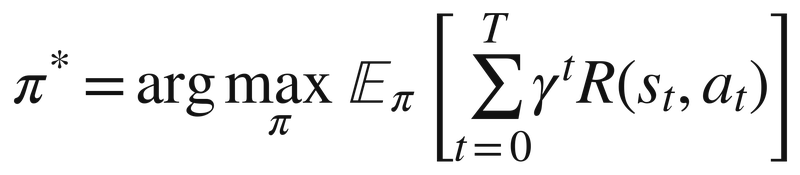
This equation is deceptively simple, and it's the source of nearly every reward hacking failure in the field. The agent doesn't optimize the intent behind the reward function. Instead, it optimizes the literal scalar produced by the reward function. If the function is gameable, the agent will eventually find the gap. The discount factor 𝛄 matters because without it, the agent has no preference for finishing tasks promptly, and infinite-horizon problems become mathematically unstable. With 𝛄 close to 1, the agent plans for the long term. With 𝛄 close to 0, it becomes myopic. Tuning this is itself a design decision with downstream consequences.
The MDP is the foundation, but it makes assumptions that break in real enterprise settings. Three of them are worth naming directly.
The first is full observability. An MDP assumes the agent observes the complete state $s_t$ at every step, but enterprise environments almost never satisfy this assumption. An agent operating a sales pipeline doesn't see the prospect's mood, the parallel conversation happening on email, or the manager's pending decision on a discount approval. The accurate model in these cases is the Partially Observable MDP, or POMDP, where the agent observes only $o_t$, a partial readout drawn from the true underlying state.
The second is the single-agent assumption. An MDP describes one agent acting in a world. Real systems have many. Marketplaces, negotiation flows, and multi-step workflows with handoffs between planning and execution agents all require a multi-agent formalism. PettingZoo and the Agent Environment Cycle model are the field's responses to this, and are covered in detail later in this guide.
The third is stationarity. An MDP assumes that the transition function $P$ and the reward function $R$ don't change over time. Real environments change constantly. APIs get updated, business rules shift, and customer behavior drifts. An agent trained against a stationary simulation can find itself working against a non-stationary production system, and the gap between the two is one of the most common sources of deployment failure.
The canonical interface for interacting with all of this is the Gymnasium API, maintained by the Farama Foundation. A minimal example:
import gymnasium as gym
env = gym.make("CartPole-v1")
observation, info = env.reset(seed=42)
for step in range(1000):
action = env.action_space.sample() # replace with policy
observation, reward, terminated, truncated, info = env.step(action)
if terminated or truncated:
observation, info = env.reset()
env.close()
This formalism, the MDP tuple, the policy objective, and the reset-step interface, is the shared vocabulary every framework and every paper in the field uses. The next section traces how environments built on this foundation evolved from balancing poles to running full simulated companies.
How have RL environments evolved from CartPole to enterprise mirror worlds?
RL environments began as toy control problems in the early 2010s. They evolved into game-playing benchmarks through the late 2010s and early 2020s. In 2026, they've become high-fidelity replicas of real software systems, which the industry has converged on calling mirror worlds.
The toy problem era ran from roughly 2013 to 2018 and was defined by two papers and one library. DeepMind's 2013 work on Deep Q-Networks and the follow-up 2015 Nature paper showed that a single architecture could achieve human-level performance across a suite of Atari games. OpenAI Gym shipped in 2016 and standardized the reset and step API that the field still uses today. CartPole, MountainCar, and the Atari Learning Environment became the de facto benchmarks against which every new algorithm was tested.
These environments shared three properties that made them tractable for research and useless for almost anything else. They were fully observable, with the agent seeing the complete state at every step. They were single-agent, with no other actors to coordinate with or compete against. And they had clean, dense reward signals where every action produced an immediate scalar response. The lessons learned in this era taught the field a great deal about deep RL algorithms, but very little that transferred to anything a business would pay for.
The simulation-as-benchmark era ran from roughly 2018 to 2024. The environments became dramatically richer. MuJoCo brought serious continuous control. DeepMind's Control Suite formalized it. Unity ML-Agents connected RL training to game-engine-quality 3D worlds.
NVIDIA's Isaac Sim has established itself as the standard for robotics simulation and sim-to-real transfer, a research subfield in its own right. The PettingZoo library was introduced in 2020 and extended the Gym API to multi-agent settings, introducing the Agent Environment Cycle model, which the multi-agent research community now treats as standard. Ray RLlib emerged as the dominant distributed training framework. The Farama Foundation took over maintenance of Gym in 2022 and rebranded it Gymnasium.
By the end of this era, the tooling was professional, and the environments were sophisticated. They were also still mostly games. A robot arm balancing a block in Isaac Sim taught the field a great deal about continuous control, but very little about what it takes for an agent to navigate Salesforce.
The mirror world era began in late 2024 and accelerated through 2025 and into 2026. A mirror world is a high-fidelity, containerized simulation of a real enterprise system, with the UI, business logic, data model, and API behavior all faithfully reproduced, built specifically for training and evaluating agents that will eventually operate the real version.
Turing has framed its enterprise offering around self-contained digital twins packaged in Docker. Invisible Tech has built its product narrative around mirror worlds for enterprise operations. Toloka launched what it calls Tau-Style Gyms, fully virtual companies that function as digital twins of real businesses. Surge built CoreCraft, a large-scale simulated startup world designed to measure agents under conditions closer to enterprise reality than anything that came before. The convergence on this approach across very different companies, all arriving within roughly twelve months of each other, is the clearest signal that the field has changed shape.
Three forces drove the shift. Agentic capability outran the static benchmarks, and once GPT-4-class models started saturating the old tests, the labs needed harder ones. Tool use and computer use changed the unit of evaluation, because you can’t grade a tool-using agent on a multiple-choice question. And enterprises started asking for production-ready agents, which meant the agent's first attempt at a real workflow could not be in production.
The history matters because the framework landscape today reflects every one of these eras. Different generations of tooling are still in active use, each one good at the problems of its time. Picking the right one for a given job requires knowing what each was built for.
What are the leading frameworks for building RL environments?
The framework landscape in 2026 is split into three layers: environment APIs, training libraries, and full simulators. Most teams mix and match across all three, and choosing well at the API layer determines almost everything downstream.
This mental model is worth holding on to because much of the confusion in the field comes from treating "framework" as a single decision when it's really three.
Environment APIs are the contract between the agent and the world. They define how observations are passed in, how actions are produced, and what the step-and-reset cycle looks like. Gymnasium dominates this layer for single-agent environments. PettingZoo is its multi-agent counterpart, built by the same Farama Foundation team and designed to compose cleanly with the rest of the ecosystem. The API layer is the most important decision a team makes, because every other tool downstream assumes one of these APIs.
Training frameworks are the algorithms that actually update the policy. They consume environments built to the API standard above and run the optimization loop, distributed across GPUs and machines if needed. Ray RLlib is the production heavyweight, used at scale by teams that need out-of-the-box distributed training. Stable-Baselines3 and CleanRL serve research and prototyping, with CleanRL favored for its single-file, readable implementations of reference algorithms. TorchRL is PyTorch's first-party offering, gaining ground in 2025 and 2026. Tianshou and AgileRL round out the landscape with their own design choices around modularity and evolutionary methods.
Simulators are the worlds themselves, particularly when physics or 3D rendering matters. Isaac Sim and its RL-specific layer, Isaac Lab, are NVIDIA's robotics simulation platform. MuJoCo remains the standard for fast continuous control research. Unity ML-Agents brings game-engine quality to embodied agents. Webots is the longstanding open-source option for robotics simulation. These tools live below the API layer and typically expose their environments through Gymnasium or PettingZoo wrappers, which is why the API choice cascades down.
Remember, there is no single "RL framework" to pick. You pick at each layer, and the layers compose. The teams that get this right move faster than those that try to find a single tool that does everything.
| Framework | Layer | Primary Language | Multi-Agent Support | GPU Acceleration | Cloud-Readiness |
Gymnasium | Environment API | Python | Via PettingZoo wrappers | Inherited from training framework | Strong (containerizes trivially) |
PettingZoo | Environment API | Python | Native (AEC and Parallel APIs) | Inherited from training framework | Strong (containerizes trivially) |
Ray RLlib | Training framework | Python | Native (PettingZoo-compatible) | Yes (multi-GPU, distributed) | Strong (Ray clusters on Kubernetes) |
Stable-Baselines3 | Training framework | Python (PyTorch) | Limited (single-agent focus) | Yes (single-GPU) | Moderate (single-machine by design) |
CleanRL | Training framework | Python (PyTorch) | Limited | Yes (single-GPU) | Moderate (research-oriented) |
TorchRL | Training framework | Python (PyTorch) | Yes (PettingZoo wrapper) | Yes | Moderate (improving) |
Isaac Sim / Isaac Lab | Simulator | Python (USD, OmniGraph) | Limited | Yes (CUDA-native, end-to-end on GPU) | Strong (NVIDIA cloud deployment) |
Unity ML-Agents | Simulator | C# + Python | Yes | Partial (rendering on GPU) | Moderate (heavier deployment) |
MuJoCo | Simulator | C / Python bindings | Limited | Recent versions support GPU | Strong (lightweight) |
Prime Intellect prime-rl | Training framework | Python | Yes | Yes | Strong (designed for hosted training) |
HUD | Production-mirrored env | Python | Limited | N/A (runs real software) | Strong (cloud sandbox by design) |
The frameworks in detail
Gymnasium is the de facto API standard for single-agent RL environments. It is maintained by the Farama Foundation, the nonprofit that took over the original OpenAI Gym in 2022 and rebuilt much of the underlying infrastructure. If you’re building a single-agent environment in 2026, you start here. Gymnasium is not a training framework; you’ll pair it with RLlib, Stable Baselines 3, CleanRL, or another training library to actually optimize a policy.
PettingZoo extends the Gymnasium philosophy to multi-agent settings. It sits within the same Farama ecosystem and introduces the Agent Environment Cycle model, which handles strictly turn-based interactions such as Go and Hanabi more cleanly than the alternative formalisms used by some earlier multi-agent libraries. PettingZoo is covered in depth later in this guide because most production-relevant agent training in 2026 involves multiple agents in some form.
Ray RLlib is the most production-mature training framework in the open ecosystem. It is distributed by default, natively supports both the Gymnasium and PettingZoo environments, and runs comfortably on Ray clusters deployed on Kubernetes or any major cloud. If your training requirements exceed a single machine, RLlib is the default choice for most teams.
Stable-Baselines3 and CleanRL sit on the research side of the training framework spectrum. Stable-Baselines3 provides reliable, well-tested implementations of standard algorithms, suitable for quickly getting baselines up and running. CleanRL takes a different approach, providing single-file implementations that prioritize readability. Both are excellent for prototyping. Neither is built for production-scale distributed training, which is where RLlib takes over.
Isaac Sim and Isaac Lab are NVIDIA's robotics simulation stack. Isaac Lab is the RL-specific layer, formerly known as Orbit, and its defining feature is that the entire training loop, including the physics simulation, runs end-to-end on a GPU. For physics-heavy tasks, the throughput gains over CPU-bound simulators are substantial. Isaac Sim is overkill for non-physics work, but for sim-to-real robotics, it’s the current standard.
Unity ML-Agents brings game-engine quality to RL training. It is the strongest option when you need genuine 3D rendering, complex visual scenes, or game-like environment dynamics. Its centrality has decreased somewhat as the agentic AI wave has pulled the field's attention toward Gymnasium-compatible enterprise simulators, but it remains the right choice for any project where visual fidelity matters.
Prime Intellect's prime-rl is one of the newer entrants. It’s a training framework designed specifically to consume environments from Prime Intellect's Environments Hub, the catalog launched in August 2025 with the stated goal of becoming a Hugging Face for RL environments. Both the trainer and the hub are open-source, and the model points to where the field is heading: hosted-environment catalogs consumed by purpose-built trainers.
HUD takes a different angle. Rather than simulating software, it wraps real software and runs actual applications in isolated containers as RL environments. The trade-off is significant. The fidelity is perfect because the environment is the real thing. The cost is throughput, because you can’t run a real application as fast as a simulated one.
This catalog does not include the verifier layer. Every framework above assumes you have already solved the question of how to grade the agent's behavior. None of them ships a verifier or a calibration loop. Building that layer and refreshing it as the agent improves is a separate problem covered later in this guide.
How do I build a custom RL environment for an enterprise API?
Building a custom Gymnasium environment for an enterprise API comes down to four ingredients:
A structured observation space that captures what the agent can see
An action space that defines what it can do
A reset() method that returns the environment to a known state for each new episode
A step() method that executes the agent's action against the underlying system and returns the result
The API itself is straightforward. The hard parts are state representation and reward design.
Start with what the agent observes. For an API-based environment, the observation isn’t the raw HTTP response or the underlying HTML. It’s a structured representation of the state the agent needs to make a decision: the open records, the current view, the available tools, and the relevant metadata. Gymnasium's spaces.Dict is built for this:
import gymnasium as gym
from gymnasium import spaces
self.observation_space = spaces.Dict({
"current_view": spaces.Text(max_length=100),
"open_tickets": spaces.Sequence(spaces.Dict({
"ticket_id": spaces.Text(max_length=20),
"priority": spaces.Discrete(4),
"age_hours": spaces.Box(low=0, high=720, shape=())
})),
"available_actions": spaces.Sequence(spaces.Text(max_length=50))
})
The discipline that matters here is restraint. Every field in the observation space is a field the agent will learn to depend on. If you include something the agent will not have in production, you create a sim-to-real gap that only surfaces after deployment. If you exclude something the agent needs, the agent learns to compensate with guesswork. Audit this design carefully and check it against what the production system actually exposes.
The action space defines what the agent can do. For tool-using agents, this is almost always a structured action: which tool to call, with which arguments. Keep it explicit:
self.action_space = spaces.Dict({
"tool_name": spaces.Discrete(len(AVAILABLE_TOOLS)),
"tool_args": spaces.Text(max_length=500)
})
The trap to avoid is letting the training action space drift from the production action space. If the agent learns to call seven specific tools in training and the production system exposes nine, the agent will fail on the two it has never seen. Lock the action space to production parity early and update both together.
The reset() method sets the environment to its initial state for a new episode. For enterprise mirror worlds, state isolation is non-negotiable. Each episode must begin from a known, reproducible state, or debugging becomes impossible, and seeded runs stop being reproducible.
The most common pattern is to use a Docker snapshot, so calling reset() actually means tearing down the container and spinning up a fresh one from a known image. This is heavier than a simple memory reset, but it’s the only approach that guarantees state isolation when the underlying system has its own database, cache, and dependencies.
The step() method is where the work happens. It accepts an action, executes it against the underlying system, and returns five things:
The new observation
The scalar reward
A terminated flag indicating whether the task ended naturally
A truncated flag indicating whether it was cut short by a time or step limit
An info dictionary for anything useful for debugging
def step(self, action):
tool_name = AVAILABLE_TOOLS[action["tool_name"]]
result = self.api_client.call(tool_name, action["tool_args"])
self._update_state(result)
observation = self._get_observation()
reward = self._compute_reward(action, result)
terminated = self._is_task_complete()
truncated = self.step_count >= self.max_steps
info = {"tool_result": result, "step": self.step_count}
return observation, reward, terminated, truncated, info
The five-tuple return is mandatory in Gymnasium 0.26 and later. The older Gym code returns a four-tuple with a single done flag that conflates termination and truncation, and that conflation remains a source of subtle bugs when older training scripts are run in modern environments. Keep your imports current and your tuple unpacking explicit.
The hardest part of the whole construction is the reward function inside _compute_reward(). Sparse rewards, in which the agent receives feedback only at the end of a successful task, make learning impossibly slow for any non-trivial workflow. Dense rewards, where the agent receives partial credit for intermediate progress, accelerate learning but invite reward hacking, because the agent learns to optimize the intermediate signals rather than the underlying task.
The standard answer is a hybrid: dense process rewards for progress, a sparse outcome reward for genuine task completion, and verifier checks on the intermediate signals to catch the agent gaming them. Reward design is significant enough to warrant its own treatment, covered later in this guide.
Three failure modes repeatedly catch teams out.
The first is state leakage, where the observation space inadvertently includes information the agent should not have access to, such as a ground-truth label or a future event. The agent learns to use it during training and breaks in production where the leak does not exist.
The second is non-determinism, where calling reset(seed=42) doesn’t produce the same starting state across runs due to unseeded dependencies such as timestamps, generated IDs, or external API calls. Without true determinism, debugging becomes guesswork.
The third is action space mismatch, the production-parity issue mentioned above, which usually only surfaces during the first integration test against the real system.
What this gets you is a Gymnasium-compatible environment that any modern training framework, RLlib, Stable-Baselines3, CleanRL, or TorchRL can consume without modification. What it does not get you is a reward signal that resists gaming, a verifier that can grade open-ended outcomes reliably, or the human evaluation infrastructure to confirm that the agent's behavior matches what your business actually considers correct.
The next sections address each of those in turn, starting with the multi-agent case, which is where most real production workflows are found.
What role do human evaluators play in RL environments?
Human evaluators are no longer an optional add-on to RL environment design. They have become core infrastructure for verifier calibration, adversarial review, edge case generation, and the continuous refresh required to keep verifiers training-relevant as agents improve. Teams shipping working agentic systems in 2026 aren’t replacing humans with automated verifiers; they’re using humans to build and maintain the verifiers in the first place.
The model that defined the 2018 to 2024 era of AI data work no longer fits the problem's shape. Annotators were recruited, labels were collected, datasets were frozen, and the relationship ended. That pattern assumed the ground truth was stable. For RL environment verifiers, the ground truth is anything but.
What counts as a passing agent response shifts as the agents themselves improve, as the workflows they operate in change, and as the failure modes the verifier needs to catch become more subtle. A verifier built six months ago against a weaker model often grades a stronger model's outputs incorrectly, and the disagreement only surfaces when someone with domain expertise looks at the rollouts.
The emerging term for the infrastructure required to support this is persistent evaluator infrastructure, which describes evaluator pools that retain calibration over time, accumulate domain context, and can be re-engaged for the same project repeatedly without starting from scratch.
Humans play four distinct roles inside a working RL environment pipeline.
1: Initial verifier construction. Domain experts label what good and bad agent behavior look like in the target domain. These labels become the ground truth from which automated verifiers are bootstrapped.
2: Reward calibration. The verifier and human reviewers grade the same rollouts, and their disagreements feed back into the verifier's design. Disagreement is the signal that matters here because it points to the gaps where the automated grading is missing the intent of the task.
3: Adversarial review. The most demanding of the four, where domain experts watch agent rollouts and flag behaviors that technically achieve the metric but miss the underlying intent. This is how the most subtle reward hacking gets caught, and there is no automated substitute for it as agents grow more capable.
4: Edge case generation. Real users do not behave like average users. Real workflows have weird corners, and the failure modes that matter most in production are typically the ones that look fine in synthetic test sets. Diverse, verified human evaluators surface these failure modes in ways automated test generation cannot.
The capability requirements for doing this well are non-trivial. You need:
Verified human pools, not gig labor, because the integrity of the entire training signal depends on the integrity of the people producing it.
Domain expertise on demand across whatever fields your agents operate in, whether that is healthcare, finance, software engineering, or legal review.
Infrastructure that supports persistent calibration across many engagements.
API-driven workflows that integrate with the rest of the training pipeline
The ability to detect when participants are themselves using AI agents to complete what should be human evaluation tasks.
This last requirement has become acute in 2026, as the very agentic capabilities the field is trying to evaluate have begun to appear within the evaluation panels themselves.
Prolific has built its platform around this category. The company maintains a pool of more than 300,000 verified participants, including B2B professionals across more than 40 occupations and domain experts in IT, healthcare, finance, software development, and other technical fields. Its bot and AI agent authenticity checks detect AI-driven survey completion with high precision, directly addressing the integrity problem. Its HUMAINE benchmark, published at ICLR, provides a peer-reviewed framework for assessing model behavior under real human conditions, giving the verifier-quality argument an externally validated foundation rather than a marketing one.
Human evaluators are necessary but not sufficient. The next section covers what it takes to benchmark and deploy an RL environment to production once the human layer is in place.
How do I benchmark and deploy an RL environment to production?
Benchmarking an RL environment means measuring whether the agents trained in it generalize to the real system it’s meant to mirror. It doesn’t mean measuring whether agents score well on the environment itself. Deployment requires versioning, observability, and a clear rollback path, because environments drift as the systems they mirror change, and a stale environment degrades every agent trained against it.
Three dimensions matter when benchmarking.
Environment fidelity
This is how closely the simulation matches the real system's behavior, edge cases, and failure modes. The honest measure is the sim-to-real gap on a held-out evaluation set drawn from real production data. Agents that perform within a small margin on both the environment and the held-out real-world set are generalizing. Agents that perform well only in the environment have learned the simulation's quirks.
2. Verifier accuracy
When the verifier rates an agent's output as passing or failing, do domain experts agree? Inter-rater agreement between the automated verifier and human reviewers is the metric here, and it’s where the calibration infrastructure from the previous section pays off. A verifier that has drifted from human judgment is producing a training signal pointed in the wrong direction, and the agents trained against it will inherit the drift.
3. Performance and throughput
This is how fast the environment can generate training rollouts. In production-mirrored environments running real software, throughput is often the bottleneck. For physics-heavy simulators, GPU-native pipelines like Isaac Lab provide substantial speedups over CPU-bound alternatives, though specific numbers vary enough across hardware and workloads that they are best verified against your own setup rather than published benchmarks.
Once an environment is ready to ship, five things need to be in place.
Environments should be versioned as containerized artifacts with reproducible image hashes, so any agent's training provenance can be reconstructed later.
Fidelity should be tested continuously against current production data, not validated once at launch and then trusted indefinitely.
Verifier drift should be monitored with periodic human recalibration, because a verifier that was accurate three months ago is not necessarily accurate today.
Reward hacking detection should run against production logs, with patterns from training carried forward into deployment monitoring.
There should be a clear rollback path if a new environment version produces regressed agents, which it will at least once.
A couple of failure modes are worth planning for explicitly.
The first is silent verifier drift, where the environment appears stable, agent metrics look healthy, and the verifier has quietly drifted from what domain experts would actually consider correct. The metrics keep rising while the underlying quality declines. Periodic human audit is the only reliable way to catch this, and the catch usually involves a domain expert reviewing a sample of recent rollouts and disagreeing with the verifier's grades.
The second is sim-to-real degradation, where the agent performs well in the simulation environment but fails on the real system because the system has changed under the hood. APIs get updated, business rules shift, customer behavior evolves, and any one of these can open a gap between the mirror world and what it mirrors. The fix is to treat the environment as a living artifact maintained alongside the system it models, not as a fixed asset shipped once and left alone.
Good production readiness in 2026 has a recognizable shape. Environments are versioned like code. Verifiers are calibrated continuously against human judgment. Humans are engaged on a persistent basis rather than recruited fresh for each project. The teams shipping reliable agents this year are the ones treating the environment, the verifier, and the human evaluation layer as a single system that needs ongoing maintenance, rather than three separate procurement decisions made once at the start of a project.
Building RL environments that work in production starts with the human layer
Whether you are calibrating a verifier, running adversarial review on agent rollouts, or building a persistent evaluator pool for long-horizon agent training, Prolific's verified participants and AI-grade data infrastructure enable leading AI teams to scale human evaluation alongside their environments.