Prolific explores AI uncertainty and persuasion at NeurIPS 2026
An AI model can tell you it’s unsure of an answer and still give that answer without asking for clarification. So how do you test whether recognizing uncertainty helps it decide when to ask for more information?
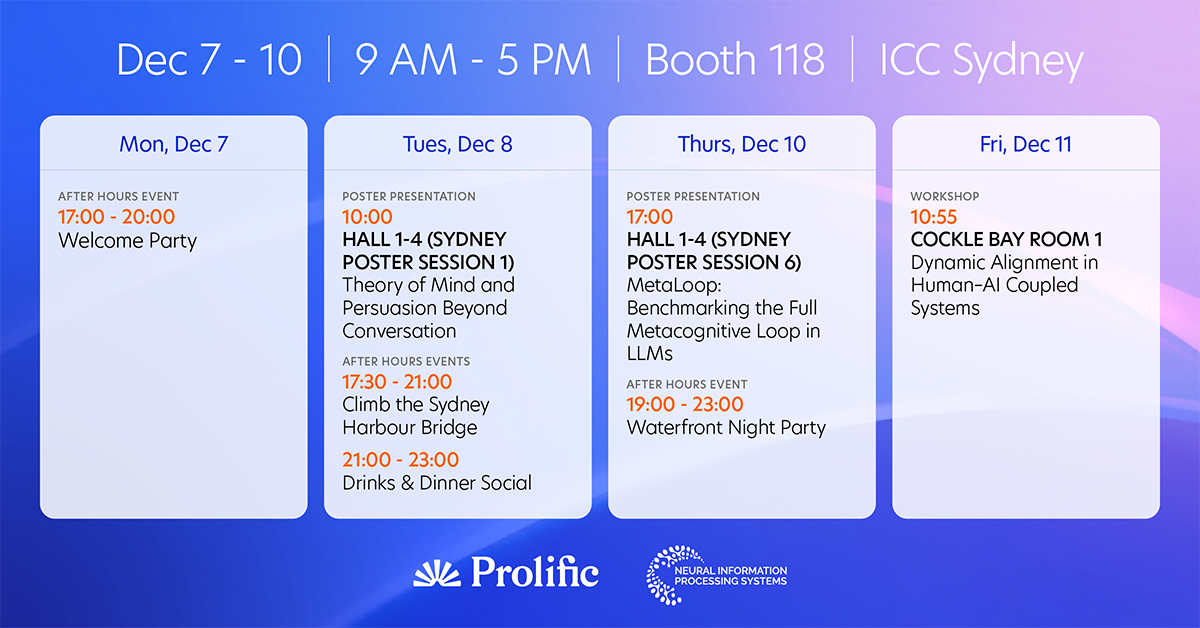
That’s one of the research topics we’ll be exploring at NeurIPS in Sydney, December 6–12, 2026. Our team has two papers accepted at the conference, including a collaboration with Cambridge and Google on how AI agents influence what others believe. You’ll find us at booth #118, and we’ll also be at the BiAlign workshop and hosting events during the week. If you’d like to catch up in Sydney, book an in-person meeting with us.
Here’s what we’ve been working on and where you can find us.
Knowing when to think again
When evaluating a model, you need to know how often it gets the answer right. But what happens when you ask it to judge its own work?
MetaLoop is a benchmark for testing how well AI models assess their own performance and use that judgment to guide their decisions. Our research with MetaLoop found that high-accuracy models routinely approved their own errors. Being good at the task didn’t predict how well a model could assess its performance.
The benchmark tests metacognition across seven tasks, with 12 frontier models and 460 human participants. It assesses whether a model uses its uncertainty estimates to guide decisions and revises its approach after receiving feedback. With this benchmark, researchers get a connected picture of each model’s performance across the loop.
Most models produced helpful confidence signals but struggled to act on them appropriately. Only one combined good calibration with rational wagering. In other words, estimating the chance of being right didn’t necessarily translate into sensible bets.
The human participants also had their own difficulties, tending towards loss aversion while models were overconfident. Being able to detect when a question needed clarification was a clear human advantage.
If you’re using confidence scores to decide when an agent should ask for help, the best bet is to test whether low confidence prompts the agent to seek clarification before answering.
How AI agents act to influence others’ beliefs
Most Theory of Mind benchmarks ask a model to read a story and answer questions about what the characters believe. Useful, certainly. But an agent working towards a goal also needs to account for how its actions change what others know.
The paper Theory of Mind and Persuasion Beyond Conversation, led by Ben Slater at the University of Cambridge with collaboration from Prolific’s John Burden and Google, tests whether models can plan and take actions to shape what other agents believe.
The framework, NCP-ExploreToM, gives models a target belief to produce in a simulated world. Models can move objects and direct characters between rooms, changing who sees what. Getting the object into the right room is only part of the job; the relevant character also needs the opportunity to observe it.
Tasks include second-order beliefs, where one character has a belief about what another character believes. Models may need to satisfy several goals at once, making it harder to plan an action without undoing something they’ve already achieved.
The study evaluated six models across 600 task instances, with a human comparison group. GPT-5 succeeded on roughly 80% of tasks in the agentic setting and was the only model to outperform the human participants. Its performance was still more sensitive to context, though. Changing the setting affected models more than people.
There’s another finding worth a closer look if you build evaluations. The researchers paired action-based tasks with question-and-answer (Q&A) versions, where models answered questions about characters’ beliefs instead of taking actions to influence them, to see how well performance carried across.
GPT-5 passed 74 false-belief tasks in the agentic setting while failing their Q&A equivalents. 62 went the other way. Similar overall scores can conceal quite different failures.
So a Q&A result won’t necessarily tell you how a model will perform when it has to act. Testing both formats lets you examine where that relationship holds up before relying on it in your own evaluation.
Joining the BiAlign workshop
We’ll also be presenting our paper, Mirroring Is Not Sycophancy, at the BiAlign workshop. This research finds that how closely a model mirrors a user’s writing style doesn’t necessarily predict whether it changes its answer when the user challenges it or pushes for agreement. An assistant can adopt someone’s tone without adopting their views.
This distinction helps when evaluating an assistant that adapts to its users. On its own, picking up someone’s way of speaking tells you little about whether the model will agree with them.
Join us for a deeper dive into the research at the BiAlign workshop on Friday, December 11 at 10:55 in Cockle Bay Room 1 (Sydney local time).
Find us at NeurIPS
If you’d like to discuss the research behind these papers, you’ll find the Prolific team at booth 18. We’d love to hear about what you’re currently working on as well. If you’re exploring how to compare model performance with human behavior, we’d be happy to discuss the participant sample your research needs.
We’ll also be running two poster sessions during the conference. Come along if you’d like to dive into the methods with the team, including how we scored the tasks and what the human comparisons tell us.
Theory of Mind and Persuasion Beyond Conversation: Tuesday, December 8 at 10:00 in Hall 1-4 (Sydney Poster Session 1).
MetaLoop: Thursday, December 10 at 17:00 in Hall 1-4 (Sydney Poster Session 6).
All times are Sydney local time.
Join us outside the conference
We’re making time to catch up outside the conference, too. Join us at one of our four events during the week. Spaces are limited, and registration is subject to host approval. Venue or meeting-point details will be shared after registration.
All times below are Sydney local time.
Rooftop welcome party
Join the Prolific team and fellow researchers for food and drinks overlooking Sydney. Our rooftop welcome party is a chance to catch up after the day’s sessions.
Monday, December 7, 5:00-8:00 PM.
Request a spot at the rooftop party
Sydney Harbour Bridge climb
Fancy joining us above the harbor? We’re heading up the Sydney Harbour Bridge for a guided sunset climb, followed by dinner and drinks. Wear comfortable shoes; lockers will be available for personal belongings.
Tuesday, December 8, 5:30-11:00 PM. Meet at 5:30 PM; your group’s departure time will be shared once your registration is approved.
Request a spot on the bridge climb
Drinks and dinner
Spend an evening with fellow AI researchers and technical leaders over dinner in The Rocks. Doors open for drinks at 9:00 PM, with dinner and an open bar from 9:30 PM.
Tuesday, December 8, 9:00-11:00 PM.
Waterfront night party
We’re teaming up with AI Circle for a party on the Sydney waterfront. Catch up with people you’ve met during the week over food and drinks, with music through the evening.
Thursday, December 10, 7:00-11:00 PM.
Request a spot at the waterfront party
See you in Sydney
We’d love to hear what you’re working on, so come and find us at booth #118 during the week. And if Sydney isn’t on your calendar this year, you can read more about the research on Prolific AI Research.