New poll reveals how Americans feel towards asylum seekers following Supreme Court ruling

On June 25th, the Supreme Court ruled 6-3 in Mullin v. Al Otro Lado that migrants waiting on the Mexican side of an official border crossing haven't legally "arrived" in the United States, and therefore aren't entitled to apply for asylum. Writing for the majority, Justice Alito drew a line between "arriving at" the border and "arriving in" the country; Justice Sotomayor, in dissent, argued that talking to a border agent at a legal crossing point is itself the first step of arrival.
The practical effect is to clear the way for the government to revive "metering," turning asylum seekers away at ports of entry before they're ever inspected. Metering was first used under the Obama administration, expanded nationwide under Trump's first term, and rescinded by Biden in 2021. This time, it comes with the Court's blessing.
Notice how narrow the ruling actually is. It applies to one specific group: people who are still on the Mexican side of an official crossing and are requesting entry. It says nothing about someone who has already crossed the border between checkpoints and is standing on US soil when an agent finds them. Legally, those are different questions.
At Prolific, we decided to field a survey the following week, 2–3 July, among 1,500 US adults. At its core, this was an experiment testing whether it's where someone is, or why they're fleeing, that actually drives whether Americans think they deserve a hearing.
Since the Court had already ruled, we added a second step. After respondents gave their initial answer, we described the real decision to them and asked again, to check something specific: do people change their minds once they've been told the Supreme Court has ruled on something?
What we did
Every respondent read about the same specific person, a 34-year-old woman from Guatemala asking for protection in the US. We randomly varied two things about her: where she was when she asked to start the asylum process, and why she was asking. That lets us separate whether attitudes toward asylum seekers depend on the reason, the location, or both. Specifically:
Where she is. Either she is waiting at an official border crossing on the Mexican side and has not entered the US, or she has already crossed between checkpoints and was found by agents shortly after entering US territory.
Why she is fleeing. Either she says she's fleeing political persecution, having received death threats after speaking out against corruption and gangs, or she says she's fleeing persecution over her gender identity, as a transgender woman who says Guatemalan authorities won't protect her.
Around 375 people saw each of the four versions, and nobody saw more than one. We asked whether they thought she should be allowed to start the asylum process (not whether she should get asylum, just whether her case should be heard). After they answered, we described the real Supreme Court ruling, accurately and in plain language, and asked the same question again about the same person.
Why someone is fleeing matters more than how they got here
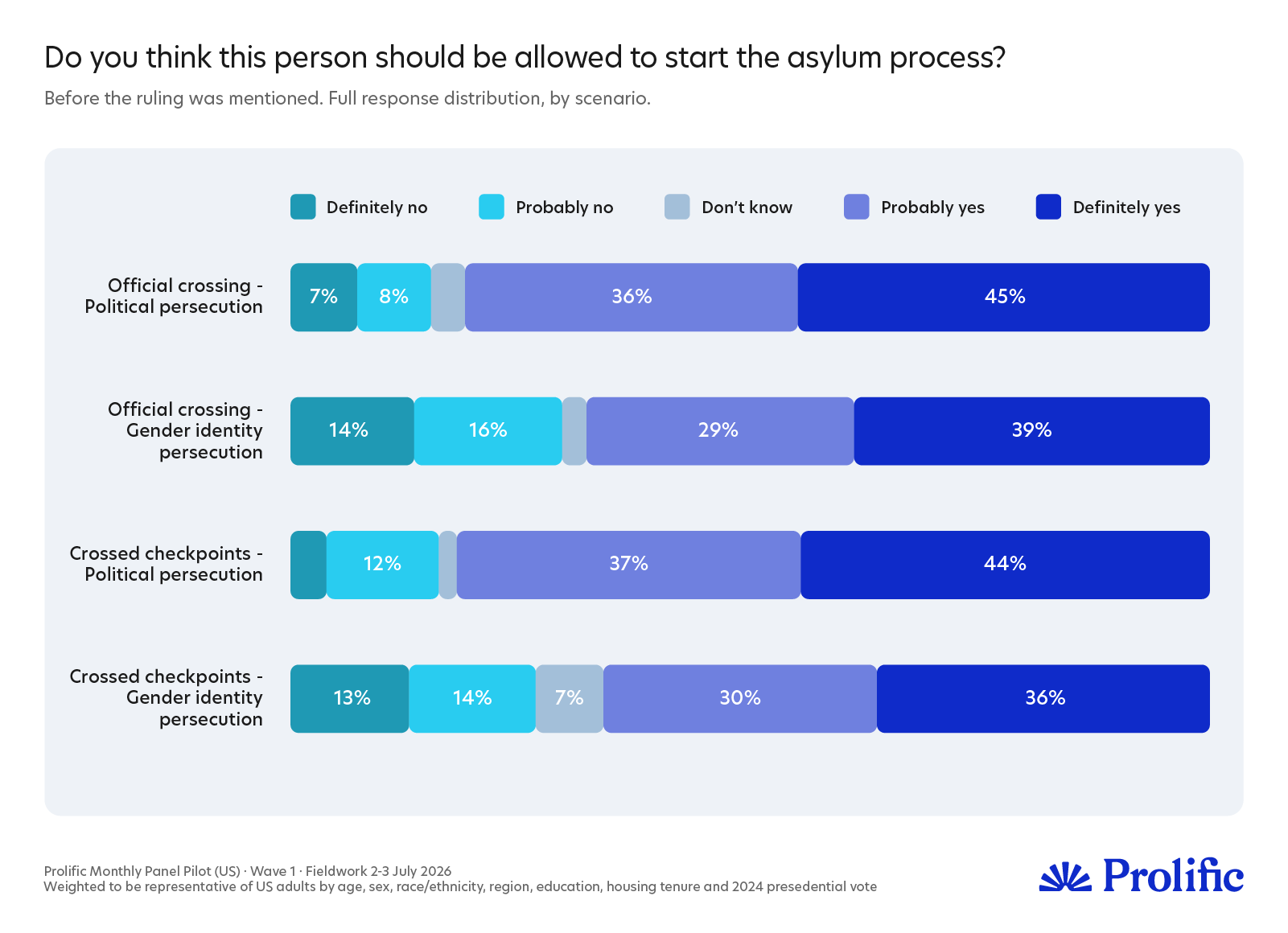
Before we mentioned the ruling at all, we asked people a simple question. Should this woman be allowed to start the asylum process? If public opinion followed the same logic as the law, where she's standing should matter quite a bit, but it didn't.
When she was fleeing political persecution, support was high and barely moved with her location. 80.9% said yes while she waited at an official crossing, and 81.8% said yes once she'd already crossed the border for the same reason.
Switch the reason to persecution over her gender identity, and support fell substantially, but again barely moved with location. 67.7% at an official crossing, 65.9% after already crossing.
Putting those two comparisons side by side, we can see that political persecution draws 14 to 16 points more support than gender-identity persecution, and that gap holds almost exactly regardless of her location. The variable on which the Supreme Court's ruling is actually built, location, barely changes anyone's mind. The reason for fleeing does. Before we'd even told people about the ruling, Americans were already answering a different question than the one the Court had just answered. Not where she is, but why she's running.
Republicans' support for asylum depends on why someone is fleeing
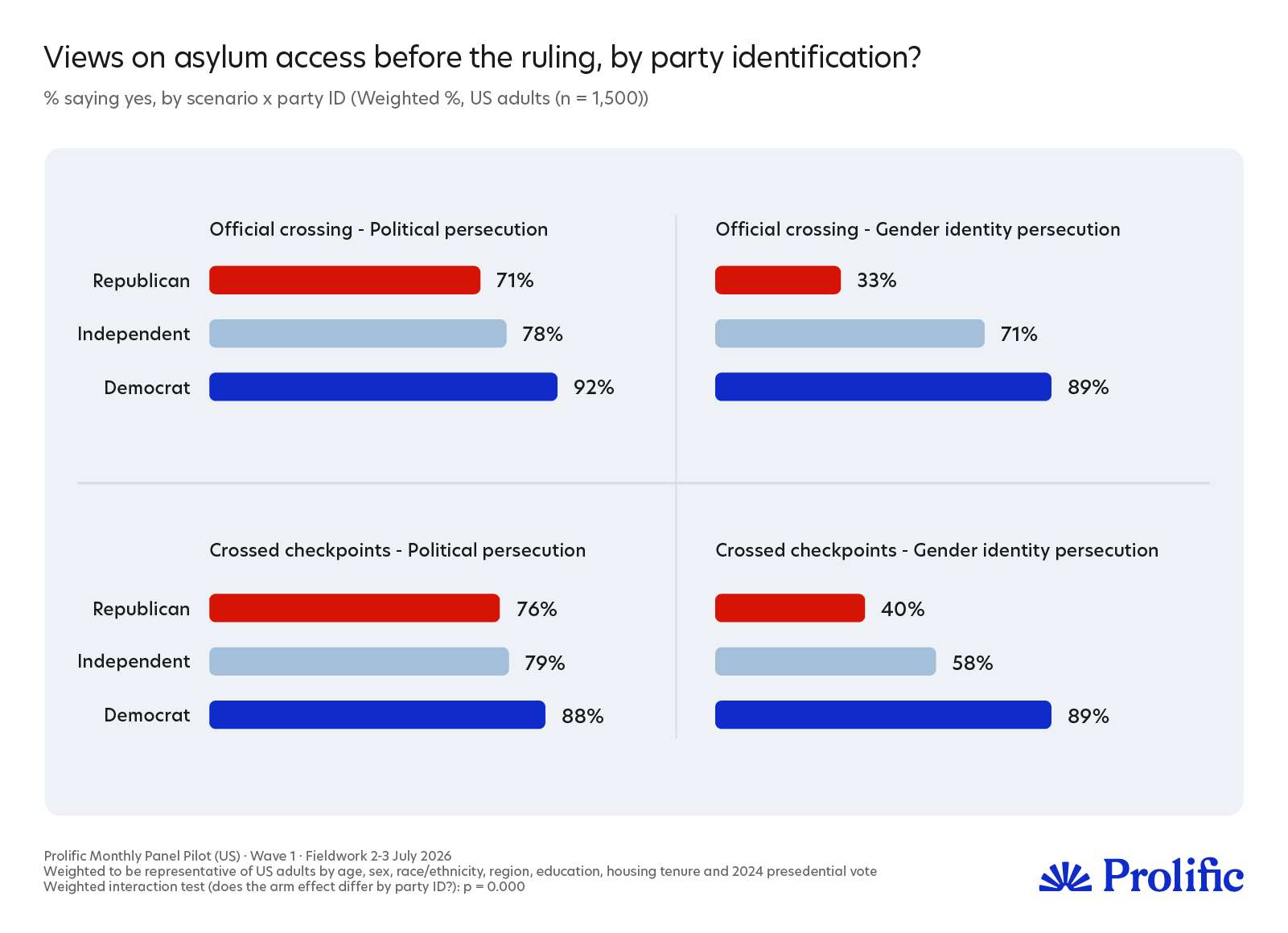
We also wanted to see whether this varied by party identification. It does, and in a pretty informative way.
For Democrats, support barely changes across scenarios; the difference here is bigger than sampling noise. Regardless of where the asylum seeker is, or why she's fleeing, around 90% of Democrats support her being able to start the asylum process.
Now look at Republicans, and it's a completely different story. If she's fleeing for political reasons, between 71% and 76% of Republicans say she should be allowed to start the process, regardless of where she is. But if she's fleeing because being transgender puts her at risk, support drops to 33% at an official crossing, and 40% after she's already crossed.
What about Independents? Do they sit closer to Democrats, closer to Republicans, or somewhere in between? It's a bit more complicated than that.
On political persecution, they're close to Republicans. 78% would let her start the process at an official crossing, almost identical to the 79% after she's crossed. On gender identity, Independents do something neither party does. At the official crossing, 71% support her, well above Republicans' 33% and close to Democrats.
But once she's already crossed the border, that falls to 58%, still a majority, but a 21-point drop from the 79% who'd support her in that same situation due to political persecution. Republicans, over that same shift, move slightly in the other direction, up from 33% to 40%. Independents are the only group whose answer depends on where the asylum seeker is, once the claim is about gender identity, and they move in the opposite direction from Republicans while doing it.
Put together, this isn't simply that Republicans are tougher on asylum across the board. It's that the parties agree almost entirely when the reason isn't part of the current political debate, and disagree sharply when it is. The party gap in this experiment is about how people feel about transgender people. Independents are the exception, as their answer depends on both the reason and the location, unlike anyone else's.
We described the ruling and support fell, even for the legal scenario
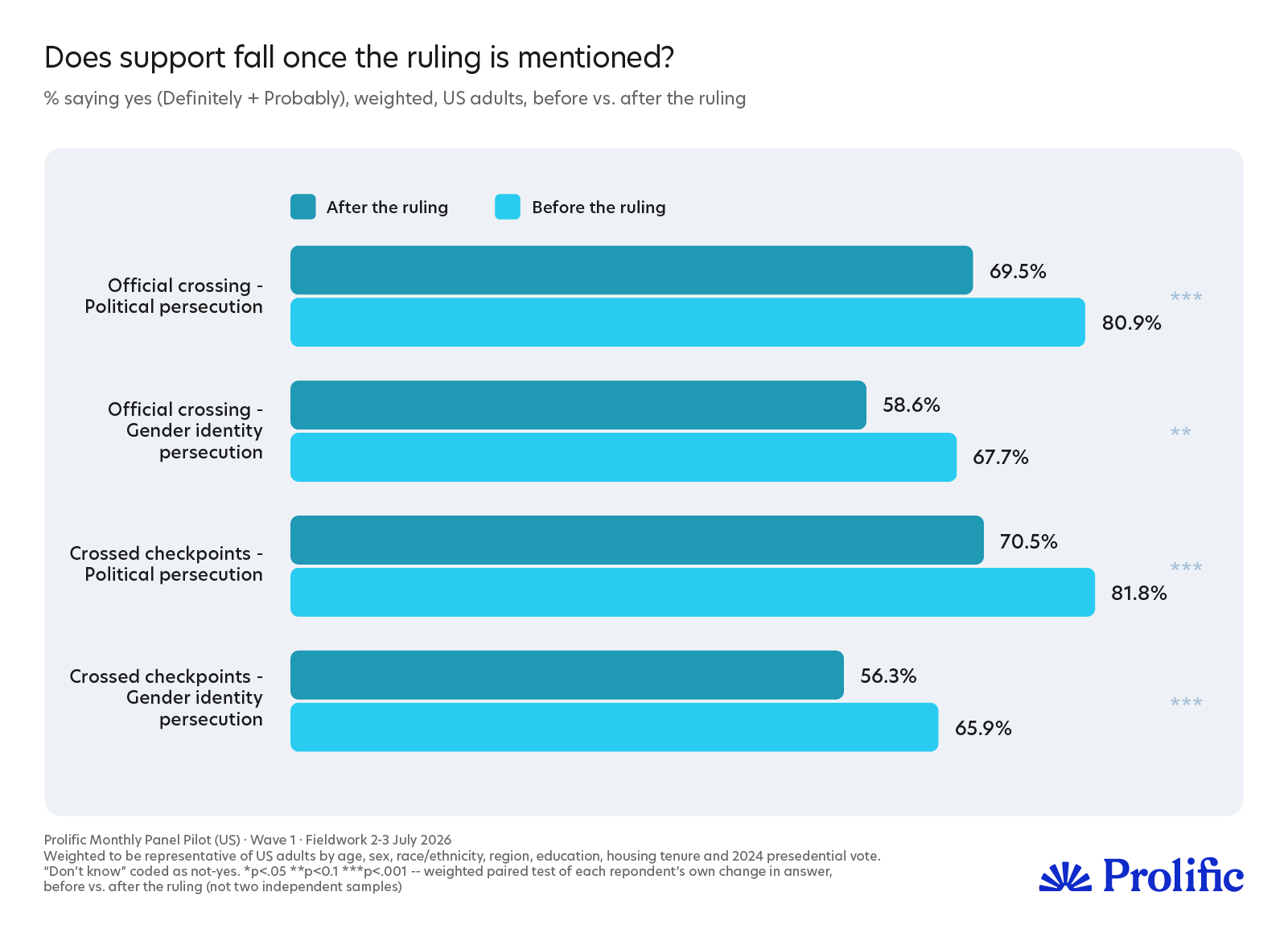
After answering the initial question, we explained the Supreme Court's ruling and asked again whether the same woman should be allowed to initiate the asylum process. We hypothesized that, for respondents shown the official-crossing scenarios, the ruling should push some people from 'yes' to 'no', since those are the cases it actually covers. For respondents shown the already-crossed scenarios, we expected the ruling to barely register, since, on paper, her situation isn't affected by it at all.
However, support fell across every scenario, not only those to which the ruling actually applies. Among the official-crossing scenarios, support for the woman fleeing political persecution dropped from 80.9% to 69.5% (down 11.4 points), and support for the woman fleeing gender-identity persecution dropped from 67.7% to 58.6% (down 9.1 points), exactly what we'd expected. But support for the woman who had already crossed the border fell by almost exactly as much: from 81.8% to 70.5% for political persecution (down 11.3 points), and from 65.9% to 56.3% for gender-identity persecution (down 9.6 points).
The ruling only applies to people still waiting at an official crossing. Someone who has already set foot in the US isn't covered by the "haven't arrived" logic at all; her situation remains, on paper, exactly as legally valid a basis for asylum as it was before the ruling. Yet opinion moved almost identically, a 9-to-11-point swing against her, regardless of whether the ruling had anything to do with her situation.
What explains that? One plausible reading is that people aren't treating the ruling as a narrow decision about who, under what circumstances, can start the asylum process. They're treating it as a signal that it's now acceptable to let people start the process at all. The ruling doesn't just carve out one legal exception; it puts turning people away back on the table as something the law permits. And once it's on the table, people seem to apply that logic well past the specific case it was written for.
The caveats
This is just one survey, with roughly 375 respondents reading each vignette. That's enough to detect a pattern as big and consistent as the one described above. It is not enough to be precise about any single subgroup number.
We also decided to make the scenarios more personal. Instead of asking vaguely about "an asylum seeker," we focused on one specific person that participants could picture. That makes the experiment feel more real and more human, but it also means the exact numbers depend on the choices we made, her age, gender, and country of origin. Ask about a different person, and people might well answer differently.
What’s key for this experiment isn't the precise level of support, which could shift for a different kind of asylum seeker, but whether that support changes depending on where she is and why she's fleeing. The experiment shows that where she is barely matters, but why she is fleeing does.
After presenting the case, we told respondents about the Supreme Court's ruling. The results justify that choice, the ruling does change people's opinion, and the experiment lets us quantify how much. But because the ruling we described was real, decided a week before we fielded, some respondents' "before" answer may already have been shaped by news coverage they'd seen before our survey ever mentioned it. Our before/after comparison measures the effect of us explaining the ruling on top of whatever people already knew, not the effect of the ruling existing in a world where nobody had heard of it yet.
Another fair objection to the before-and-after results is that this is just a measurement artifact. Maybe some respondents didn't register which scenario they'd read, and drifted along with whatever the ruling implied.
That's worth checking directly, so we did in two ways. Restricting the analysis to only respondents who could accurately recall which scenario they'd read (which was most of them), the drop in support barely changes, shifts of a point or two at most. And testing directly whether failing the attention check predicts someone's opinion, once you control for which scenario they saw, it doesn't. The effect is statistically indistinguishable from zero, both before and after the ruling. It holds up even once you restrict it to people who read the scenario correctly.
Do you want to use this data for reporting, academic work, or something else? Contact oriol.jover@prolific.com to discuss potential collaborations.
Methodology: Prolific surveyed 1,500 US adults on 2–3 July 2026 using quotas for age, sex, and region. Results for the headline (scenario-level) figures were weighted to the US adult population on age × sex, race/ethnicity, region, education × age, housing tenure, and 2024 presidential vote via ranking. The party-ID breakdown reported later in this piece uses unweighted models with demographic controls; see the methods note above for why. Respondents were randomly assigned to one of four experimental scenarios (n≈375 each) and read a single version before answering.
The four scenarios respondents read were:
Official crossing, political persecution: A 34-year-old woman from Guatemala traveled to the US-Mexico border and presented herself at an official border crossing, asking US border officials for protection. She is waiting on the Mexican side of the crossing. She has not entered the United States. She says she is fleeing because she received death threats after speaking publicly against corruption and the influence of criminal gangs in local politics. She says she cannot safely return to Guatemala.
Official crossing, gender identity persecution: A 34-year-old transgender woman from Guatemala traveled to the US-Mexico border and presented herself at an official border crossing, asking US border officials for protection. She is waiting on the Mexican side of the crossing. She has not entered the United States. She says she is fleeing because she is transgender and has received threats and harassment because of her gender identity. She says the authorities in Guatemala would not protect her, and she cannot safely return.
Already crossed, political persecution: A 34-year-old woman from Guatemala crossed the US-Mexico border between official checkpoints and was found by US border agents shortly after entering US territory. She told the agents that she wanted to apply for asylum in the United States. She says she is fleeing because she received death threats after speaking publicly against corruption and the influence of criminal gangs in local politics. She says she cannot safely return to Guatemala.
Already crossed, gender identity persecution: A 34-year-old transgender woman from Guatemala crossed the US-Mexico border between official checkpoints and was found by US border agents shortly after entering US territory. She told the agents that she wanted to apply for asylum in the United States. She says she is fleeing because she is transgender and has received threats and harassment because of her gender identity. She says the authorities in Guatemala would not protect her, and she cannot safely return.
After answering once, all respondents read the following before answering again: "In June 2026, the US Supreme Court ruled that people waiting on the Mexican side of an official border crossing have not legally 'arrived' in the United States for the purpose of applying for asylum. This means that the US government can turn people away at the border before they can start the asylum process, because legally they are not actually in the US."