Britain wants Thames Water nationalized, and it wants creditors not to be paid in full

Sometime around October, Thames Water is expected to run out of cash. The company serves roughly 16 million people across London and the South East, and it currently owes something around £19 billion. The government now has to decide what happens next.
The plan currently on the table comes from Thames Water's senior creditors. They would put in £3.35 billion of new equity, arrange a further £6.55 billion in debt, write off roughly £9.4 billion of what's currently owed, and commit to £20 billion of investment through 2030. Thames Water would stay in private hands.
Emma Reynolds, the environment secretary, has reportedly told the creditors this isn't good enough, calling it weak and pointing to "15 years of mismanagement and failure." If the plan is rejected, the fallback is a special administration regime, a government-appointed administrator running the company temporarily, technically distinct from nationalization, with an eye toward eventually selling it back to private owners.
Then there's the option ministers keep insisting isn't on the table: full public ownership. However, British Prime Minister Andy Burnham has been making the case for nationalization. "Public ownership is absolutely an option," he told the Guardian. "I would say for Thames Water, that is what should be done."
Some say that making this happen would be challenging. In particular, the Treasury's objection is straightforward: Thames Water's debt would land on the government's books, at a moment when the deficit is already running at about 4% of GDP. However, estimates of what full nationalization would cost the public finances are themselves contested, since there could be the option of not paying creditors all they are owed.
So there are, roughly, four live options: leave Thames Water with its creditors, put it under temporary public administration, nationalize it and pay creditors back in full, or nationalize without full compensation.
We wanted to know which option the public actually wants, and, because this is a Labour government making the call, which one would do Labour the most political good.
What we did
We surveyed 1,500 UK adults on 2 July, weighted to be representative by age, sex, region, education, housing tenure, and 2024 vote. Inside the survey, we included an experiment, where each respondent was randomly shown one of four short, neutrally worded descriptions of a government approach to Thames Water (you can see the full text at the end of the post):
- Private creditor-led rescue.
- Temporary public control.
- Public ownership with full creditor repayment.
- Public ownership with reduced creditor repayment.
We then asked whether they supported it, and whether it would make them more or less favorable toward Labour.
Roughly 375 people saw each version. No one saw more than one, which is the point. We're not asking people to compare options side by side; we're measuring how the same policy lands depending on how you frame it, and letting the random assignment do the comparing for us.
Britain wants nationalization
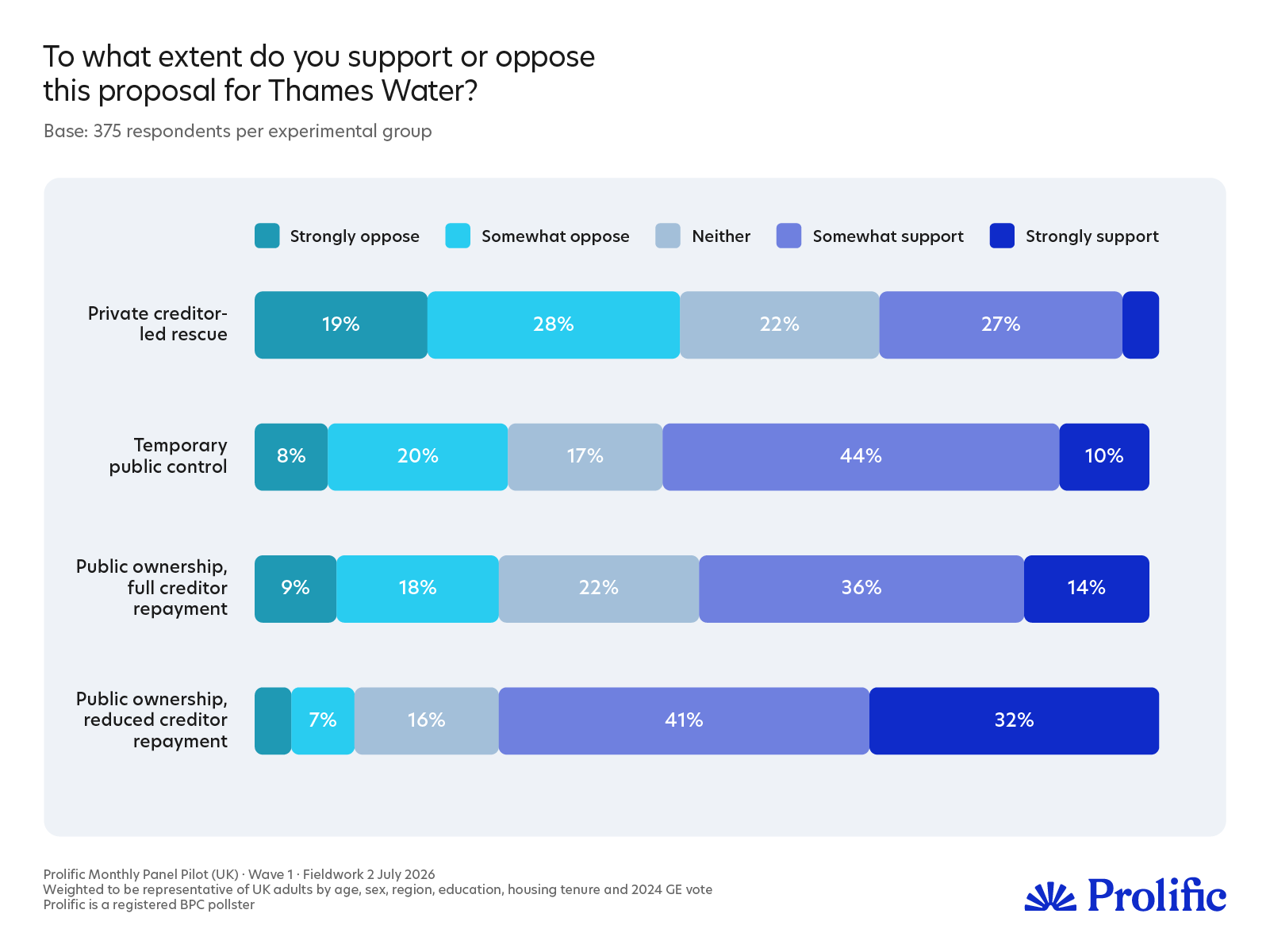
Let’s start with the creditor-led rescue, the option ministers are currently negotiating. Only around 31% of people who read that description supported it, while 47% opposed it. Every other option does better.
Both temporary public control and nationalization with full compensation get majority support (54% vs 50%). Nationalizing without paying creditors in full, however, is the clear public favorite: 73% support, with strong support alone (32%) beating the entire support base of the creditor-led rescue plan.
There is sometimes the assumption that the public might oppose measures that could scare markets, but they don't. If anything, respondents seem to read "creditors don't get their money back" as the point, not the cost.
Nationalization is popular and good for Labour specifically
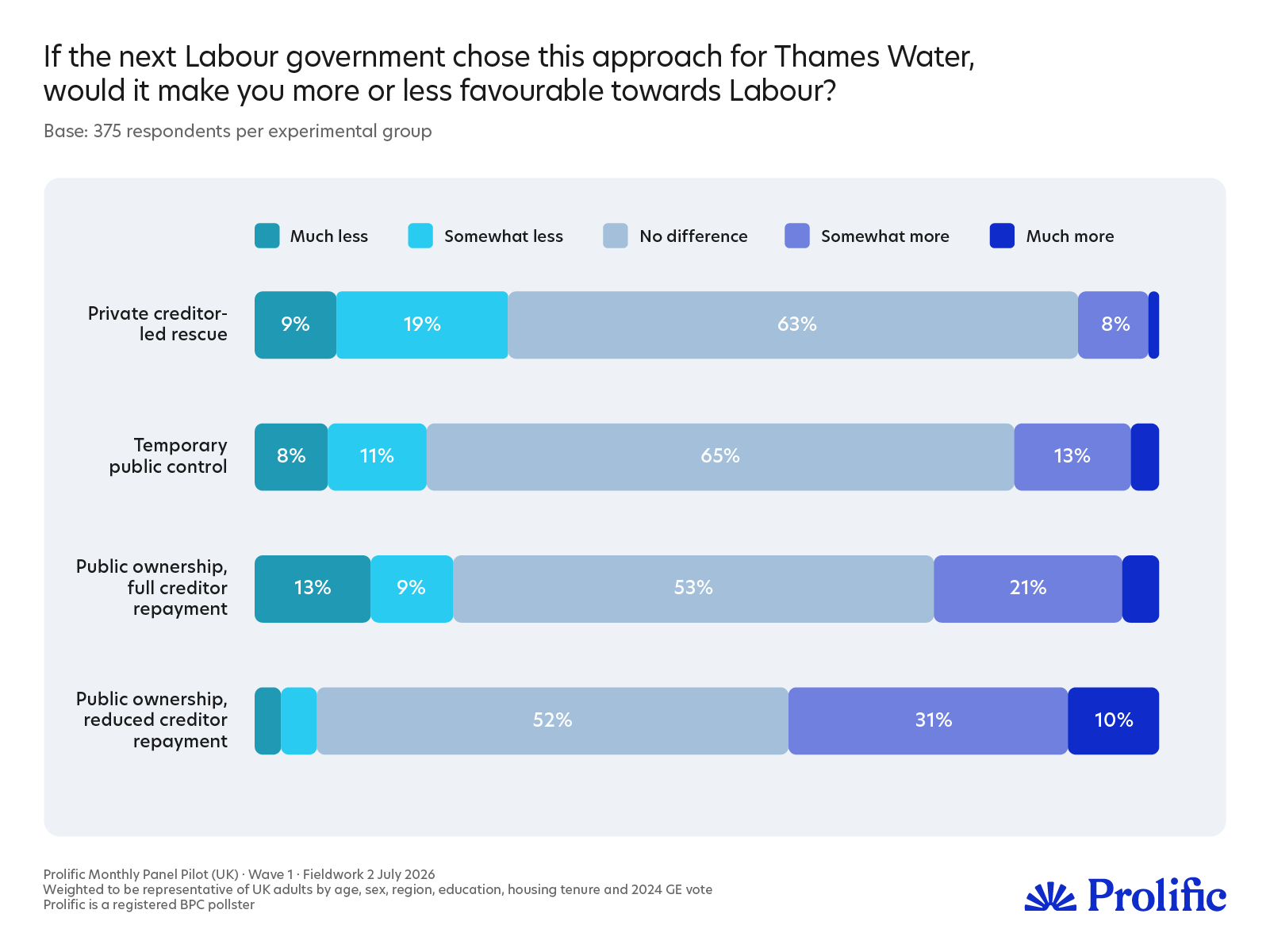
We also asked directly whether this would make people more or less favorable toward Labour. In every condition, most respondents say it would make no difference. But the more popular an approach is, the more likely it is to make people more favorable toward Labour too.
The creditor-led rescue would reduce Labour's favorability overall: 28% of Britons say they'd be less favorable toward Labour, against 9% more. Temporary public control is close to a wash, and full-compensation nationalization leaves similar shares more and less favorable. The only approach with a clearly positive effect on Labour's image is full nationalization with reduced creditor repayment; 41% more favorable, against 9% less.
When you put the two findings together, it becomes clear that Britain wants nationalization. And the tougher the government is on Thames Water's creditors, the more the public likes both the policy and the party proposing it. There's no trade-off between "popular" and "toughest." In these numbers, at least, they're the same option.
Nationalization is popular across the electorate
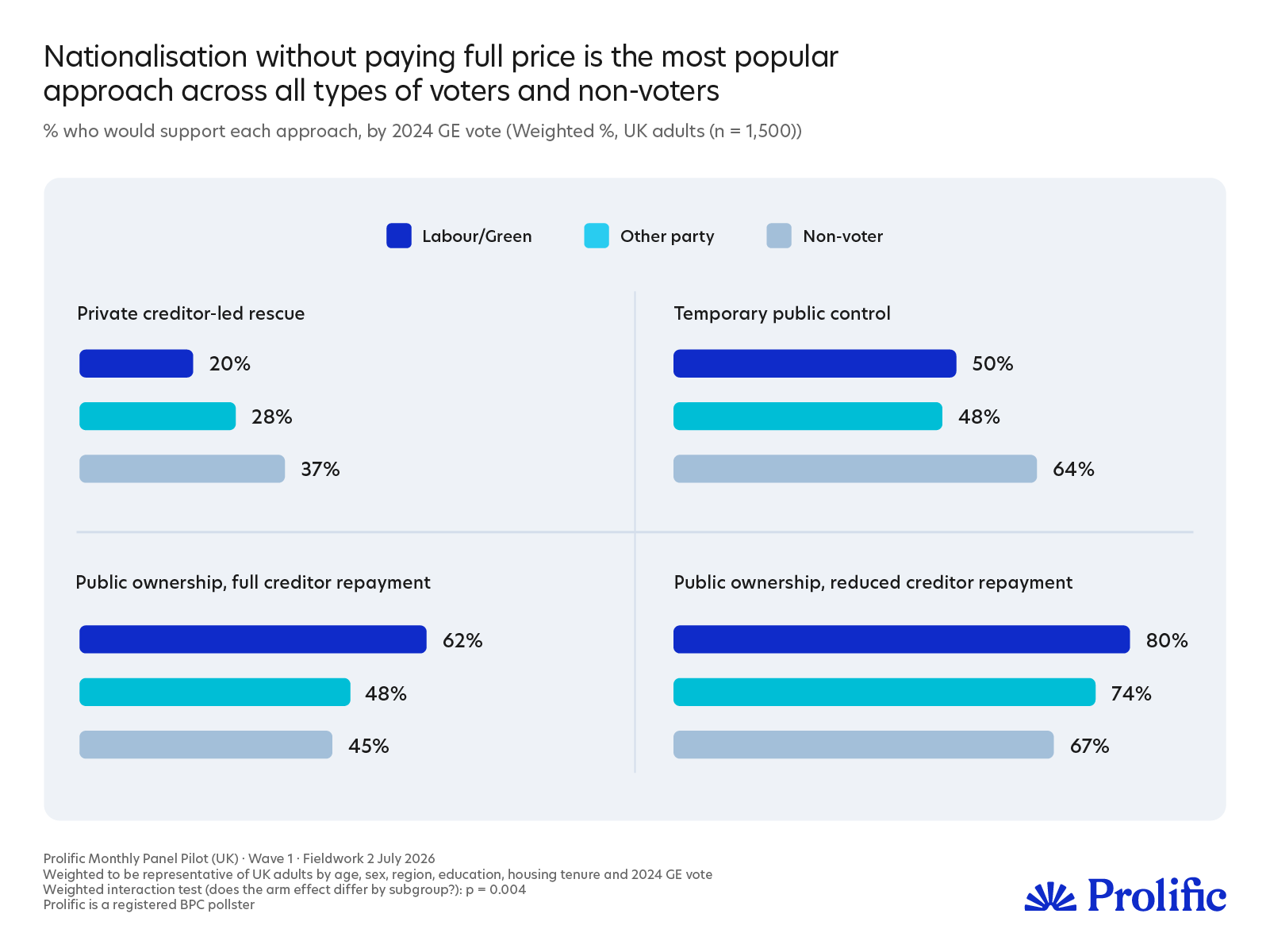
We also wanted to see whether this pattern holds outside Labour's obvious base, beyond people who voted Labour or Green in 2024.
You'd expect those who voted Labour or Green to warm to a policy that brings utilities back under public control, and they do. Support for reduced-compensation nationalization hits 80% among Labour/Green 2024 voters, and it's the option that swings favourability the most in this group (57% would see Labour more favorably, up from just 11% for the creditor-led rescue). A weighted interaction test confirms the arm effect really does differ by subgroup here (p = 0.021 for favourability, p = 0.004 for support).
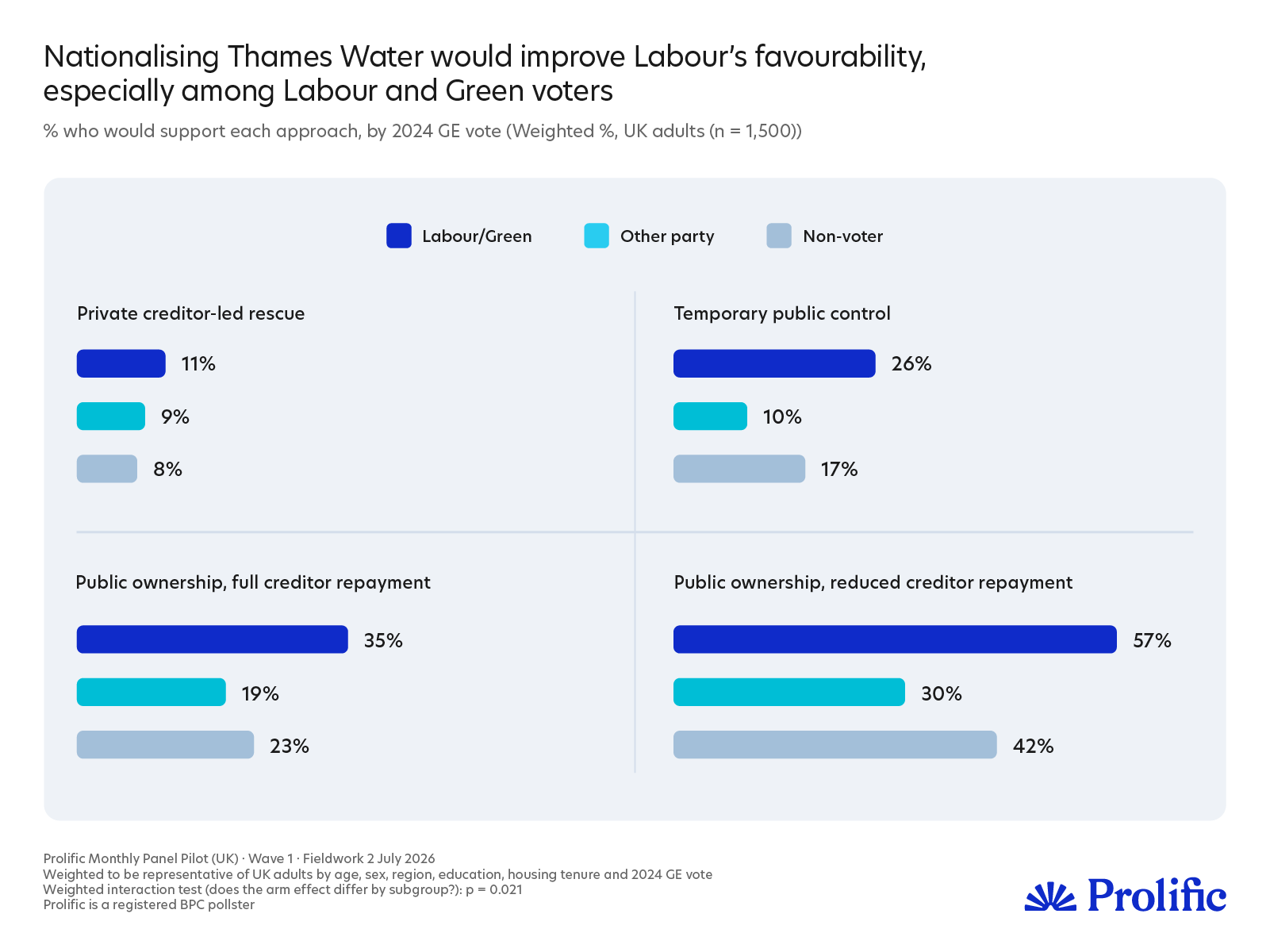
What's more interesting is that the pattern holds well beyond voters ideologically close to Labour. Among people who voted for someone other than Labour or the Greens in 2024, support for the toughest nationalization option is still 74%, and 30% would view Labour more favorably for doing it, nearly triple the 9-11% who'd say the same about the creditor-led rescue. Among those who did not vote, support reaches 67%, and the share seeing Labour more favorably jumps from 8% to 42%.
Play the Andy Burnham Simulator
Since Andy Burnham is set to become the next Prime Minister and will have to decide the future of Thames Water, we built something fun to go with this data: the Andy Burnham Simulator.
Imagine you're the one who has to decide what happens to Thames Water. Pick one of the four approaches above, and the tool shows you, from this same survey, how the public might react to your choice.
First, choose a policy: the creditor-led rescue, temporary public control, or one of the two nationalization options. Second, choose what you want to see: public support for the policy, or the effect on Labour's favourability. Third, you can break the results down by 2024 vote, sex, age, education, or housing tenure to see whether your chosen policy plays out differently with, say, homeowners versus renters or younger versus older voters.
The simulator then shows what the public might think of your chosen policy, and how it might affect Labour's favourability, based on our experiment. Break it down by a specific characteristic, say, sex or age, and it'll show how those numbers shift, for instance, whether men and women see the same policy differently.
Every number comes with a 95% confidence interval, shown as the dark bracket on each bar: that's the range the true value is most likely to fall within, given the sample size. Wider brackets mean less certainty; when two groups' brackets overlap heavily, treat any gap between them as suggestive rather than proven. Some breakdowns end up with fewer than 30 respondents in a cell; those are flagged and should be read with real caution rather than treated as solid numbers. The percentages also update against a baseline: the creditor-led rescue, since that's the closest thing to what's actually being negotiated right now, so every other option is shown against the status quo path.
Watch the video below to see how it works. You can play the Andy Burnham Simulator here.
The caveats
This is just one survey, with roughly 375 respondents reading each vignette. This is enough to detect the big, consistent pattern like the one we see above. However, it is not enough to be precise about any single subgroup number. On the positive side, results hold up across the different weighting approaches we tested, whether you look at raw, unweighted responses, individually weighted results, or a more conservative post-stratified estimate.
The scenarios were also deliberately generic, with no pound figures or creditor names, so respondents were reacting to the shape of each policy rather than specific details of the different options. Real-world coverage of the actual numbers could move opinion in either direction. And a hypothetical, low-salience question about a specific company isn't the same as a lived political moment. Telling a pollster you'd think better of Labour is cheaper than actually rewarding them at the ballot box eighteen months later.
Still, it's rare to see a policy option that is simultaneously the most popular choice on the merits, the best one for the governing party's image, and consistent across the electorate. That combination is the headline here, no matter how this actually gets resolved in Whitehall.
Do you want to use this data for reporting, academic work, or something else? Contact oriol.jover@prolific.com to discuss potential collaborations.
Methodology: Prolific surveyed 1,500 UK adults on 2 July 2026 using quotas for age, sex, and region. Results were weighted to the UK adult population on age, sex, region, education, housing tenure, and 2024 general election vote. Respondents were randomly assigned to one of four experimental groups (n≈375 each) and shown a single description of a government approach to Thames Water before answering. Prolific is a registered BPC pollster.
The specific scenarios we showed participants were the following:
Creditor-led rescue: The government is considering what to do with Thames Water. Some people are proposing that Thames Water should remain privately owned. Following this proposal, its senior creditors, organizations, and investment funds owed money by Thames Water, would take control of the company through a financial restructuring. The creditors would provide new funding to keep the company operating and would write off some of the debt they are owed. Thames Water would stay under private ownership. Supporters say this would bring in private money, reduce some of the company’s debts, and avoid the government having to borrow money up front. Critics say it could leave creditors with too much influence over an essential service, while not doing enough to protect customers, bills, or the environment.
Temporary public control: The government is considering what to do with Thames Water. Some people are proposing that the government should temporarily take control of Thames Water through a special administration process. A government-appointed administrator would run the company to make sure water and sewage services continue. Thames Water would not be permanently nationalized. The aim would be to stabilize the company, restructure its debts, and eventually transfer it to new private owners. Creditors would negotiate how much of the money they are owed they get back. Supporters say this would allow the government to step in quickly, protect essential services, and restructure the company without committing to permanent nationalization. Critics say it could still involve public costs while leaving open the possibility that Thames Water eventually returns to private ownership.
Public ownership, full creditor repayment: The government is considering what to do with Thames Water. Some people are proposing that the government should take Thames Water into permanent public ownership. The company would then be run by a publicly accountable body, with operating surpluses reinvested into infrastructure, environmental improvements, and customer bills rather than paid to private investors. Creditors would be repaid all the debt they are owed. This would require the government to cover Thames Water’s debts. Supporters say this would bring Thames Water permanently under public control while avoiding a dispute with creditors and investors. Critics say it would mean the government spending a large amount of money to repay creditors after a private company failed.
Public ownership, reduced creditor repayment: The government is considering what to do with Thames Water. Some people are proposing that the government should take Thames Water into permanent public ownership. The company would then be run by a publicly accountable body, with operating surpluses reinvested into infrastructure, environmental improvements, and customer bills rather than paid to private investors. Creditors would not be repaid in full. Parliament or an independent process would decide what counts as fair compensation, which would be less than what Thames Water owes to creditors. Supporters say this would bring Thames Water permanently under public control while making sure that investors bear some losses when a private company fails; critics argue this could affect the willingness of private companies to invest in UK infrastructure in the future.