Most Britons oppose large political donations. Reform voters see things differently.

In September, Reform UK received £72 million in donations from just two people, the largest individual donations ever made to a UK political party. The announcements renewed the debate about whether there should be limits on how much a single person can donate to a political party.
Under the current rules, there is no limit on how much an eligible individual can donate. Someone registered to vote in the UK can give as much as they want, even if they live abroad. The government has proposed a £100,000 annual cap on donations from overseas electors, including restrictions on people who have recently returned to the UK. But there would still be no general limit on donations from people living in the UK.
But what exactly do people object to when they oppose large political donations? Is it the amount of money, who is giving it, or which party receives it? These things are difficult to separate when asking about real donations. Someone might oppose the £36 million given to Reform because they think no individual should be allowed to give that much money, because of who the donors are, or simply because they don't like Reform.
We wanted to understand how much each factor matters. So we designed a survey experiment to separate the effects of the donation amount, who makes the donation, and which party receives it.
We wrote one sentence, then changed it 36 ways
To do this, we ran a survey experiment with 1,500 UK adults. Rather than asking people whether they supported political donations in general, we presented them with hypothetical donations and asked whether they thought each one should be legally allowed.
Each donation followed the same basic description:
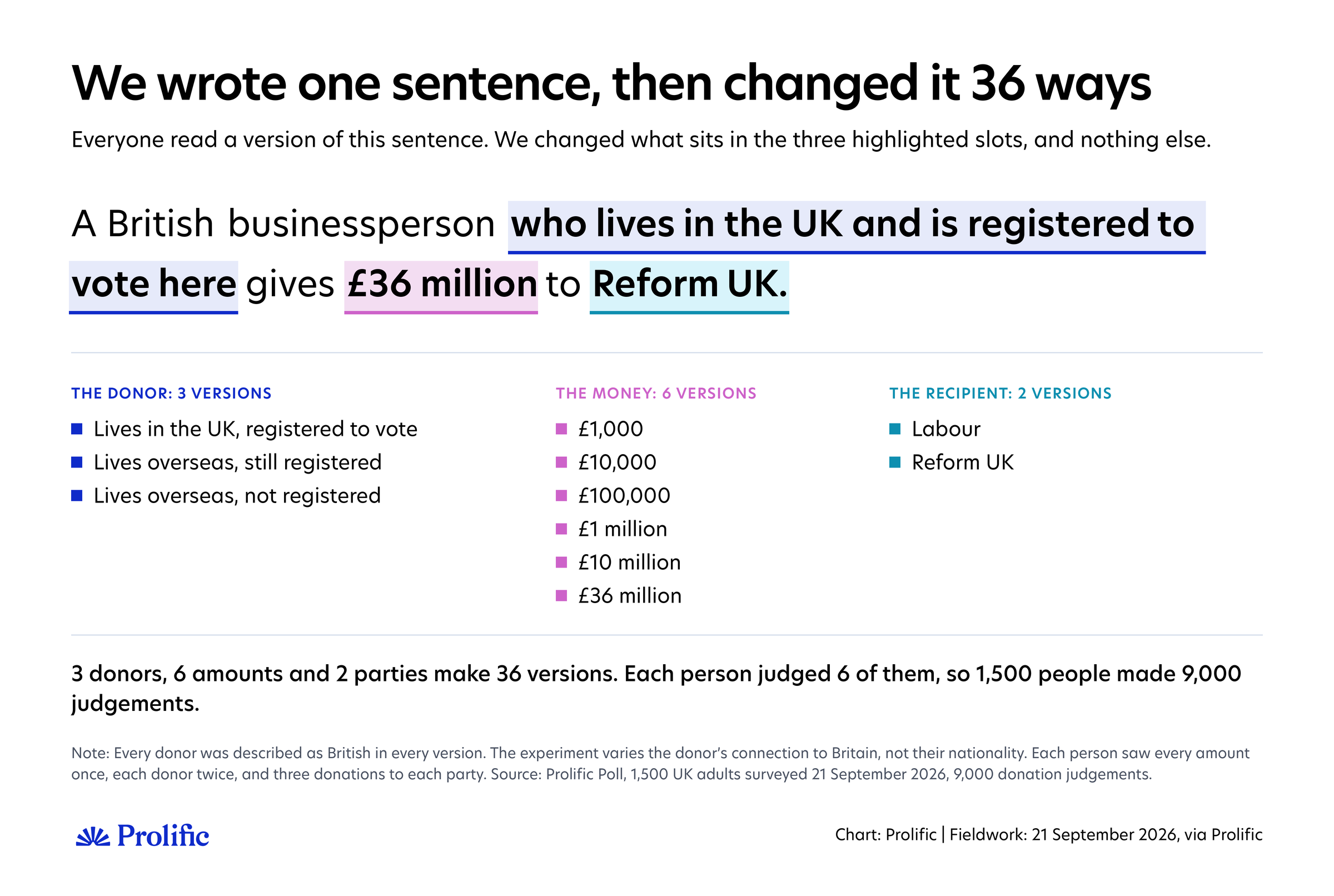
A British businessperson [who lives in the UK or overseas and is/is not registered to vote] gives [an amount between £1,000 and £36 million] to [Labour or Reform UK].
We varied three things. First, who was making the donation. The donor was always British, but could be living in the UK and registered to vote, living overseas and still registered to vote in the UK, or living overseas and no longer registered. Second, the donation amount: £1,000, £10,000, £100,000, £1 million, £10 million, or £36 million. Finally, the party receiving the money: Labour or Reform UK.
This gave us 36 possible combinations. Each respondent saw six of them and was asked the same question: should a political party legally be allowed to accept this donation?
We designed the experiment so that everyone saw all six amounts, each of the three donor types twice, and three donations to each party. We randomized the combinations and their order while maintaining this balance.
We wanted to understand what drives people's opposition to political donations, rather than simply how many people oppose them. If someone thinks a £1,000 donation should be allowed but a £36 million donation should not, we can observe that difference within the same respondent. And by varying the characteristics of the donor and the receiving party across the experiment, we can examine how much each factor influences people's answers.
In total, we collected 9,000 judgments from 1,500 people, allowing us to examine how the amount donated, the donor's characteristics, and the receiving party independently affect people's attitudes towards political donations.
The whole experiment in one picture
Let's start with the overall results.
The chart in this section shows the percentage of respondents who thought each type of donation should be legally allowed. Each box represents a different combination of donation amount and donor characteristics. Moving from left to right, the amount donated increases. Moving from top to bottom, the donor has a weaker connection to the UK.
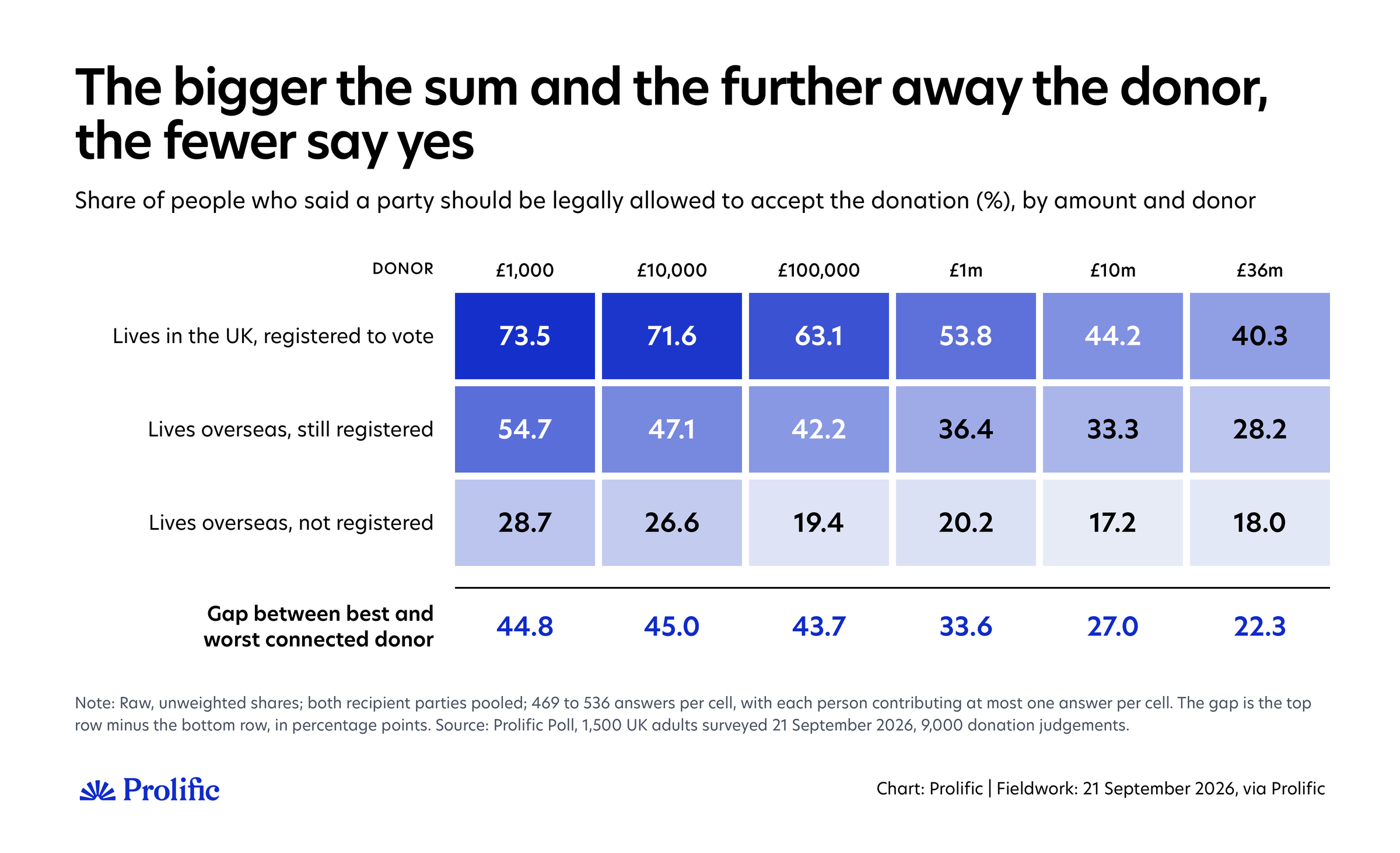
Two patterns stand out. People are less likely to support large donations, particularly when they come from donors living overseas. For example, 73.5% of respondents thought a £1,000 donation from someone living and registered to vote in the UK should be allowed. But that figure drops to just 18.0% for a £36 million donation from a British citizen living overseas who is no longer registered to vote.
These differences are substantial, but they don't tell us exactly what is driving them. Is the lower support for the second donation mainly because of the amount, because the donor lives overseas, or because they are not registered to vote?
To answer that, we need to look at each factor separately.
How to read the results
The chart above shows the percentage of respondents who thought each type of donation should be allowed. From here, we're interested in something slightly different: how much acceptance changes when we vary one characteristic of the donation while accounting for the others.
For example, if we say that acceptance falls by 17 percentage points, we mean that changing one characteristic is associated with a 17-point reduction in the percentage who would allow the donation, holding the other characteristics constant. Because respondents evaluated multiple scenarios and we randomized their characteristics, we can estimate the effect of each factor separately.
How much does the amount donated matter?
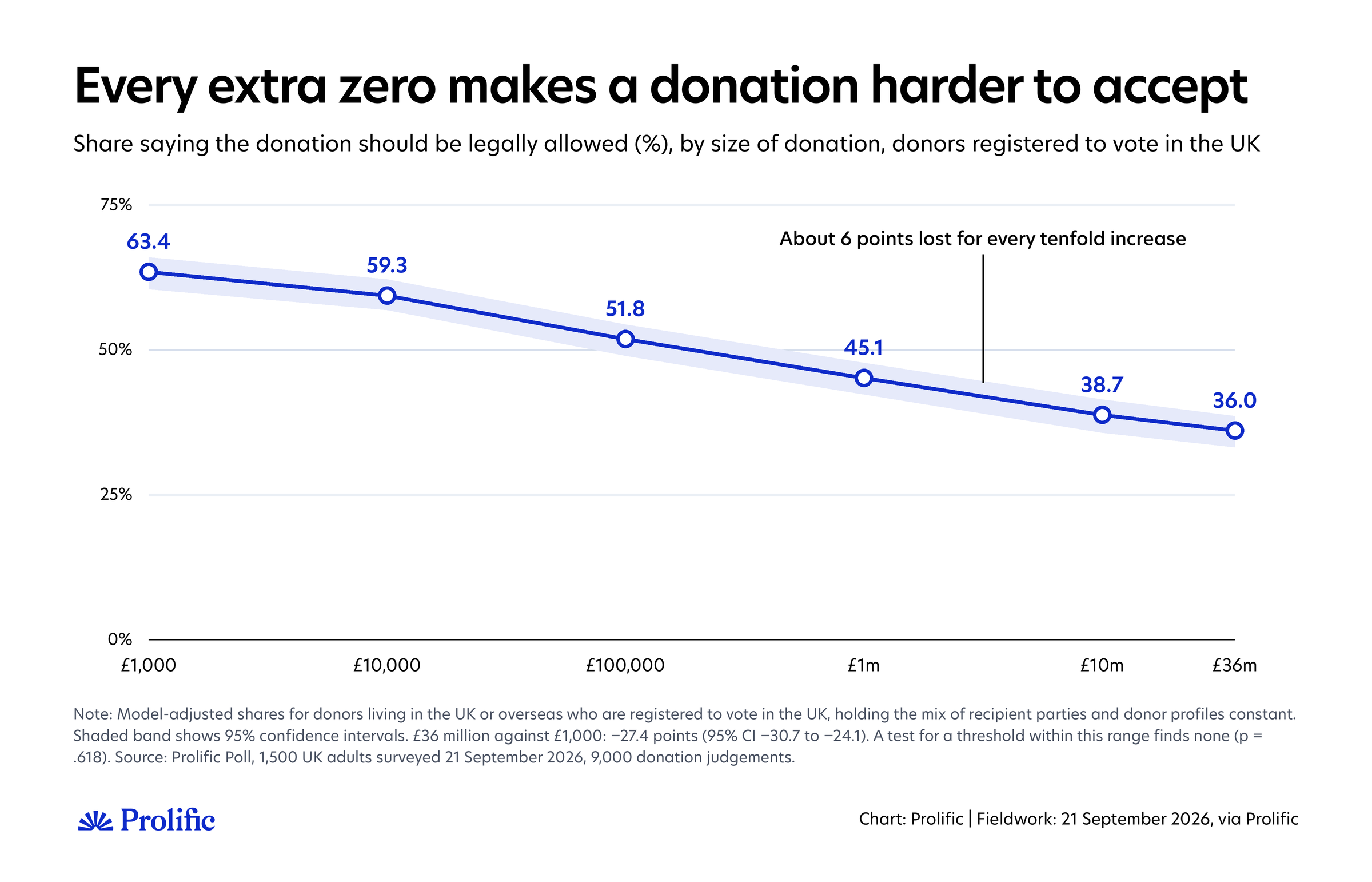
Let's start with the donation amount. Looking at donations from British donors who were registered to vote, whether they lived in the UK or overseas, we find a clear pattern: the larger the donation, the less likely people are to think it should be allowed.
At £1,000, 63% of respondents thought the donation should be allowed. This falls to 52% at £100,000, 45% at £1 million, and just 36% at £36 million.
The difference between the smallest and largest donations is 27 percentage points (95% CI: 24.1 to 30.7). The decline is relatively consistent as the amounts increase. On average, acceptance falls by around six percentage points every time the donation increases tenfold.
This suggests that people are not necessarily drawing a clear line between acceptable and unacceptable donations at a particular amount. Instead, support declines progressively as donations get larger, without an obvious threshold at which attitudes suddenly change.
How much does the donor's connection to the UK matter?
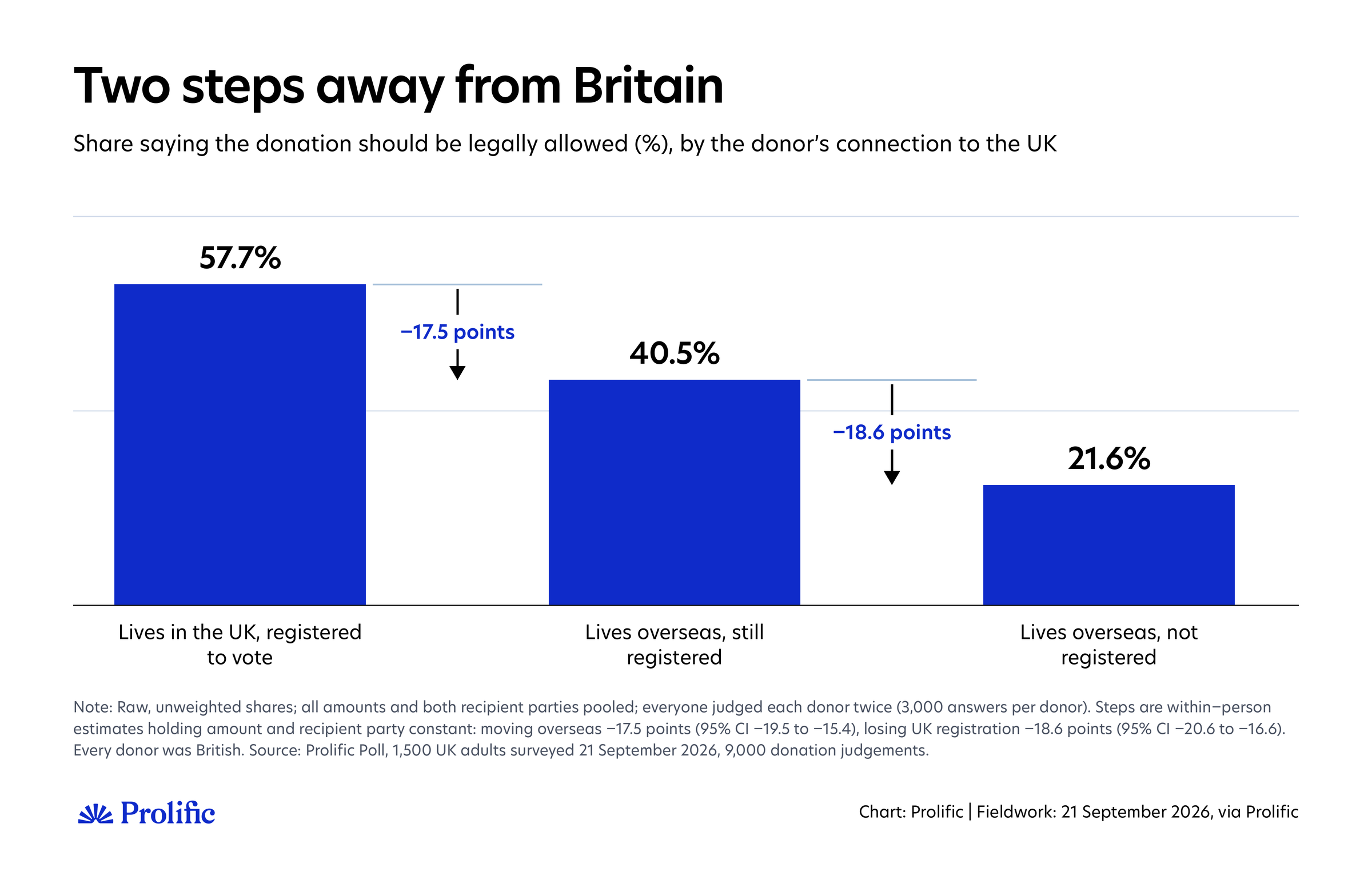
Next, we look at who is making the donation, holding the amount of money constant. In all three scenarios, the donor is a British citizen. What changes is whether they live in the UK or overseas, and whether they are registered to vote.
When the donor lives in the UK and is registered to vote, 58% of respondents think the donation should be allowed. This falls to 41% when the donor lives overseas but remains registered to vote in the UK, and to just 22% when they live overseas and are no longer registered.
Both factors seem to matter substantially. Moving a registered donor from the UK to overseas reduces acceptance by around 17 percentage points (95% CI: 15.4 to 19.5). Removing their UK voter registration reduces it by a further 19 points (95% CI: 16.6 to 20.7).
This suggests that people distinguish between living abroad and no longer being registered to vote. Both characteristics independently reduce how acceptable a political donation is perceived to be.
Do voters from different parties see donations differently?
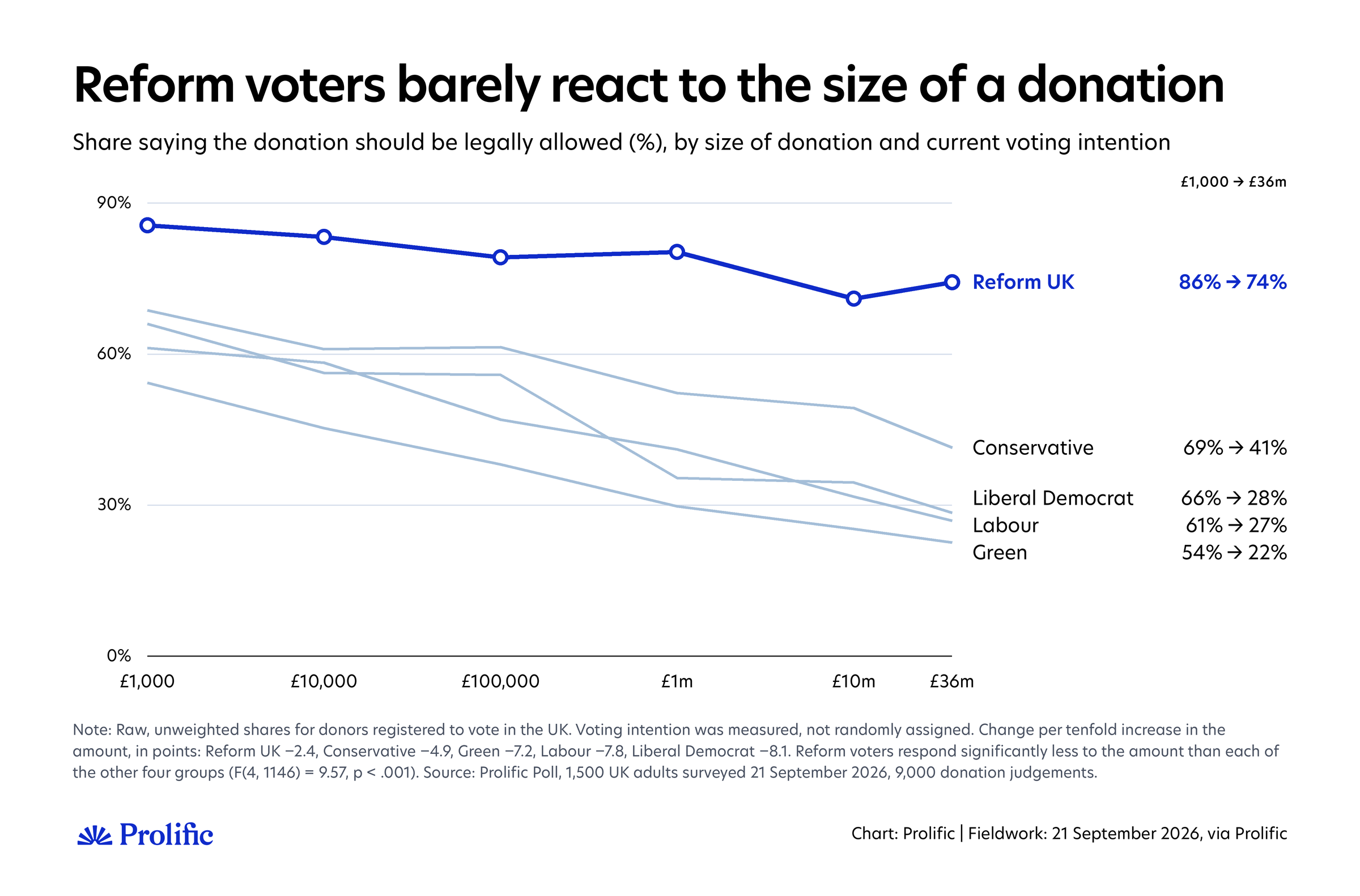
So far, we've looked at what Britons think about political donations overall. But do these attitudes differ by party?
Let's start with donation amounts. Among Labour, Conservative, Liberal Democrat, and Green voters, we find a similar pattern: acceptance declines substantially as donations get larger. Labour voters go from 61% accepting a £1,000 donation to just 27% accepting £36 million. Liberal Democrats go from 66% to 28%, Greens from 54% to 23%, and Conservatives from 69% to 41%.
Reform voters, however, are much more accepting of large donations. At £1,000, 86% think the donation should be allowed. At £36 million, that figure is still 74%. In other words, even when the amount increases by a factor of 36,000, acceptance falls by just 12 percentage points. Reform voters show the smallest decline of any of the five groups, and we find statistically significant differences between voter groups in how they respond to the amount donated (F(4, 1146) = 9.57, p < .001).
Does this mean Reform voters are simply less concerned about political donations? Not quite. When we look at who is making the donation, we find a more interesting pattern.
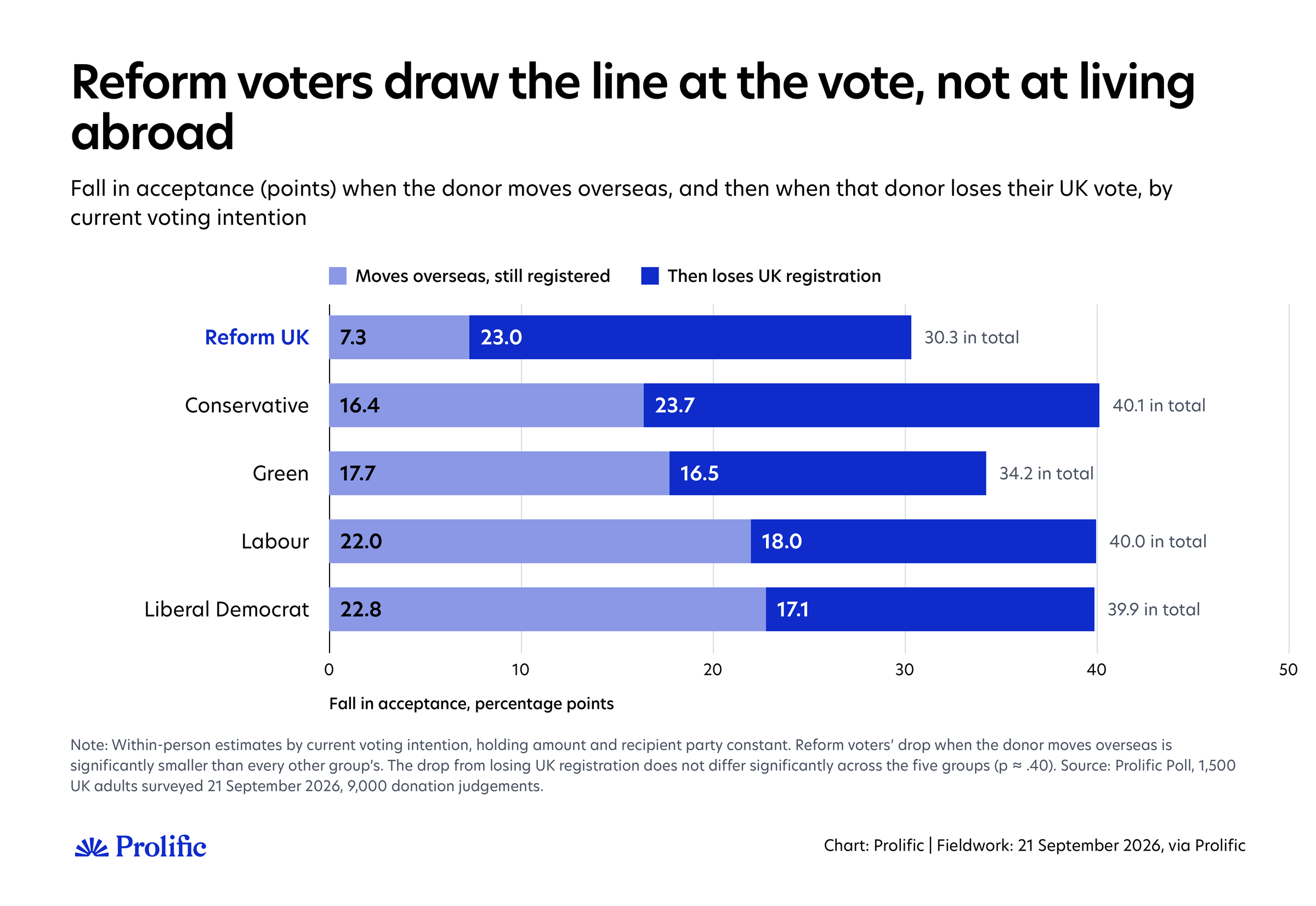
Among Reform voters, moving a donor from the UK to overseas, while keeping them registered to vote in the UK, reduces acceptance from around 83% to 75%. In the adjusted comparison, this is a decline of 7.3 percentage points, compared with reductions of between 16 and 23 points among voters of the other four parties.
But when the overseas donor is no longer registered to vote in the UK, Reform voters react much more strongly. Acceptance falls from 75% to 52%, a 23-point drop. This is very similar to what we find among voters of the other parties, where the decline ranges from 17 to 24 points. In fact, we find no statistically significant differences between the five voter groups in how they respond to this change (p ≈ .40).
This is an important distinction. Reform voters are considerably more accepting of large donations and less concerned about whether a donor lives overseas. But they do care about whether that donor is still registered to vote in the UK. For them, electoral registration appears to matter much more than residence. Other voters, by contrast, are substantially less accepting of donations as soon as the donor moves abroad, even if they retain their right to vote.
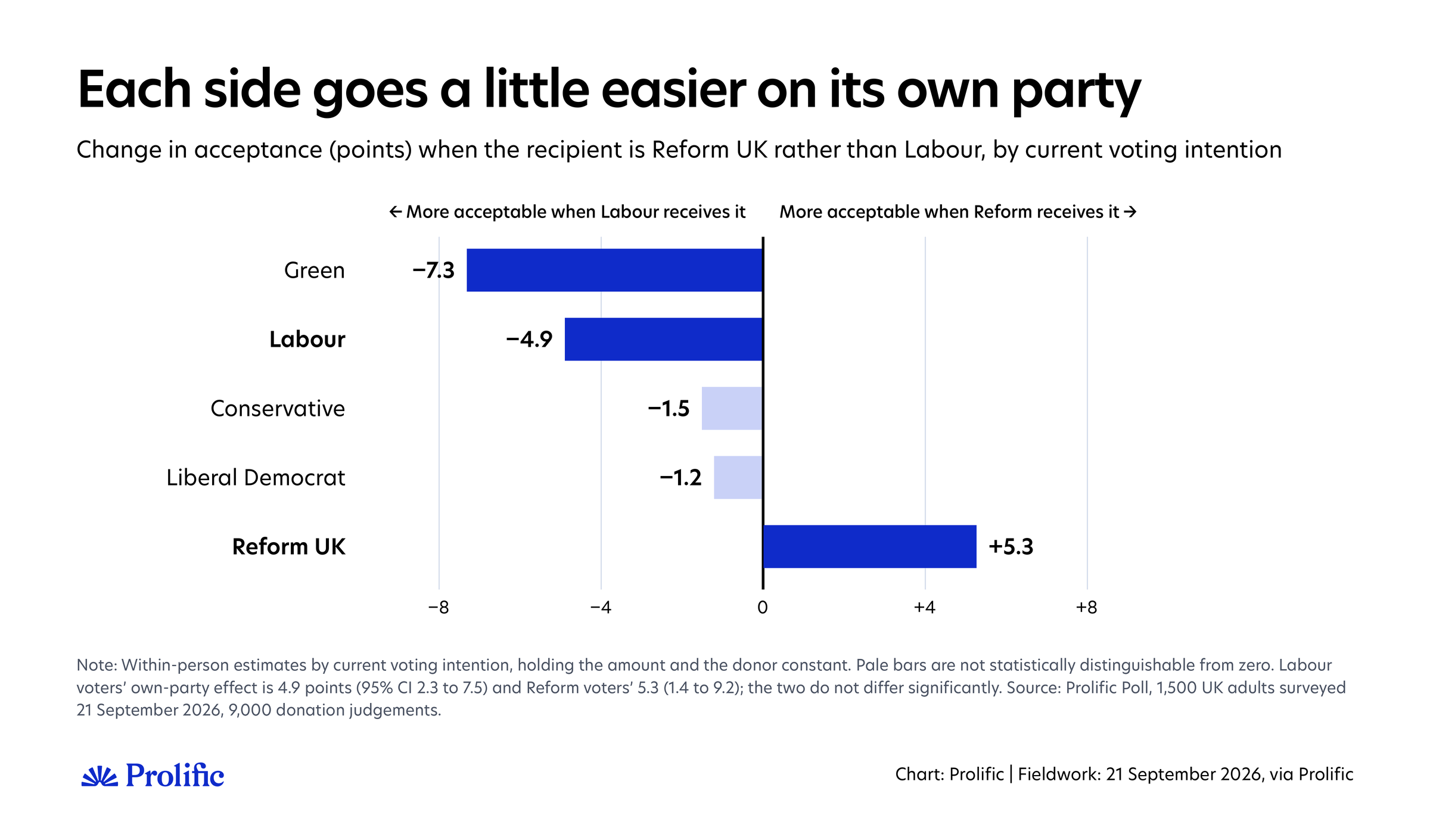
Finally, we looked at whether attitudes change depending on which political party receives the donation.
Here, Reform voters are not particularly different from Labour voters. Reform voters were 5.3 percentage points more likely to accept a donation when it went to Reform rather than Labour. Among Labour voters, we find almost the exact opposite: they were 4.9 points more likely to accept a donation when Labour was the recipient. We found no statistically significant difference between these two effects.
The largest effect of the receiving party comes from Green voters. They were 7.3 percentage points less likely to accept a donation when it went to Reform rather than Labour, despite neither being the party they support.
So while Reform voters stand out in their attitudes towards donation amounts and donors living overseas, we find little evidence that they are more influenced by which party receives the money than Labour voters are.
Most Britons support a cap on political donations, but fewer support increasing public funding
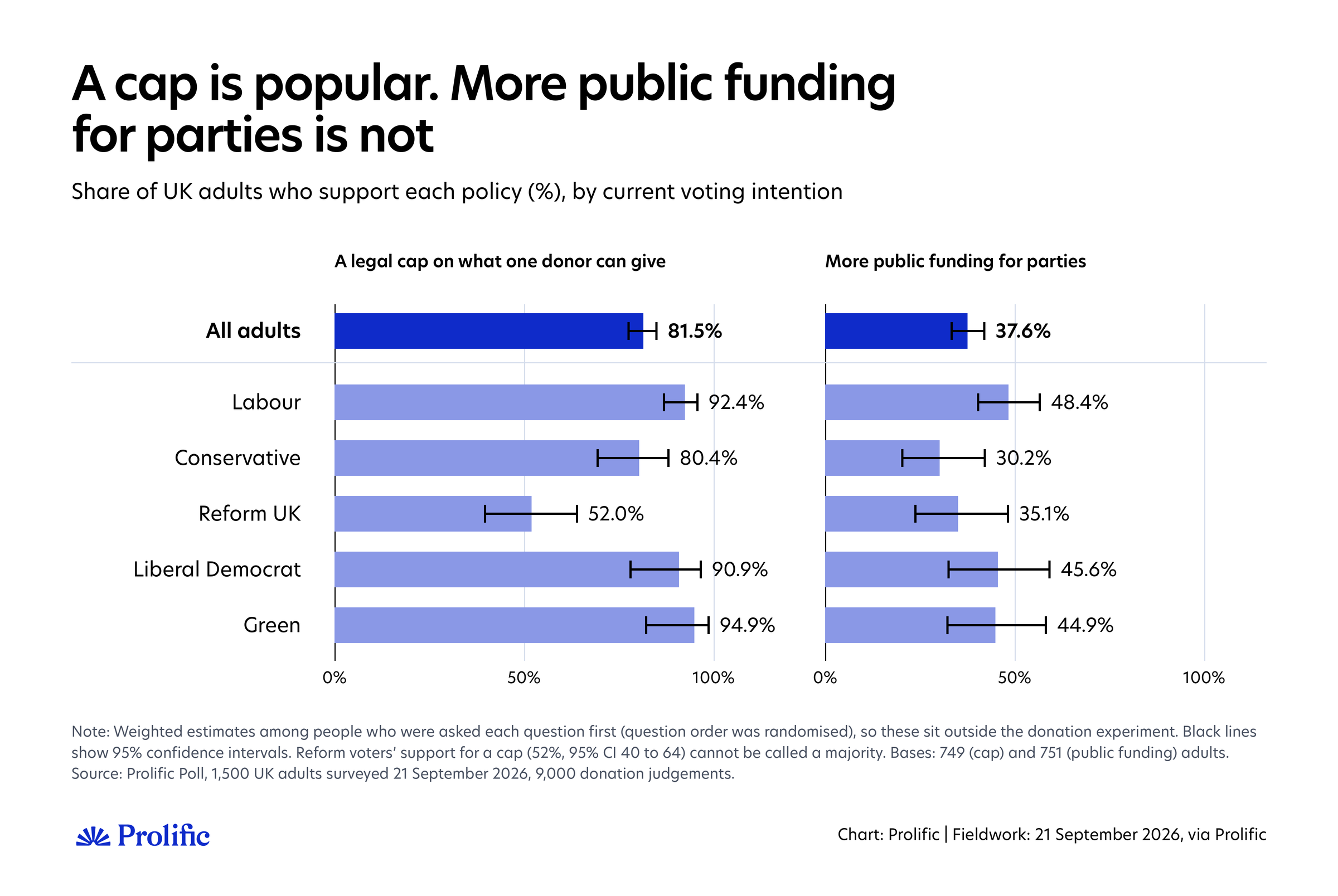
Finally, we asked respondents directly about two possible changes to how political parties are funded: introducing a legal cap on donations and increasing public funding to reduce parties' reliance on large private donors.
We randomized the order of these questions. To avoid any potential influence from the other question, we focus here on the responses from those who saw each question first.
We find overwhelming support for introducing a legal cap on how much an individual or organization can donate to a political party. Overall, 81% of Britons support this measure. Support is particularly high among Labour, Liberal Democrat, and Green voters, at close to 90%, and also reaches around 80% among Conservatives.
Reform voters are again the exception. Around half support introducing a cap, considerably fewer than among voters of the other parties. However, uncertainty is higher (95% CI: 40% to 64%), so we cannot confidently say whether a majority of Reform voters support the measure.
But what about increasing public funding for political parties, so that they depend less on large private donations?
Here, we find a very different picture. Only 38% of Britons support increasing public funding, and support does not reach a majority among voters of any of the five parties, including those most supportive of introducing donation caps.
This raises an interesting question. A large majority of Britons want limits on how much wealthy individuals and organizations can donate to political parties, but far fewer support increasing public funding to compensate for the loss of private donations. In other words, there is considerable agreement on limiting donations, but much less on how political parties should be funded instead.
What does this tell us about how Britons think about political donations?
Our results suggest that three factors influence whether people think a political donation should be legally allowed, although some matter much more than others.
First, the amount donated. The larger the donation, the less likely people are to think it should be allowed. We find no obvious threshold at which acceptance suddenly drops. Instead, it declines relatively consistently as donations increase, from £1,000 to £36 million.
Second, and even more importantly, who is making the donation. People are substantially less accepting of donations from British citizens living overseas, even if they are still registered to vote in the UK. And acceptance falls further when the donor is no longer registered. In fact, the difference between donors living and registered in the UK and those living overseas without a UK vote is larger than the difference between the smallest and largest donations we tested.
Third, whether Labour or Reform receives the money. This matters much less than the other two factors. Labour and Reform voters are around five percentage points more likely to accept donations to their own party, but we find little evidence that either group is more partisan than the other in this respect.
Perhaps the most interesting finding, from a political perspective, is how differently Reform voters think about political donations. They are much more accepting of large donations than voters of other parties, with 74% still willing to allow a £36 million donation. They are also considerably less concerned about whether the donor lives overseas. But this changes when the donor is no longer registered to vote in the UK. On that question, their response is much more similar to what we observe among voters of the other parties.
This distinction is particularly relevant to the debate surrounding Reform's £72 million in donations. While most voters become considerably less accepting as donations grow, Reform voters appear to place much less importance on the amount. Instead, whether the donor is still part of the UK electorate seems to matter much more to them.
Finally, our results reveal an interesting tension around regulating political donations. A large majority of Britons, 81%, support introducing a legal cap on donations. But only 38% support increasing public funding to reduce parties' dependence on large private donors.
There seems to be considerable agreement that political donations should be limited, but much less agreement on how political parties should fund themselves if those limits are introduced.
How we ran the survey
The experimental estimates in this piece, covering the amount, the donor, and the recipient party, compare each respondent with themselves across their six donations, using models with respondent fixed effects and standard errors clustered by respondent. Because the comparisons come from randomization within each person, they are unweighted. Rerunning the same models with survey weights barely moves anything: the per-tenfold amount effect, for instance, shifts from 6.3 points to 5.9.
The two policy questions are different in kind. They are ordinary weighted survey estimates, calibrated to the UK adult population on age and sex, region, education by age, housing tenure and 2024 general election vote.
We also asked, separately, whether the party itself should accept each donation regardless of legality. That question agreed with the legal one in 95% of cases and reproduced the same pattern throughout: lower acceptance of larger amounts, lower acceptance of less connected donors, and a small own-party advantage. Reassuring, though we would treat it as a replication rather than an independent finding, since the same people answered both sets of scenarios.
The comparisons between voter groups deserve more caution than the rest. Voting intention was measured, not randomly assigned. The experiment can tell us how a random change to a donation lands within the Reform sample, but not why Reform voters begin from a different level than everyone else. Every donation in the study was hypothetical. The strongest evidence here is about the direction and the relative size of the randomized comparisons. The absolute levels, and any claim about the wider population, warrant more care.
You can access the full experimental results here.
You can access the full questionnaire here.
Do you want to use these data for reporting, academic work, or something else? Contact oriol.jover@prolific.com to discuss potential collaborations.
Methodology
Prolific surveyed 1,500 UK adults on 21 September 2026, using quotas for age, sex and region. Each respondent evaluated six hypothetical political donations, for 9,000 evaluations in total. The design balanced donation amount, recipient party, and donor profile within each respondent. Policy estimates are weighted to the UK adult population on age and sex, region, education by age, housing tenure, and 2024 general election vote. Experimental estimates use respondent fixed effects and respondent-clustered standard errors. Prolific is a registered British Polling Council pollster.