How to maximize retention in longitudinal studies: reducing attrition and dropout across multi-wave studies


Longitudinal research is uniquely powerful, but only if your participants actually come back. Retention isn't just an operational concern; it's a validity one. And participant dropout in longitudinal studies is rarely random. If the people who drop out of your study are systematically different from those who stay, your data may no longer represent your intended population.
The good news is that there are levers you can pull that can improve retention. Based on our in-house research scientists' experience running and advising on longitudinal studies at Prolific, here are the most effective longitudinal study retention strategies, grounded in real data.
1. Keep sessions close together where possible
Session interval length is one of the strongest predictors of retention. Weekly waves retain substantially more participants than monthly ones — in fact, in our testing, participants in a one-week interval condition were 1.6x as likely to complete all sessions as those on a four-week interval (80% vs. 50%). Daily or near-daily studies also work well, especially when the per-session burden is low. The longer the gap between waves, the more opportunity there is for participants to disengage, forget, or simply move on. Where your research question allows it, err on the side of shorter intervals.
2. Make the effort for each session feel manageable
One of the most effective ways of retaining participants in longitudinal studies is reducing friction. Participants who can complete each wave quickly are much more likely to build a routine around your study. However, we get that some studies are necessarily complex.
Your goal should be to make the participant experience as clear, proportionate, and predictable as possible. Where tasks are demanding, set expectations upfront: explain how long each wave will take, what participants will need to do, whether later waves differ from the first, and what support is available if something goes wrong. Clear instructions, realistic time estimates, fair payment, and well-tested task flows all help participants feel that their effort is understood and worthwhile.
Think carefully about what you're asking at each wave, and whether there's anything you can cut or simplify without compromising your research questions.
3. Front-load all the information participants need
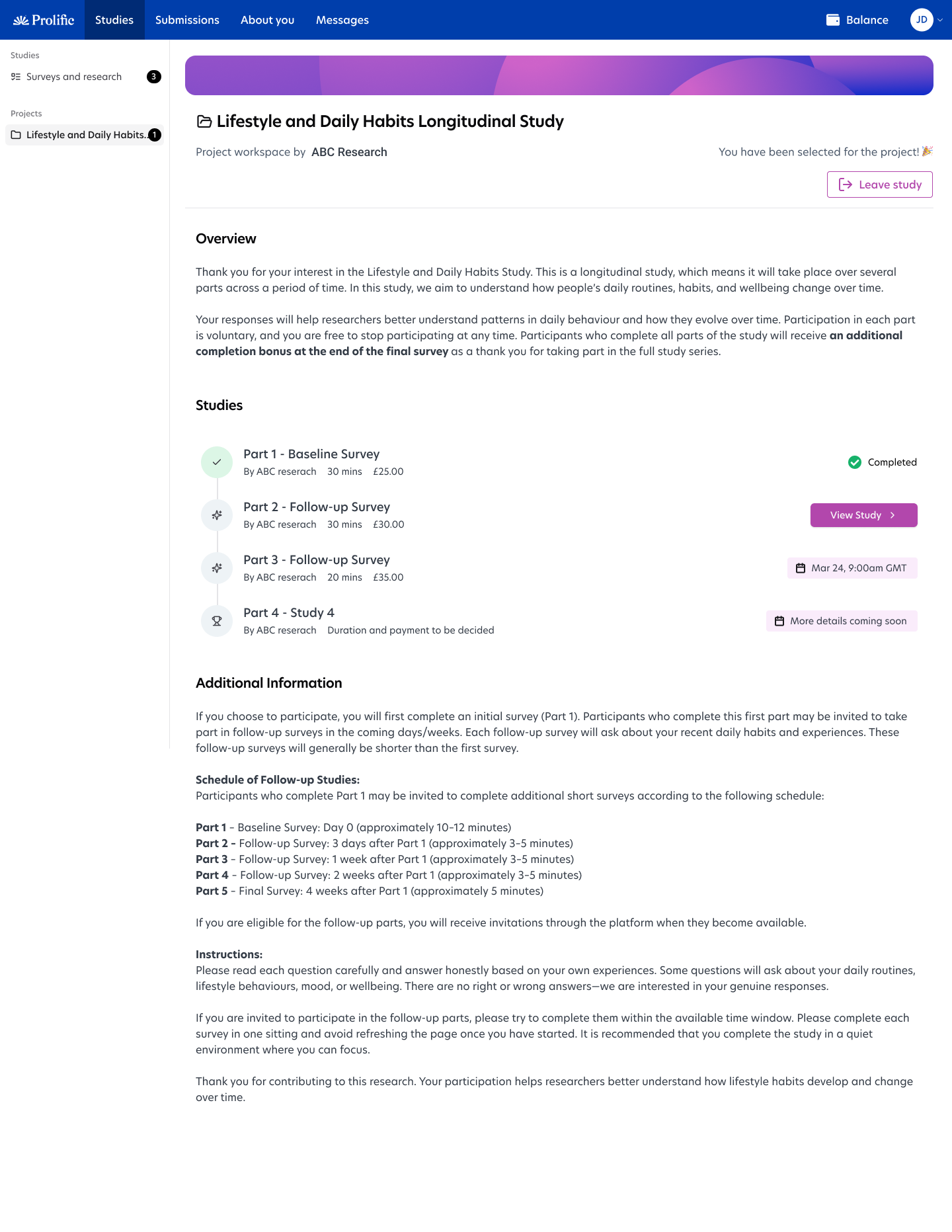
Retention starts before wave one. Participants who clearly understand what they're committing to are far more likely to follow through. Your longitudinal study description should clearly outline what the study is about, the exact dates each session will launch, the pay structure (including any bonuses), and what will be expected of them across all waves.
A participant should be able to read your description and make a fully informed decision about whether to take part. With longitudinal projects on Prolific, participants can see the full study schedule upfront, including each wave, time commitment, and payment. This means the people who opt in are the ones who intend to return.
4. Reinforce continuity throughout waves
Participants are more likely to return when each wave feels like a continuation of something meaningful, not a new task that appeared in their notifications. Make it clear that each session is part of the same ongoing study. Remind participants how many waves there are, where they are in the sequence, and what comes next.
Consistency helps here too. Keeping the structure, instructions, and format similar across waves reduces cognitive load and makes it easier for participants to orient themselves. A brief recap at the start of each session covering “where you’ve been, where you are now, and what's next” goes a long way.
5. Do offer a completion bonus, but don't over-rely on pay to drive retention
Within typical pay ranges on Prolific, incremental pay increases have limited impact on retention. In our testing, an 80% increase in the effective hourly rate made less than a 3 percentage point difference to retention. Pay matters, and participants notice if they feel undervalued. But a modest bump between waves won't offset poor study design or inconvenient timing. Larger completion bonuses for finishing all waves, or substantially higher overall pay (Ritchey et al., 2023), are more likely to make a difference. Just don't treat compensation as a substitute for a well-structured study.
When setting up pay, be upfront about the structure from the start. If completion of all waves is required to receive a particular bonus or payment, tell participants that clearly in your description.
You should also bear in mind Prolific's 21-day auto-approval window: after 21 days of a participant completing a wave, they’ll be approved and paid automatically. If your study has waves launching less than 21 days apart, you'll need to manually approve participants before the next wave opens, since participants can only progress to subsequent waves once their previous submission has been approved.
6. Filter for experienced participants
Participants with a strong track record on Prolific, with higher prior approval counts, tend to show better retention in longitudinal studies. Our research shows that each additional 1,000 prior approvals is associated with 23% higher odds of completing all sessions — given that experienced Prolific participants often have several thousand approvals, the cumulative effect is substantial.
When setting up your study, consider filtering for more experienced participants. It's a simple screening step that can meaningfully improve your completion rates. However, there are some disadvantages to this, as it can affect sample naivety.
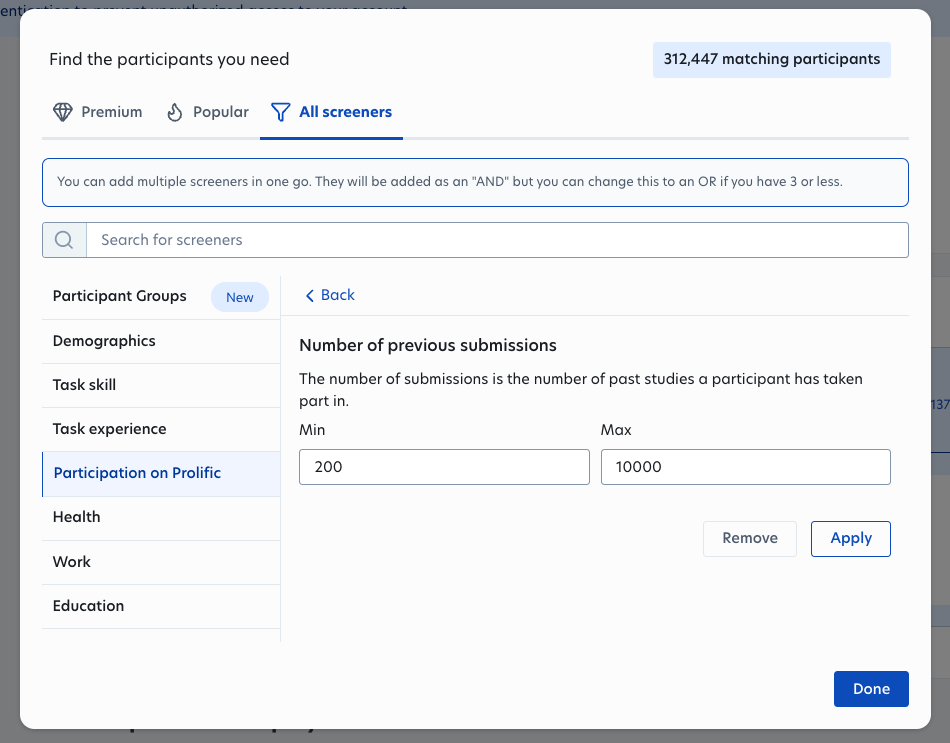
To find more experienced participants on Prolific, go to “All Screeners”, then “Participation on Prolific”, and select “Number of previous submissions”. Then input how many previous studies you’d your participants to have completed on Prolific.
7. Plan for some attrition from the start
Attrition in longitudinal studies is unavoidable — even well-designed studies lose some participants across waves. This is normal, and the right response is to plan for it rather than hope it won't happen. Over-recruit at wave one so that natural drop-off still leaves you with a sufficient final sample.
Prolific's longitudinal projects include a built-in retention and cost calculator: enter your target final sample size and anticipated retention rate, and it will calculate how many participants you need to recruit at wave 1 to hit your goal, with projected drop-off shown wave by wave.
If too many participants drop out during your study, the live attrition dashboard will flag it early, giving you the chance to open up additional places and get back on track.
If you’re unsure what retention rate to expect, the most reliable approach is to run a small pilot study in advance. Piloting gives you an evidence-based estimate of how participants actually behave across waves in your specific design, rather than relying on generic benchmarks for your longitudinal study sample size.
Even a lightweight pilot (e.g. 50–100 participants over 2–3 waves) can reveal important dynamics, including where drop-off happens, how engagement changes over time, and whether incentives or timing need adjustment. These observed retention rates can then be fed directly into your planning assumptions and Prolific’s retention calculator.
If you’re unable to run a pilot, we advise looking for analogous designs in research literature to benchmark your retention rate. If those don’t exist, you can also refer to our retention estimates within our paper.
8. Send reminders to participants
Don't assume participants will remember your study is due or see it as soon as it is released. Many don’t have Prolific open all day every day. Some participants will set a calendar reminder and show up reliably; many won't. Plan for the latter.
Use Prolific’s in-platform messaging to reinforce expectations, give advance notice before each wave opens, and message participants who have not yet completed to remind them. Make it as easy as possible for participants to plan ahead, regardless of their habits.
9. Add extra participant places to boost recruitment if needed
If you’ve tried everything else but you’re not quite hitting your target sample size, Prolific lets you increase the number of places for live studies. Plus, the retention tracking tool will tell you how many extra participants you need to recruit in order to get back on track.
Let’s imagine participants are partway through your longitudinal study, and you’re falling short of your final sample size. You’re seeing 60% retention across completed waves, but you originally predicted 80% retention. In this instance, adjust the retention calculator to mirror the actual retention you’re seeing (60%), or slightly lower to account for further future drop-off. The calculator will then tell you how many participants you need to add to wave 1 to hit your final sample size.
To open up places for more participants, go to the submissions page for the first study, select ‘Action’ in the top right corner, and select ‘Increase places’. This will automatically invite more participants for that wave. You’ll then need to increase places for wave 2 and all subsequent waves. Learn more about increasing study places here.
A note on the research behind these tips
Many of these recommendations are grounded in data from studies run on Prolific. Researchers have achieved results like 90% retention across 30 daily waves with 300 participants and 82% retention across four weekly waves with 2500 participants.
If you want to go deeper on the evidence, we encourage you to read our paper on longitudinal retention on Prolific.
For a closer look at how other researchers have approached this in practice, see our case studies on how Professor Steve Gangestad ran a complex longitudinal study and how Columbia Business School built one of the most extensive public datasets for digital twin research.
These results are achievable, but not accidental. They reflect deliberate choices around participant retention in longitudinal research, from study design and timing to incentives and communication. Knowing how to reduce attrition in longitudinal studies won't eliminate dropout entirely, but it will put you in a much stronger position to hit your target sample and protect the integrity of your data.
How to run a longitudinal study on Prolific today
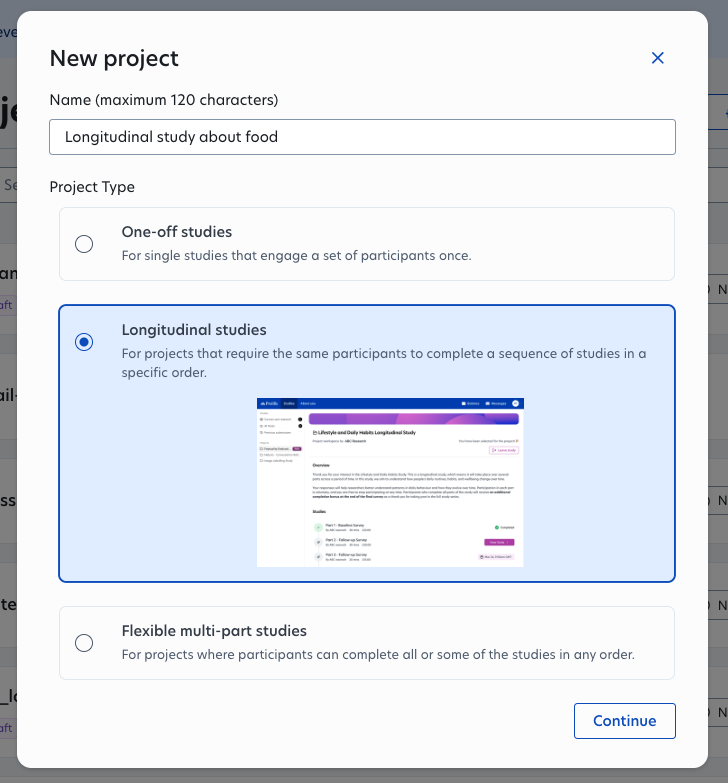
Want to run a longitudinal study on Prolific? Sign up or log in to your Prolific account, create a new project, and select 'Longitudinal project'.
Or get in touch with our managed research services team if you're working on something complex and want support designing and executing it at scale.