Bees or peas? How Wellesley College broke ground in speech perception with FindingFive and Prolific

Wednesday Bushong, Assistant Professor at Wellesley College, needed intuitive tools and native English speakers to run speech perception research. So, they used FindingFive's experiment platform combined with Prolific's verified participant pool.
The integration enabled their lab to capture insights from hundreds of participants in hours - and uncover surprising findings on how we perceive speech that could have a profound impact on hearing loss intervention.
The challenge
Conducting interactive listening studies
Wednesday studies how people understand speech sounds in real time. Their research explores the way we process spoken language, like how we distinguish subtle differences in sound or use context when listening in noisy environments.
In a recent study, participants were asked to listen to ambiguous sounds, like a word that could be either "bees" or "peas", and report what they heard. The sentence around that word provided contextual clues. Hearing "I don't mind bees, but I hate wasps" suggests the speaker probably said "bees." Change "wasps" to "squash," and suddenly "peas" seems more likely.
Finding the right tools and participants for precise speech research
To run this research, Wednesday needs participants who are native speakers of American English.
"Here's a little-known fact," Wednesday explains. "Even though most languages have B and P contrasts, they're actually slightly different in every language." Spanish speakers hear these sounds on a different part of the acoustic spectrum than English speakers. Even different English dialects process these simple sounds differently.
This level of precision matters. Knowledge of acoustic cues becomes set within the first year of life. If participants don't have the exact linguistic background the study needs, the data becomes unreliable.
Finding the right combination of tools to run the experiments and sourcing the right participants presented some key challenges.
- Student accessibility: Wednesday trains undergraduate research assistants. They needed tools that students could learn quickly without a lot of programming knowledge.
- Balancing complexity and ease of use: Wednesday’s studies involved complex stimuli and millisecond-level timing, so basic tools wouldn’t cut it. They could build experiments from scratch in JavaScript, but this would mean months of training for their students.
- Vetting participant backgrounds: They needed to confirm not just English proficiency, but native speaker status, country of birth, and location.
- Speed without sacrificing quality: Conducting 200 in-person interviews in a college lab would take an entire semester. Online recruitment platforms could speed up the process, but many were filled with bots and unverified users.
"Other recruitment platforms weren't giving us good data we could trust," Wednesday recalls. "You can't be sure of things like their location or native language."
The solution
FindingFive: An intuitive platform for complex cognitive research
Prolific partner FindingFive provided the perfect balance of accessibility and hands-on control. The one-stop platform enables researchers to easily run cognitive studies online with user-friendly tools.
"I really appreciate the design interface," Wednesday explains. "With various experiment programming systems, you tend to have a trade-off between ease of use and experimental control."
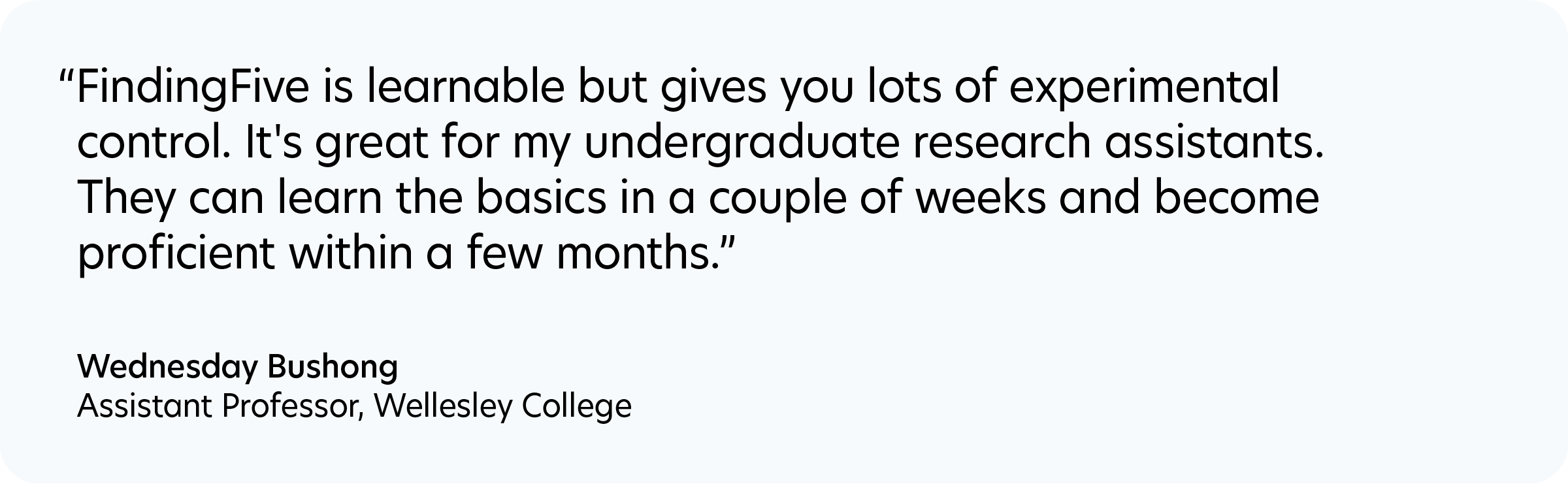
FindingFive gave Wednesday the tools they needed to run the complex tasks required in their research, from presenting auditory stimuli to capturing reaction times.
Prolific: Verified participants who meet exact criteria
When FindingFive enabled its users to integrate with Prolific seamlessly, Wednesday was excited.
"Prolific does a really good job vetting its users," Wednesday notes. "My experience with Prolific users has been really positive."
Unlike other platforms they had tried, which were plagued by bots and fraudulent responses, Prolific's rigorous verification - including over 110+ identity and quality checks - ensured real, engaged participants giving authentic responses.
Prolific's 300+ filters made it easy for them to find the participants they needed by precise criteria, including:
- Native language (American English)
- Country of birth (United States)
- Current location (to match speaker dialect)
- Demographics (age, education, gender, ethnicity)
Prolific's workflow structure also helped Wednesday streamline their research process.
"I really like how things are arranged into projects with experiments within projects," they said. "You can duplicate experiments with all your filters and settings already filled in. And you can automatically exclude people who have taken other experiments within the project.”
This top-down organization meant less manual tracking and fewer errors - crucial when running multiple related studies with overlapping participant requirements.
Seamless integration
FindingFive works seamlessly with Prolific, which removed the technical headaches that Wednesday encountered with other recruitment workflows.
"When I was using other recruitment platforms, there was a lot of programming required to get systems talking to each other," they recalled. "It was easy to mess up and could be really difficult. The FindingFive and Prolific integration is really good and easy to use."
The results: From semester-long studies to same-day insights
Data collection in hours, not months
"Depending on the experiment's complexity, we usually recruit between 40 and 200 subjects," Wednesday explains.
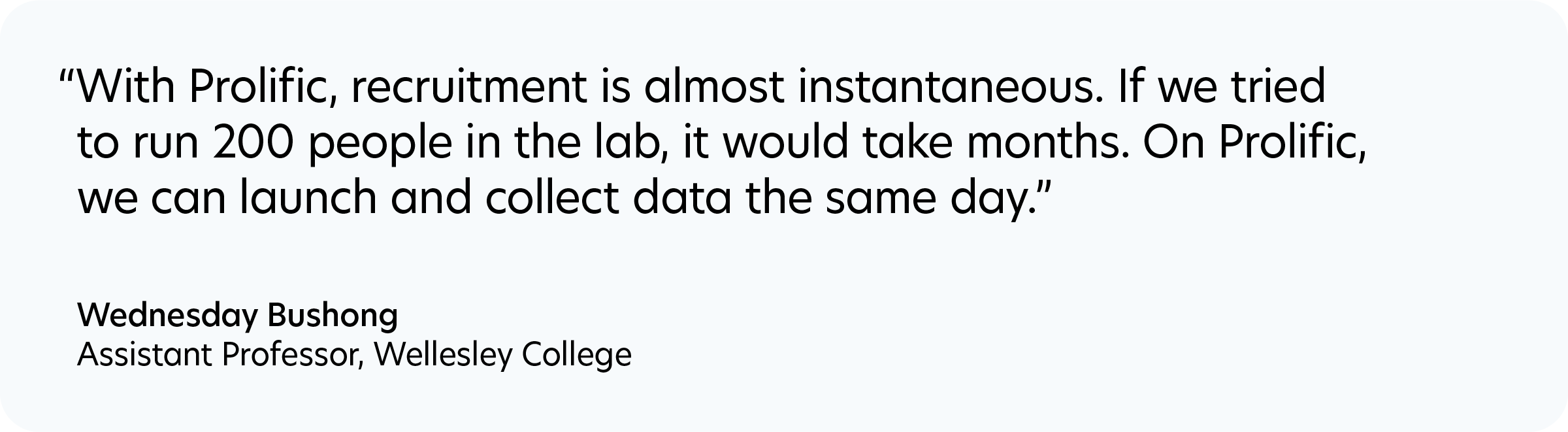
With Prolific, Wednesday and their lab could gather the data they needed over 100x faster. "It's very instant gratification," they noted.

Diverse, representative samples
With instant access to a diverse pool of participants, Wednesday’s lab captured a true cross-section of American English speakers in their research.
"Many psychology studies are conducted on undergraduates at the researcher's institution. So you get a very young, more educated sample," they explained. "We aim for a better picture of the average American. Not just the average college student at a liberal arts college.”
Breakthrough findings on speech perception
With rapid and reliable data, Wednesday's lab uncovered surprising insights about how humans understand speech.
We use context, even when we don't need to: Nearly every participant combined what they actually heard with contextual clues, even though the task was to report just the sound. Our brains automatically pull in every available piece of information to make the best guess possible.
But we don't adjust when listening gets harder: When noise was added to make the sounds harder to hear, participants didn't lean more heavily on sentence context to compensate. "You'd think if you have trouble hearing, you'd pay more attention to context," Wednesday notes.
The findings from the study challenge conventional wisdom and open new research directions. If people with normal hearing don't use more context when acoustics are degraded, this could have implications for age-related hearing loss.
"There's an intuition that as you age and your hearing worsens, you rely more on context. But now we're wondering if that's actually true," Wednesday says. "If using sentence context is beneficial, perhaps we can train people to do so to help compensate for hearing loss."
The research now informs studies that are exploring whether this effect is general or situation-specific. This work could lead to practical interventions for people with hearing difficulties.
Get quality data for complex cognitive research in hours
Need verified participants with specific demographic profiles for cognitive science research? Prolific's filtering capabilities and verified participant pool make it easy to find the exact participants you need - so you can get quality data in hours, not months.