5 ways AI leaderboards should evolve, according to the experts


Originally published August 1, 2025. Last updated July 2026.
Leaderboards once felt like a niche research tool. Now they set the narrative for nearly every new model announcement, and the gap between what they measure and what users experience has become impossible to ignore.
The criticisms have only intensified since we first published this piece. Stanford's 2026 AI Index cautions that a benchmark score tells us little about how a system performs in a real deployment, noting that the field still lacks measures of how well an agent needs to function in a particular setting. Scores climb, benchmarks saturate, and practitioners keep discovering that the model topping the chart underperforms on their actual workload.
In our webinar "Why AI leaderboards miss the mark," we gathered industry leaders to dissect these limitations. Their analysis pointed to an urgent need for benchmarks that go beyond narrow technical measures and instead capture genuine user experience, ethical alignment, and real-world relevance.
For the full expert discussion that shaped this piece, watch our webinar, "Why AI leaderboards miss the mark."
A year on, their five recommendations have proven remarkably durable. They also shaped how we built HUMAINE, our human-centered evaluation framework, which launched shortly after the original webinar and was published at ICLR 2026. Below, we revisit each recommendation with the evidence we've gathered since.
1. Make benchmarks memorization-resistant
One critical shortcoming our panelists highlighted was the vulnerability of benchmarks to memorization, where models achieve high scores through rote recall of test data rather than genuine reasoning. Nora Petrova, an AI researcher at Prolific, pointed out how this undermines the fundamental purpose of evaluation: measuring how effectively models generalize to new scenarios.
Nora cited ARC-AGI as a benchmark designed to resist memorization by requiring reasoning over novel tasks rather than recall of familiar ones. The broader pattern she described has accelerated. Benchmarks now saturate within months of release. Humanity's Last Exam, built specifically to be the hardest test available, went from single-digit scores to above 50% in roughly a year. When a benchmark saturates that fast, it stops discriminating between models and starts rewarding whoever trained on the most similar data.
Evaluation formats that can't be memorized offer a structural fix. Blind, multi-turn conversations with real people generate novel interactions every session, so there is no fixed test set to contaminate. This is the format HUMAINE uses across every model it evaluates.
2. Increase diversity in tasks and evaluations
Hua Shen, a postdoctoral scholar at the University of Washington who led research on bidirectional human-AI alignment, emphasized the need to diversify both the tasks in leaderboards and the people doing the evaluating. Current evaluations rely heavily on narrow task sets, judged by evaluator pools that skew toward a specific demographic profile. Both limits reduce how far results generalize.
Building on Hua's point, Nora suggested that standardized evaluation frameworks across research labs would ensure researchers are comparing like with like when they interpret performance metrics.
We now have data on how much evaluator diversity matters. HUMAINE stratifies its participant pool across 22 demographic groups in the US and UK, with results post-stratified to census data. The findings are striking: of the demographic axes studied, age produces twice as much rank shuffling as ethnicity or political affiliation. Models tuned on feedback from tech-savvy users systematically underperform for older populations.
3. Shift from marginal gains to real-world applications
Hua also highlighted the field's excessive focus on marginal, incremental improvements against technical benchmarks rather than meaningful advances in real-world use. Leaderboards incentivize narrow optimization, diverting resources away from making models genuinely useful.
She proposed embedding AI systems within realistic scenarios, tasks, and contexts that reflect actual user needs. Instead of chasing small performance gains, developers and researchers would focus on how AI works in real situations and how people experience it.
Open-ended conversation is one of the most realistic evaluation contexts available, because it's the setting where most people actually use these systems. Multi-turn dialogue surfaces qualities that single-prompt benchmarks never touch: whether a model stays coherent across a long exchange, adapts to the user, and remains useful when the conversation goes somewhere unscripted. Evaluating models in this setting consistently reveals capability differences that static test sets miss.
4. Benchmark the benchmarks
Oliver Nan, a research scholar at Cohere and author of "The Leaderboard Illusion," underscored the need to critically evaluate benchmarking practices themselves. New benchmarks emerge constantly, but comparative analysis of their methodologies remains scarce.
He advocates for meta-analytical research to identify common patterns and biases across benchmarks. Nora added that initiatives like BetterBench have begun surveying the benchmarking landscape with exactly this goal.
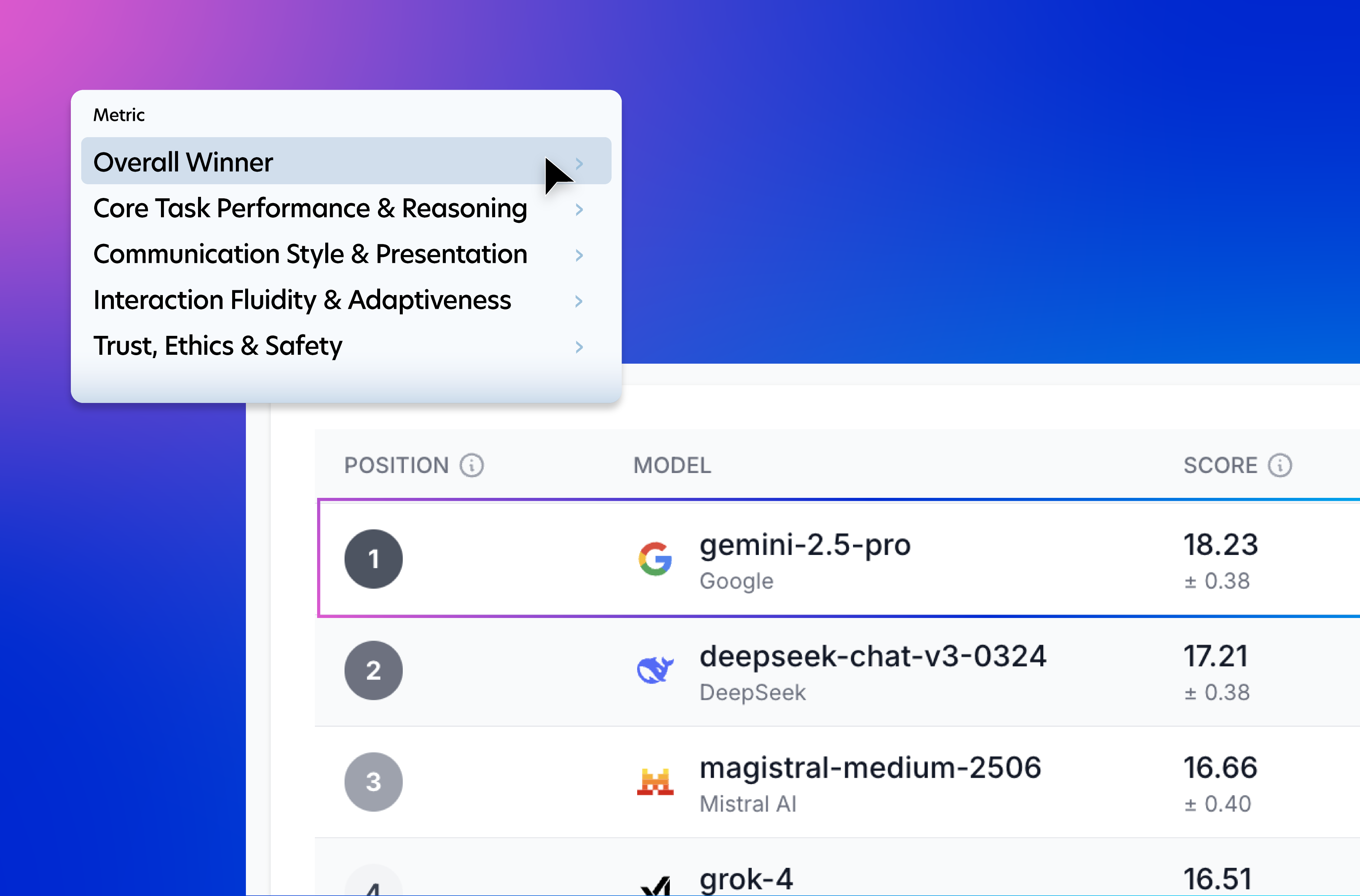
Our ICLR 2026 paper on HUMAINE contributes to this line of work, and its headline finding shows why the meta-analysis matters. The top-ranked model on the leaderboard holds a 98.8% posterior probability of being best when you collapse everything into a single score. Look across the five evaluation dimensions separately and that certainty drops to 41.9%. The winner changes depending on which metric you ask about. Any leaderboard reporting one aggregate number is concealing that disagreement, and users making deployment decisions on the aggregate are choosing on incomplete information. The full methodology and results are in the paper.
5. Expand beyond technical skills
Nora further argued for expanding leaderboards beyond purely technical metrics. True AI performance should also cover alignment with human values, emotional intelligence, and ethical considerations, none of which traditional benchmarks capture.
The evidence here is now concrete. HUMAINE measures trust and safety as a distinct dimension, and it behaves nothing like task performance. Models that score identically on task performance rank up to seven positions apart on trust. Improvements in conversational engagement between model generations do not reliably translate into improvements in trust perceptions. If you only measure technical skill, you have no visibility into the dimension that matters most for real deployment decisions.
Broadening evaluations to include trustworthiness, adaptability, and communication quality gives a far more complete picture of how an AI system will affect the people who use it.
From recommendations to a shipped benchmark
When we first published this piece, the closing section described the benchmark we intended to build. It now exists.
HUMAINE is Prolific's human-centered evaluation framework, published at ICLR 2026 and presented by Nora Petrova and Enzo Blindow in Rio. It evaluates frontier models through blind, multi-turn conversations with demographically representative participants. At the time of writing, the study draws on 48,325 participants across 22 demographic groups in the US and UK, covering more than 50 frontier models across five evaluation dimensions derived from factor analysis, with results post-stratified to census data.
The leaderboard is live and updates as new models ship, so the rankings reflect the current frontier rather than a snapshot. Recent debuts include Claude Fable 5, which entered at #4 and holds that position even after correcting for sycophancy, a check most leaderboards don't run at all.
Every recommendation our panelists made is testable against it: memorization-resistant format, demographically stratified evaluators, realistic conversational tasks, published methodology, and dimensions that go well beyond technical skill.
Explore the HUMAINE leaderboard to see how current frontier models compare, or view the live rankings on Hugging Face.