Not every gap in your model needs the same kind of human.

Automation works when there's a verifier to check against. The moment judgment turns subjective, cultural, or rare, it needs a different kind of signal. We know exactly which one, and who's qualified to give it.

Trusted by 100+ AI research teams

Google
AI2
Hugging Face

Synthetic data works, until judgment turns subjective, cultural, or rare.

Automation runs on a verifier - a simulator, a rubric, a reward model. That works right up until the question doesn't have one. Then the loop closes quietly, and the model drifts until deployment exposes the gap. Most teams find out at deployment. You don't have to.
One pool, every job
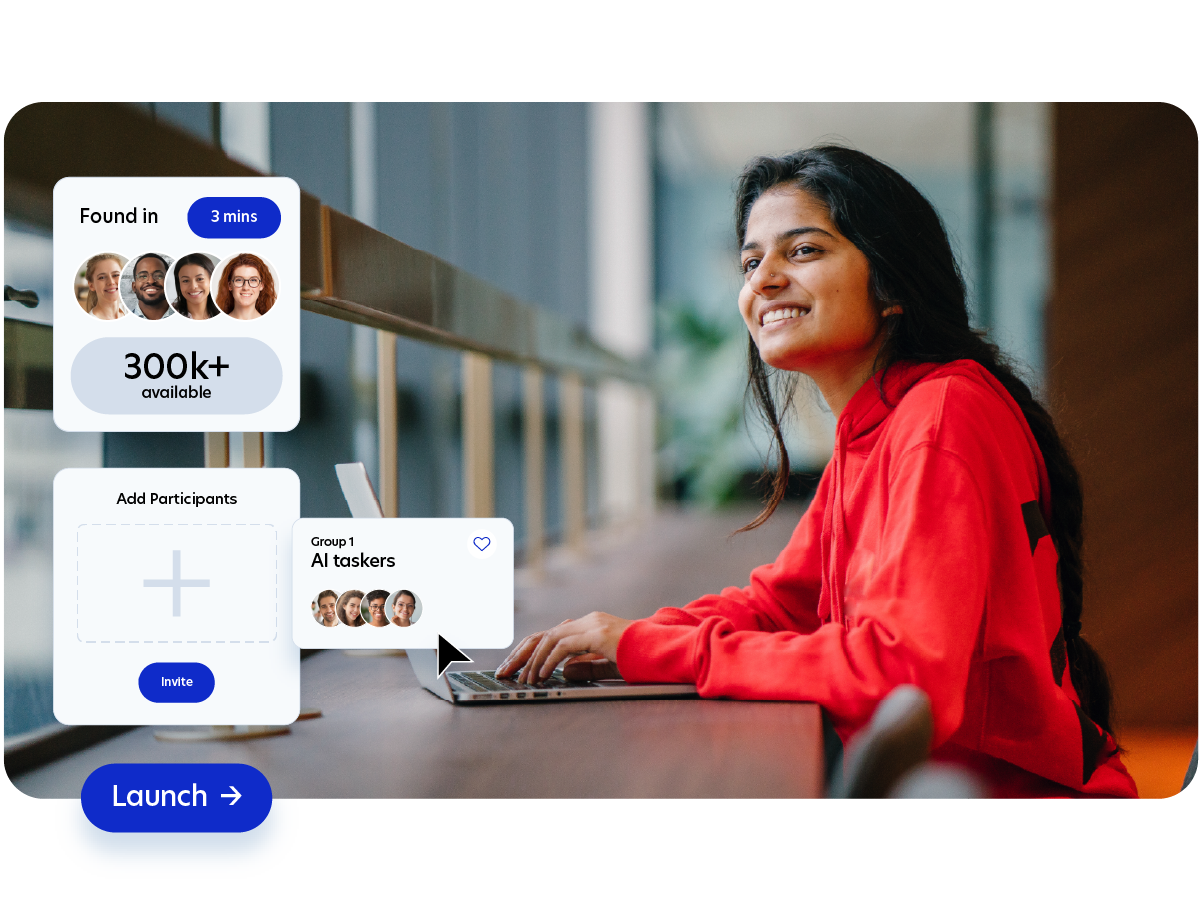
Asking a generalist annotator pool to render a safety verdict, judge tone, and log real usage in the same afternoon gets you a generic answer to a specific question.
Preference without discernment
Aggregate pairwise picks reward confidence and length, not quality. As models converge, that gap is what decides your leaderboard.
Unrepresentative thresholds
A safety line drawn by five people in one office is a liability the moment your model ships somewhere else.
Closed-loop drift
Train and eval on the same synthetic distribution long enough, and drift becomes invisible until deployment exposes it.

BEHAVIOUR

What humans actually do - actions and performance in real contexts, not opinions.
Ask this when you need: ground truth for how people perform, navigate, or decide.
See Behaviour studies →
Continuous fraud detection

TASTE

What resonates - subjective preference, with no single correct answer.
Ask this when you need: to know if something is genuinely good, not just liked.

See Taste studies →

JUDGEMENT

Evaluation against a standard - what's better, safer, or accurate.
Ask this when there are consequences to getting the call wrong.

See Judgement studies →
Methodology

Verified for the specific job, not asked to wing it.

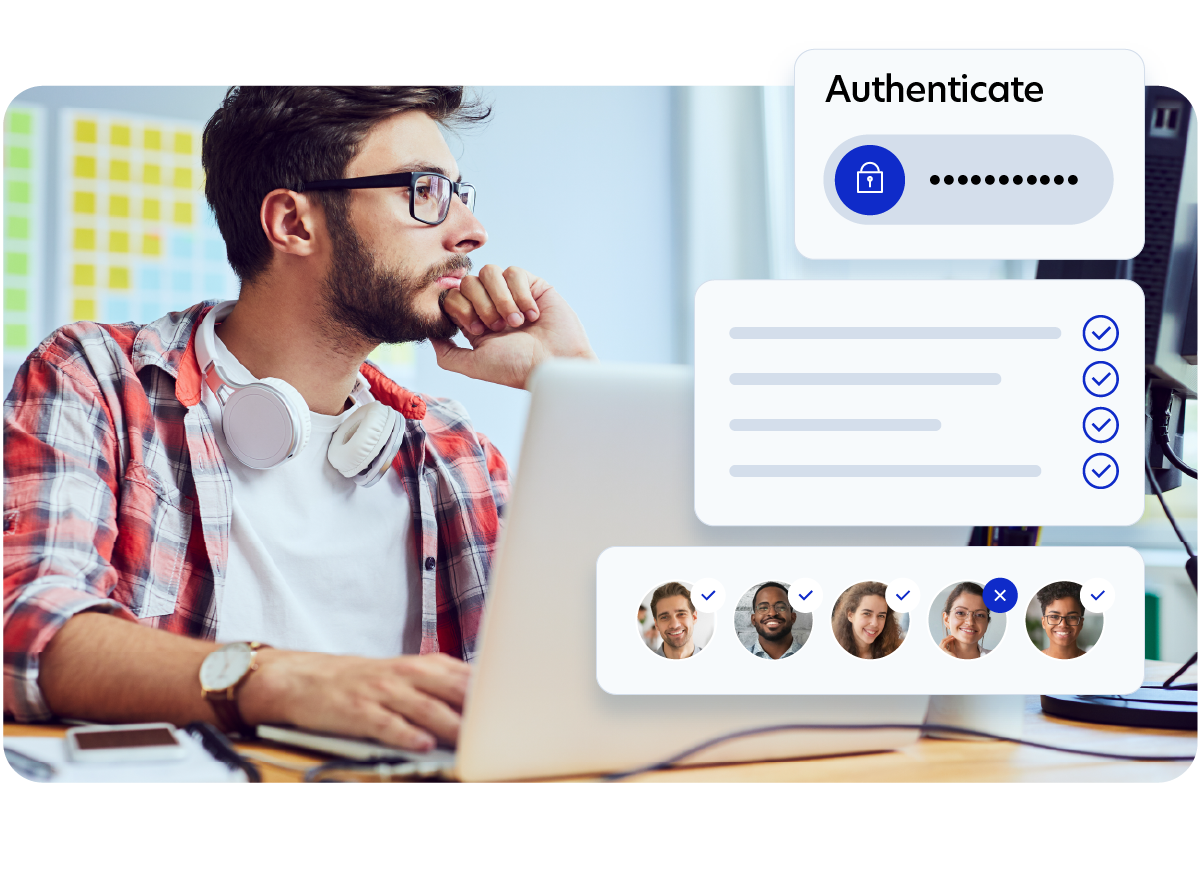
Every participant is matched to the exact question they're qualified to answer - then independently checked through Protocol, our multi-layered verification system, before their data ever reaches your pipeline.
Behaviour

Ground truth for how people actually perform.

Synthetic behaviour works as long as real signal keeps the loop open. We keep it open - real task execution, actual interaction patterns, and representative performance distributions from verified, diverse participants.

01
Human performance benchmarking
Draw samples matched to your exact target demographic. Every submission is traceable to a verified participant, so your baseline is defensible and publishable.
02
Human-AI collaboration
See what real users delegate, override, and lose trust on when working with live agent workflows - not simulated interaction logs.
03
Personalization & usage history
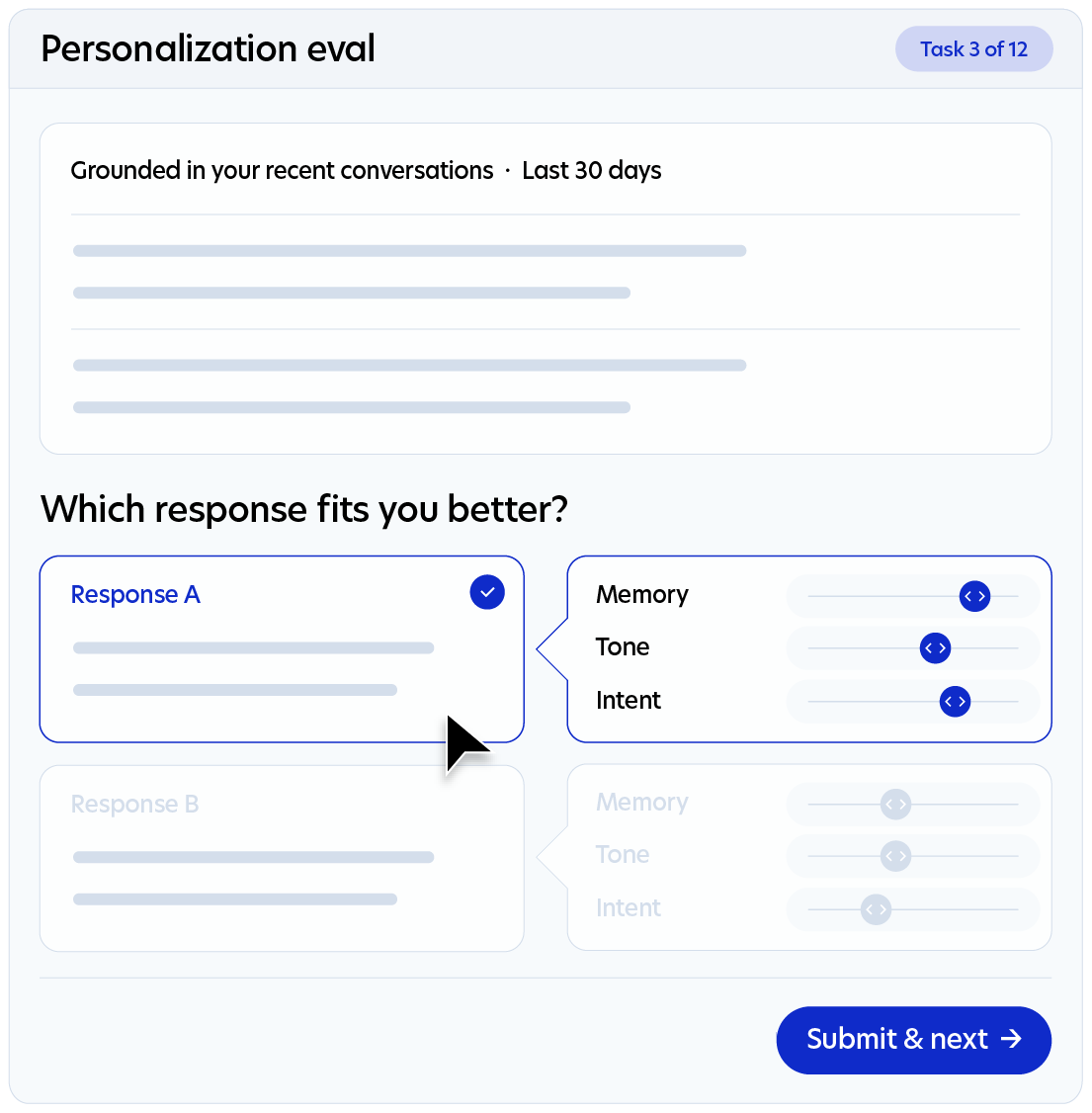
Evaluate against genuine usage histories from an opt-in, verified pool. Synthetic histories don't replicate how people actually use AI today.
04
Agentic task execution & trajectories
Capture full task trajectories - every click, scroll, decision - from a demographically diverse Network, at the same methodology from pilot to production.
05
Human-robot & embodied interaction
Egocentric and interaction data from real humans working alongside physical AI systems, consent-first and provenance-tracked.
Taste

The discriminating sense automation can't fake.

Preference is what someone picks; taste is the sense that an answer is genuinely good. As models converge, that margin compresses — and only people qualified to judge it can read it. We provide those arbiters: verified, specific, and selected for discernment, across ~45 countries and 28 languages.

01
Aesthetic & creative preference
Pure subjective response to AI-generated image, video, and audio - no ground truth to bias it.
02
Cross-cultural & multilingual appeal
Test how outputs land across the populations your model will actually serve, with samples aligned to census data and language specialists independently assessed via CEFR-certified testing.
03
Tone & persona perception
Track how your model's voice is perceived across demographic groups and model versions, with longitudinal studies built in.
04
Contextual response relevance
Participants rate whether model outputs are appropriately scoped to their actual intent, based on inferred preferences or stated goals. Captures cases where the model is technically correct but contextually misaligned.
05
Longitudinal goal tracking
Evaluate whether a model updates its understanding of a user's evolving goals across sessions. Requires persistent participant IDs and multi-session study design, scoped with clients on a per-study basis.
06
Personalization safety
Evaluate where personalization creates risk, such as sycophancy tradeoffs, inappropriate inferences, boundary violations, or cultural mismatches. Ensures quality improvements don't degrade safety properties.
Judgement

Defensible calls when there are consequences.

When your model makes a call on quality, safety, or accuracy, a threshold set by the wrong sample is a risk you can't afford. We draw that signal from verified human judgment - qualified evaluators, credential-checked Experts, and representative populations - so the call holds up internally, externally, and in published research.

01
Model & agent evaluation
Head-to-head or single-model eval against a defined rubric, from participants pre-qualified for evaluative judgment, at continuous-pipeline scale.
02
Safety & harm thresholds
Ground your thresholds in how harm actually lands across demographics and regions - what a small annotation team flags and what a real population flags are not the same thing.
03
Expert domain accuracy
Credential-checked Experts, verified against official registries, for medical, legal, scientific, and financial review.
04
Persuasion & manipulation detection
Internal teams know what to look for, so they find what they expect. Real population responses are the only valid signal for unintended influence.
05
Adversarial red-teaming
Participants filtered for specific adversarial profiles, not general annotators asked to try harder. Adversarial diversity is what surfaces the edge cases that matter.

How AI teams use Behaviour, Taste and Judgement in production

Trusted by AI/ML developers, researchers, and leading organizations across industries.

Unpacking human preference for LLMs - The HUMAINE framework
Our human-centered leaderboard ranks frontier AI models by how real, diverse users actually experience them — not just technical benchmarks. Featured at ICLR 2026.
Read the paper
humaine leaderboard
Gemini 3 Pro: Frontier safety framework
The frontier safety framework report for Google’s latest model.
Read more
google ai
Building breakthrough AI faster
Ai2 reduced human data collection from weeks to hours with Prolific, building state-of-the-art multimodal AI models faster without sacrificing quality.
Read more
Ai2

Get the right human data, for the right reason.

Whichever signal your model is missing, we know exactly who to bring in - and how to prove it holds up.
FAQ

Questions